HUBERT FLETCHER

8%

Review and Herald Publishing Association · Takoma Park Station, Washington, D. C. · Jan 24, 1907

FromReview and Herald, Vol. 84, No. 4.

Read the full edition

HUBERT FLETCHER

From Jamaica to Colon and the Canal Zone

HUBERT FLETCHER
Last October I came to Central America from Jamaica, my native land, by invitation of the West Caribbean Conference.
In Colon, where I landed, little or no regard is paid to Sunday sacredness. All are at work on that day. The shops are open, the market laborers are at work, and there is hustling and bustling everywhere. I was agreeably disappointed to find this such an important place. The town is undergoing rapid improvement by the Americans. The streets are being paved, and lighted by electric lights. A sewerage system is being established, and water-pipes are being laid. Provision is also being made against the fires that so often occur. Wireless telegraphy is established here, communicating with all parts of the world. All nationalities are to be found here.
The truth was brought to this place by Brother Muir and Sister Herbert, of Jamaica, about the year 1898. In 1904 ten persons were baptized by Elder Knight, and a church of fourteen members was organized. The following year Brother Peckover held a series of tent-meetings, and a place was secured in his new home at Mount Hope, to hold regular meetings. On account of failing health, he was obliged to leave for the States, and the brethren then took over the entire building. This they kept until February, 1906. Then the Panama Railroad, wanting the land, gave seven hundred dollars for the building, and promised us another site.
Meetings were continued for a while in a rented building, but at present they are held in the house of a brother. We have a membership of thirty-four, and we greatly need a substantial church building; that will give prestige to the work.
The Canal Zone, which is now under American control, has a government of its own. It is a strip of land ten miles wide and forty-six miles long, extending from the city limits of Colon on the west to Panama on the east. The idea of cutting a canal across the isthmus dates as far back as the sixteenth century. The first survey was made in 1581, by Antonio Pereira. In 1620 an elaborate report was presented to Philip II, but that did not meet his approval. In all, twenty-five projects of the kind were advanced, until in 1881, M. de Lesseps, at the head of a company, began operations. Owing to the reckless expenditure of money, they failed in 1891, with less than two fifths of the work done. In 1894 it was passed over to a new company, which had a small force of men at work, but allowed the canal from Bahia to the coast to fill up.
At present the canal is in the hands of Americans, who are investing unlimited sums on the sanitary improvements of the sections. A constant warfare is being waged against mosquitoes and malaria parasites, which they have to a great extent under control. They are also putting up buildings as homes for the laborers, factories, etc., preparatory to the actual digging of the canal.
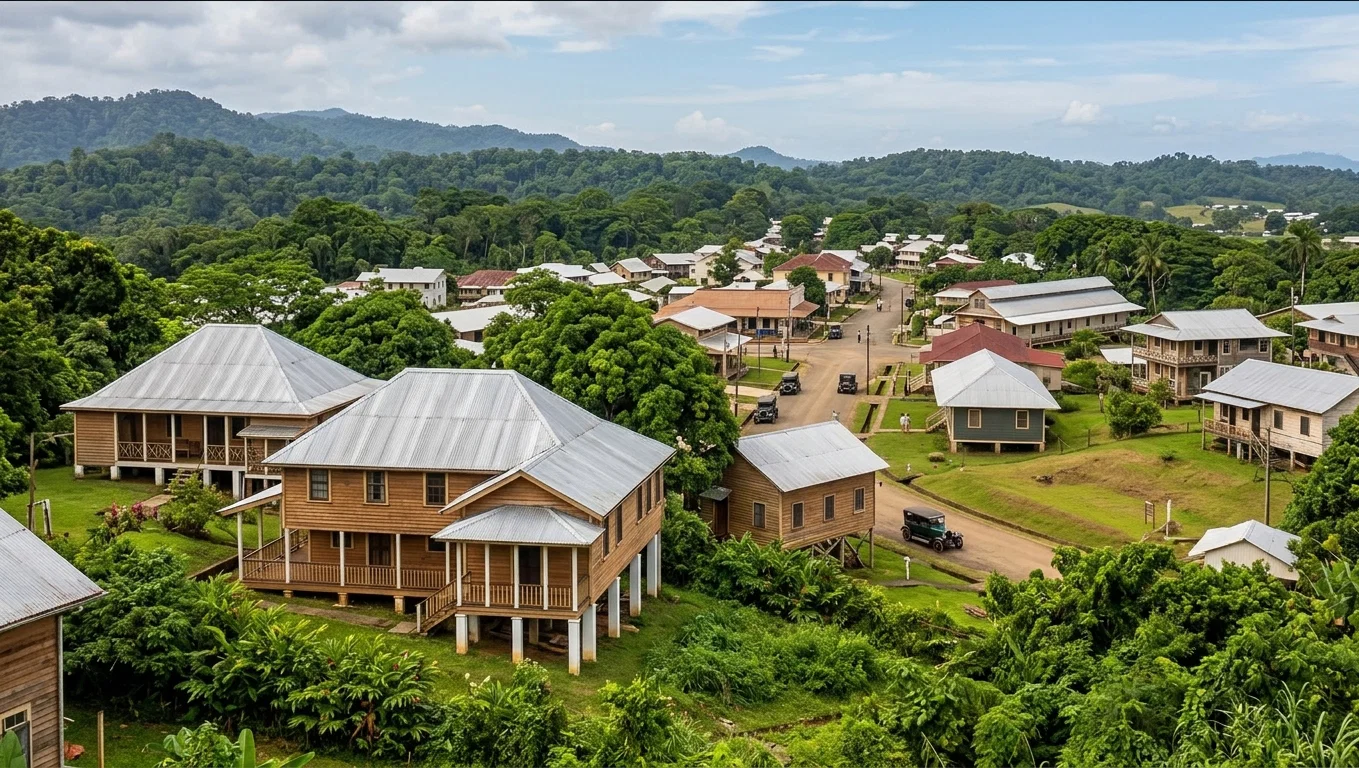
TOWN OF EMPIRE, CANAL ZONE
It has been my privilege since arriving to travel along the canal section, stopping at the most important places, and I can send a good report of all that I have seen. Many of the ill reports are untrue. All who know how to behave themselves are well treated.
The city of Empire is first in importance, and is the most improved and the healthiest. Here is a vast field, which is fully ripe for the harvest. We need an experienced man to locate on the Zone, to develop the work from Panama to Colon. Empire would be the best place in which to live. I have already applied to the mayor for a plot of land. It would be cheaper to build a mission and dwelling together. Rent is very high, and houses can not be easily obtained.
Here is quite a field for canvassing. Our books are in great demand. We hope soon to establish a depository at Colon, with a corps of well-organized and consecrated canvassers, to do pioneer work. Now is our opportunity to establish missions. We have a few Sabbath-keepers in some of the towns. Other people have told me that since their arrival they have not been anywhere to worship, as they are not allowed to attend the church for the white people. We need many of our books printed in the Spanish language, to reach the natives, who are continually asking for them.