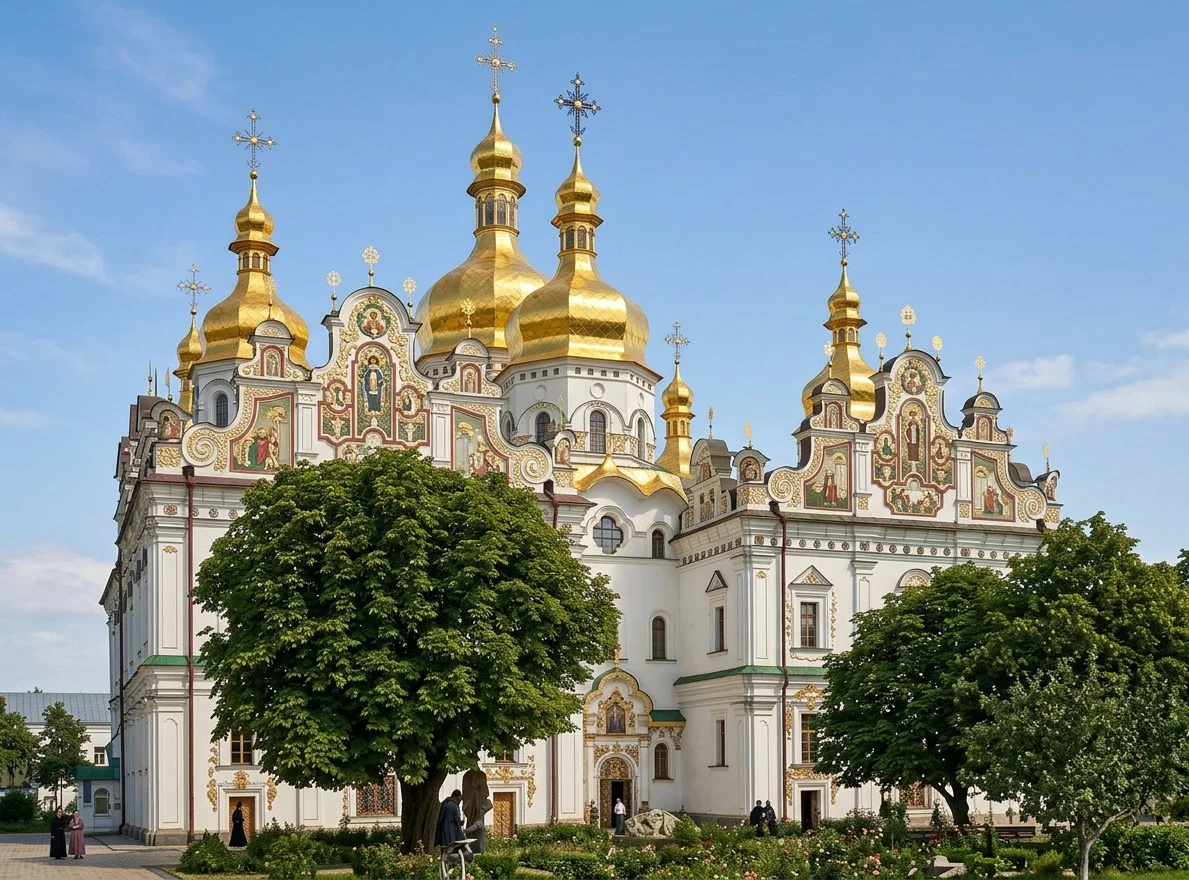
After our good meeting in Bender, we left, in company with Elder J. Perk, for Kief, the holy city of the Russians, where is the famous Lavra Monastery, to which the devout make many pilgrimages, that they may worship the so-called sacred relics or skeletons of the saints—in reality wooden images in many cases. Here the truth has secured a good foothold, as the efforts of Elder Wildgrube, assisted by Brother Schmidt among the Germans, and Brother Pilkewitsch among the Russians, have been crowned with a good degree of success. Here in the hall used for our public lectures (which accommodates about one hundred and fifty persons comfortably), we held the conference of the Middle Russian Mission field, October 10-14. As the larger number of hearers were Russians, the lectures, studies, and business transactions were translated from the German into that tongue. Sunday afternoon I was much pleased to speak to an intelligent and attentive German congregation, and the questions asked by the hearers after the lecture, showed that there is a great desire on the part of many to hear the truth for these days. In our audiences at Kief there were university professors, students, and other persons of rank and influence.
At the meetings in North and in South Russia we had passed resolutions of thanks for the permission to have all our German publications enter the country, expressing the hope that erelong the ministry of the interior might allow us the same freedom for the Russian literature. At our meeting in Kief we received the good news that this privilege had also been accorded us, so now all our publications are officially allowed in Russia.
The Middle Russian field contains almost sixty-seven million people. It has the smallest membership of any of our Russian fields,—one hundred and seventy-six. It was apparent to all that we should do our utmost to provide for the education of Russian workers; and the seventy of our own people who were at the meeting contributed and pledged over two hundred and fifty dollars toward the educational fund.
If we consider the various nationalities represented, and the many religions and the large cities; if we think of the Russians, the Tartars, the Jews, and the Tunguses and Samoyeds; if we remember15the Greek and Roman Catholic and Protestant Churches, the Mohammedan, and the heathen Shamanism, or nature-worship, religions; if we look at such cities as Moscow, Kief, Archangel, Novgorod, and Kazan,—indeed, when we realize that the people speaking forty different languages, and having such a variety of religious beliefs are to be warned, scattered as they are over such an immense territory, then we get a faint glimpse of the magnitude of the work yet before us.
In the Middle Russian field our Russian paper, known as the Olive Tree, has already been the means in the hands of God of bringing several into the truth. We saw some of these and heard their cheering testimony at Kief. We would heartily recommend this small paper to all our readers who desire to spread the truth among their Russian-speaking neighbors.
LAVRA (RUSSIA) MONASTERY
For the coming year, Elder O. Wildgrube was again unanimously chosen director of the field, assisted by a committee of four brethren—J. Ebel, A. Granberg, C. Schamkow, and A. Kusmin. There is one minister,—the director in this mission field,—one licentiate, five Bible workers, and four colporteurs.
Sunday evening, the fourteenth, we took the train for Kamyshin, about one thousand miles east of Kief; for the East Russian Conference was to be held at Dobrianka, a village about thirty miles from there, October 18-22. Two days and three nights of constant traveling brought us to Kamyshin, where we met Elder H. J. Loebsack. We had to take a boat up the Volga, to reach Dobrianka, and according to the time-table, the boat should leave immediately after the arrival of our train. The transportation company’s agent told us that the boat would probably be at the dock “any minute,” as it was past due. But the man’s “any minute” stretched out to twenty-three hours, during the whole of which time we had to march up and down the river wharf to keep warm; for there was no waiting-room, and the docks were so far from the village that we did not dare seek accommodations in the town, for fear the boat might arrive and leave again before we could get on board. To add to our discomfort, the weather was cold and wet.
But we finally reached Dobrianka, which is two hundred miles north of Saratof. We found about one hundred and sixty brethren together, among them probably ten native Russians, while the rest were Germans. Because of the total failure of the crops in this part of Russia, and the consequent poverty and need among many of our members, the churches in the East Russian Conference were poorly represented. Thirteen of our churches are located in the fam-ily district, where they have only potatoes and a kind of blackberry that grows on potato ground to eat, because their melons, pumpkins, and grains have been a failure. In many cases they have not reaped even half as much as the seed they sowed.
We were favored with extremely pleasant weather, for usually it is cold at this time of the year on the Volga. This year, however, we were able to hold our meetings in the open air. This proved a great advantage to us, for it would have been impossible to find room to accommodate the fifteen hundred outsiders who attended the evening lectures. Naturally enough, the interest of the people to hear, aroused the dragon spirit in some who were opposed to the truth. A pastor thought to cause us trouble, and to prevent the meetings. About twelve o’clock at night, after we had finished our business session, and were preparing for bed, a brother came in and said, “The police are coming at once, and have been empowered to discontinue the meetings.” A few minutes later two policemen, accompanied by the village constable, appeared, to arrest the six “hypocrites” there. Brother H. J. Loebsack replied that we had full liberty to hold religious meetings, and stated that if they wanted to assume the right to disturb a religious meeting like ours, he would request them to give us a properly written and signed document to that effect, and that he would then send this statement to St. Petersburg. They were unwilling to do this. In answer to the question as to what the names of the six “hypocrites” were, they could give no reply. Finally, we all agreed that they should report to the higher officials over forty-five miles distant (these higher officials had sent them to investigate our doings) that the meetings were political in no sense, but purely religious, and that we would close our session on the morrow, which was Sunday. The report could come back Monday, but we would have completed our work and closed the conference. Thus we were able to finish up all our business Sunday, and that evening we again had fully as large a congregation as the previous evenings. The fifty Cossacks which the police had threatened to send to disperse the meeting, did not appear. We were pleased that God had given us such favor with the government that we now can work as never before in spreading abroad the principles of the third angel’s message.
The East Russian Conference was formerly known as the South Russian Conference, but since the separation of the South Russian Mission from the conference territory at the beginning of this year, it is known as the East Russian Conference. Brother H. J. Loebsack was again unanimously chosen president; the other members of the committee are H. K. Loebsack, J. Wuckert, M. Fischer, and A. Gonder. Two ministers, one licentiate, and six missionary licentiates conduct the work among the 17,655,350 inhabitants of this field. Their present membership is 988; 102 have been received by baptism and vote since the beginning of 1906.
Although the general conditions in Russia are sad, and there is much suffering among the people, yet our work goes quietly forward. Just now is the time to work. I was much pleased to see what respect the police officials manifested when we showed them the address of thanks we had presented to his majesty the czar, and gave them a copy of the decision of the Senate stating that our meetings were in no way political, but religious, and religious only. They had been talking about the higher authorities at Kamyshin; but we were able to talk about the still higher authorities at Petersburg; and in the hands of a kind Providence, this good name at Petersburg is working wonders as far as religious liberty for us is concerned. Let all remember the work, the workers, the brethren and the people in this great field.