Basutoland, South Africa

5%

Review and Herald Publishing Association · Takoma Park Station, Washington, D. C. · Jan 17, 1907

FromReview and Herald, Vol. 84, No. 3.

Read the full edition

Basutoland, South Africa

MINNIE CORNWELL-CHANEY
BASUTOLAND is a mountainous country lying southeast of the Orange River Colony and west of Natal. It contains 10,293 square miles, and has a population of about 275,000. It is quite barren of trees generally, but a few have been planted, mostly about the houses of the few white people who reside in Basutoland, such as missionaries, shopkeepers, and English government officials. The land that is granted to these can neither be bought nor sold. Our mission here at Kolo, for instance, has for its use about eight acres of land at the foot of Kolo Mountain, where our mission buildings are located. This is treated as belonging to the mission, but it can not be sold.
The language of the Basuto people is called Sesuto. I think it is not considered difficult. It has been reduced to writing with the use of our own alphabet.
The Basutos have portions of land granted to them by the chief. They live in kraals, and have their allotted lands lying side by side, with no fence of any kind between. They raise mealies (corn) and Kafir-corn mostly, some wheat and pumpkins, a few beans, and sometimes a few other products. The plowing is done with oxen, and the women do much of the hoeing. The thrashing is done in the field, on thrashing-floors—places prepared by smoothing with spades, sweeping, and then smearing with a plaster of mud. The mealies and Kafir-corn are thrashed out by beating with sticks, generally by the men; and the women clear away the refuse and separate the chaff from the Kafir-corn by fanning it out in the wind. The wheat is tramped out by horses or by cattle.
There are quite a number of springs and streams in Basutoland, and I know of no nicer water in South Africa than we have here at our mission station. It comes down from the side of Kolo Mountain in pipes, from a spring which was granted to the mission. However, Basutoland has suffered much during the last few years from the lack of rain; and at times the locusts come and devour the crops. There are many birds here, too, that feed upon the growing grain; so the natives watch their lands to frighten away the birds. The Basutos own a great deal of stock, such as horses, cattle, sheep, and goats, and also a few ostriches. There being no fences generally, the stock is herded, usually by the little boys.
The climate of Basutoland is bright and sunny, but there is much wind. It is very dry in the winter. The summer is the rainy season. There is an occasional snowfall in some places in the winter, especially in the Maluti Mountains, which I think have more or less snow almost every winter. Basutoland has quite a high elevation. Our mission here, at the foot of Kolo Mountain, is probably about five thousand feet above sea-level. The country is not malarious, and on the whole, is quite healthful.
The natives (both Christian and heathen), men, women, and children, often wear little but blankets. The faces of the women are usually disfigured with markings made by cutting small gashes and putting into them a black, indelible substance. By the children the blanket is often dispensed with, and nothing added to take its place.
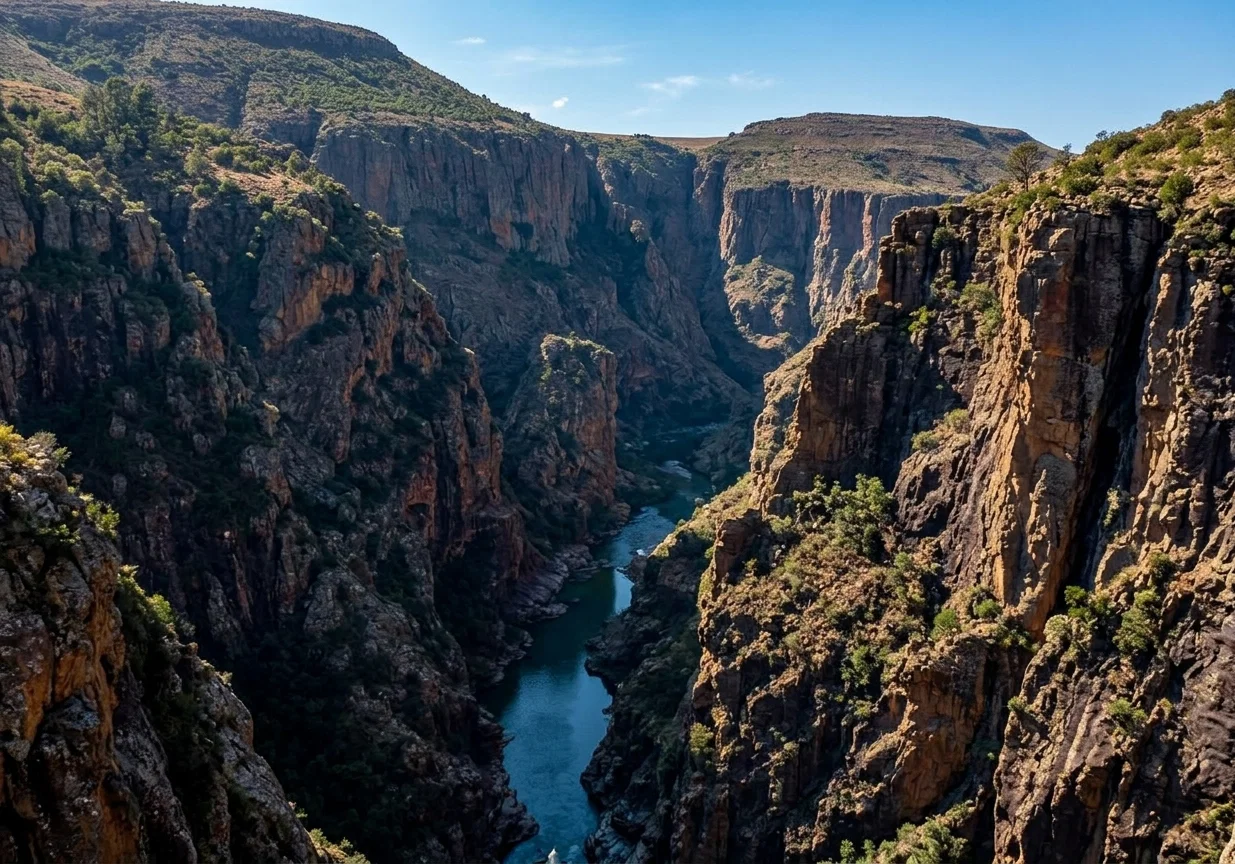
A GORGE IN BASUTOLAND
The Basuto huts are usually built of rough stone, plastered, on the inside and out, with mud. The roof is of thatch, and the floors are of earth, covered with a plaster of mud. Windows are seldom used, but small openings are left in the walls, instead. Enclosures in front of the huts are common. They are formed of Kafir-corn stalks, extending in a circular shape from corner to corner. The ground of the enclosure is plastered like the inside floors of the huts. The Kafir-corn stalks serve both as a windbreak and as a screen. The enclosure forms a sort of general living-room; and one much more cheerful, bright, and wholesome than the darkened and poorly ventilated hut. The cooking and beer making is also frequently done in these enclosures.
The Basutos are very intemperate. They make their own beer, and plenty of it. The light beer, called leting, is an important part of the regular diet. It is used freely and almost universally, among the church people as well as among the heathen. “Beer-drinks” are frequently given at the various homes, and large numbers of the people attend.
There are many schools in Basutoland, but what the people need is the school of Christ. They need Jesus. They need to be taught his will and ways, how to be like him, the necessity of having Christ abiding in the soul. They need to be taught, by the grace of God, “that, denying ungodliness and worldly lusts, we should live soberly, righteously, and godly, in this present world; looking for that blessed hope, and the glorious appearing of the great God and our Saviour Jesus Christ.” Titus 2:12, 13.
Our work since coming here has been varied, including holding gospel meetings both in the church and in the open air in the native villages, personal work, visiting, treating the sick, Bible teaching, canvassing for gospel literature, Christian-school work, including industrial work, such as cultivating the soil, brick-making, and building.
In August Mr. Chaney and I, with our interpreter,—Murray Kalaka,—went to Makeneng, the village of the late paramount chief, Lerithodi, near Morija, where we spent about a week. We were entertained by a Holland blacksmith and his colored wife and a partner of the blacksmith, who were living in the village in one of the native houses.
Prior to our visit here, Mr. Chaney had sold a book entitled “Coming King,” to an American blacksmith at Morija, and had also taken his subscription for one of our religious papers, The South African Sentinel. This blacksmith loaned the “Coming King” and some copies of The South African Sentinel to a family at Makeneng. They became so interested in these that the Hollander sent his subscription to Cape Town for the paper, directing them to send him all the back numbers for the year. Having learned of this family, Mr. Chaney went to see them; and later we made the visit mentioned.
They told us that on Sunday, only the day before our arrival there, the man was reading in the Sentinel, and there found the Sabbath truth. He called the attention of his wife and his partner, and read to them. They also saw the truth, and all three decided to obey, and walk in the way of God’s commandments.
They seemed to be hungering to hear more of the truth, and their hearts were open to receive it. It was a precious time that we spent with them. Others (natives) came in to hear, and the Lord blessed in the presentation of his message of truth.
Lerithodi’s head wife, who is the head of the village, endeavored to hinder us in our work. She got very angry because we held meetings there. However, the Lord overruled, and just before we left, she accepted some of our literature in the Sesuto language,—a copy of “Stepsto Christ,” and a booklet, “The Coming of the Lord,” which I took to her.
On Thursday evening before leaving that place, we walked to Morija and spent the evening with the American blacksmith, and with an Englishman and a young Dutchman, who were present. We had a very pleasant, and, I believe, profitable evening with them. We arranged with them to hold a meeting there on the following Sunday. On that day we drove down from Makeneng. The Lord was with us, and we had a good meeting, and left an appointment for another meeting the following Sunday.
On the next Monday morning we left Makeneng, and went to a native village, where we were entertained for the night by the chief. He gave us the use of his own hut, the best in the village. Although it was after dark when we arrived, we had a meeting with a number of the natives who came in shortly before we retired for the night. The next morning before breakfast, Mr. Chaney called the people together with his cornet, and we had another meeting, with quite a number present. After breakfast, before we left for Kolo, he called them together again, likewise, and we had the third meeting, about forty being present.
Mr. Chaney has continued the meetings at or near Morija each Sunday (with but one exception) since they were begun. There seems to be a real interest at this place. Members of the family from Makeneng attend. The wife especially is rejoicing in the light of the gospel, and says she does not fear death any more. How sweet it is to scatter the precious seed of gospel truth to hungry souls!