The Mountain View Convention

5%

Review and Herald Publishing Association · Takoma Park Station, Washington, D. C. · Apr 29, 1915

FromReview and Herald, Vol. 92, No. 21.

Read the full edition

The Mountain View Convention

This convention opened at the time appointed, with nearly a full delegation from the five unions supplied by the Pacific Press Publishing Association and its branches. The line of autos awaiting the delegates at the Mountain View station when they arrived were forerunners of the generous entertainment they were to receive at the hospitable homes of not only our own brethren in Mountain View, but of other friends who had kindly opened their doors to them. Brother James Cochran was on hand at the station with introductory compliments from the Pacific Press in the form of a four-dollar meal ticket for each one, negotiable at the Pacific Press Cafeteria. Each delegate was assured that he should not hesitate to ask for a second ticket when the first was finished.
As we entered the hall where our meetings were to be held, we noticed on the wall in large letters the text, “Behold, I come quickly.” This thought and the work to be done in winning souls before the Lord can come, was the keynote of the convention in the consideration of both the colporteur work and the home missionary work. This thought was especially emphasized in the following talk given the delegates by Elder I. H. Evans:—
“I am very glad to be here and see such a good attendance at this bookmen’s convention. I believe that these conventions are doing a great deal of good inmany ways, and it seems to me that our leaders should be stronger for this study together during these ten days than it would have been possible had they not met together in this convention.
“But we ought to be careful not to lose sight of the real object to be attained in all our work. We are doing a big work, to be sure. It almost staggers our poor, weak minds to think of how much we are doing collectively. We are breaking all records, and still going on in a progressive way. And surely it is a matter for gratitude on our part. Our people greatly appreciate this, and have confidence in the book department, believing that its work is a splendid success.
“These questions are in my mind often: What is success in this work? What constitutes success? Are money and the aggregate amount of our book sales what we should aim for, the purpose we should keep continually before ourselves and before our people? Or is there a higher ideal, a better objective, than mere finances? If I have any true conception of the object of the work of the book department, it is the winning of souls to Christ; and regardless of the number of books that one sells, or of the aggregate amount, the work is valuable in proportion as it leads poor, lost souls to accept Jesus Christ and to prepare for his coming.
“Now, if we have the monetary viewpoint, we may attain it, to be sure; but I believe we can attain to even a better standard in the number of books we sell if we continually keep in view the true object and purpose of all service. And I believe that every union and field agent ought to keep that burning in his heart continually—that the purpose of this work is to win lost souls to Jesus Christ. I believe that every worker ought to be trained with that idea in mind: that it is not enough to go out and sell books, but there must follow continually in the wake of that selling, a stream of people that are accepting the truth from the ministry of the workers. And if you, brethren, as leaders of this great department of our work, will continually keep before your helpers and assistants this ideal of winning souls to Christ. I do not believe it will lessen the number of books sold. I believe, however, that it will help each agent to be very careful of his words and of his manners. He will be more in prayer and will do far better work.
“Every man ought to have an objective to attain. It is not enough for a hundred men to pool together and say, ‘We will run a big convention this year, and work for large book sales; and then we will look for the results in the distribution that the Lord will make.’ I believe that each man ought to take rifle aim and say, ‘With the help of God, I will bring souls to Christ.’”
“This book department has grown to be a gigantic affair. More men are engaged in this than in any other line of work, unless it is our sanitarium work. A splendid work is being done, but I think we should get a better focus upon the real purpose, and then every man set his heart to bring souls to Christ. That will incite us to prayer. If a man has the true ideal of labor, he will be a man of prayer. His dependence will be upon the indwelling of the Holy Ghost to help him, when he meets persons, to speak in the name of the Lord. This is the power that will enable him to conduct himself in such a way that when he leaves the house, there will have been made an impression upon that family or that person, that can never be forgotten. That memory will be there, and it will be said: ‘I met a man who reminded me of Jesus Christ. His words, his talk, his looks, his manners, were the most impressive of any one I have ever seen. I have in my heart a hunger to meet that man, not because of anything he did, but for the impression that he left behind that he was a man of God.’ If you can put a thousand such men into the field in this country, men filled with the idea, the purpose, the one objective, resolved that every soul they meet shall be impressed with the life of Jesus Christ, I tell you, brethren, the Holy Ghost will follow up such work, and many a poor soul who otherwise would never read what you sell him will, because of the impression made, turn the pages of those books and become impressed with the truth.”
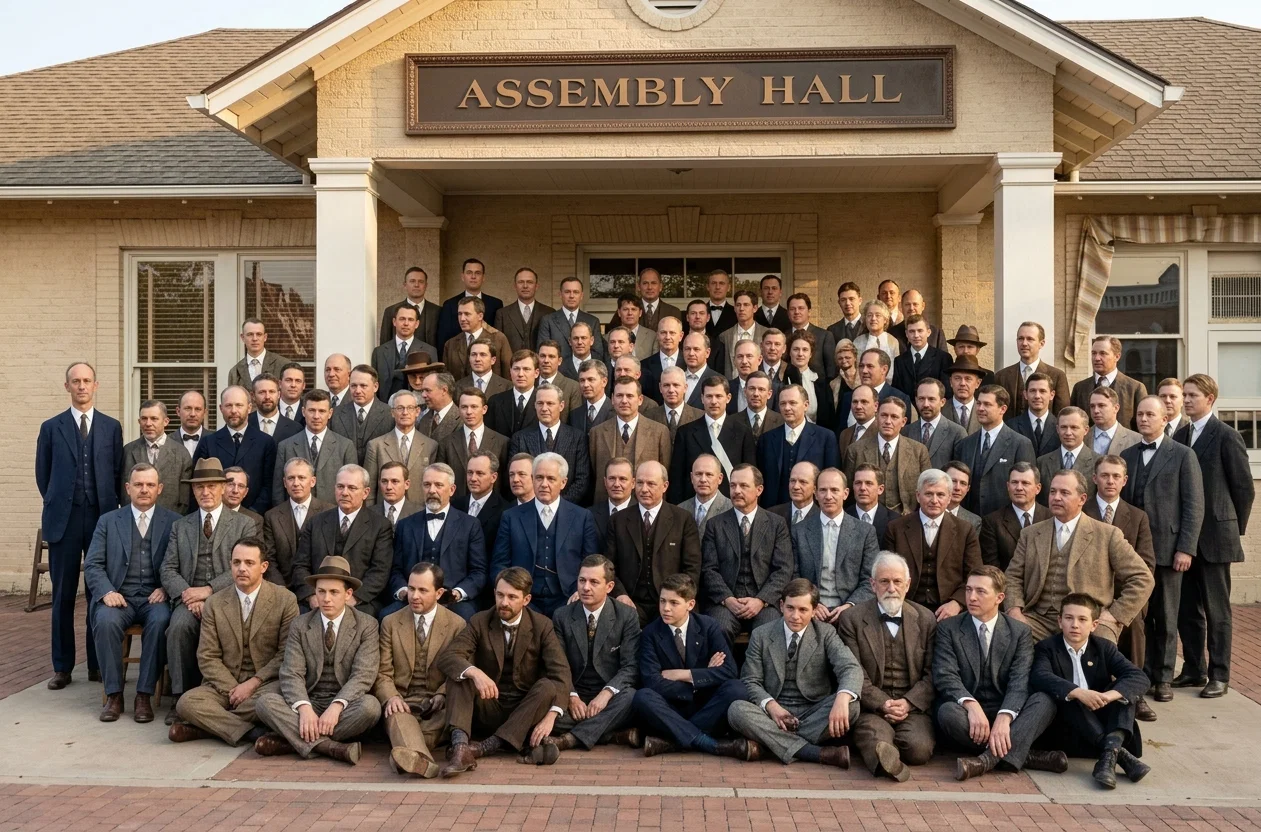
DELEGATES ATTENDING PUBLISHING CONVENTION
“I should like to see our men in the field so carry on their work that whenever a man goes into a region and sells a book, there will spring up a great demand for a minister to come and preach the gospel of Jesus Christ. It seems to me this book department is the forerunner of the ministry. With a thousand men in the field, raising up community interests in the third angel’s message, there ought to be in the wake of this book selling a great demand for evangelistic effort. I think you ought to hold this in mind, and just as soon as you have finished a community, there ought to be a demand for the evangelist to enter that territory and preach more fully the gospel. If we could run our book business in that way, brethren, it would be a mighty power in finishing this work.
“Some of you have a hundred or more men under your direction. You cannot afford to let even a day pass without keeping in close touch with God. You can lose more in one day in carelessness, in one moment of indifference, than you can undo in a long time. I do believe that as union and State men, as bookmen, it is your privilege to expect great things from God. You ought to expect and experience the baptism of the Holy Ghost. You ought never to go out into the field with a hundred men under your influence until you know that the Lord has breathed into your soul the Holy Ghost. You are entitled to it. It awaits your demand and reception. It is the mightiest thing that God can give you. I trust that at the close of this bookmen’s convention every heart will be filled with the great purpose never to go out in the work until God has given the power of the Holy Ghost in the life. With this ideal before you,—that all through your ministry your purpose and aim will be to enlarge the kingdom of God,—you will lengthen the ropes and strengthen everything connected with this work; you will win souls to Christ in prayer, in conversation, in your manners, courtesy, and kindness, under every condition; you will aim only to represent the Master, and the Lord will be with you to the end.”
There was a hearty response to the principles laid down by Elder Evans, and all those who took part in the social service which followed the talk expressed their determination to make the winning of souls the chief object of their work.
The second day of the convention the Pacific Press Publishing Association held its annual constituency meeting. The report of the manager showed that 1914 had been a very prosperous year for the Pacific Press. The balance sheet showed a net gain of $32,144. During the year the Pacific Press also gave to mission fields printing material and machinery to the amount of $2,757. In addition to this it turned over to the North American Division Conference for foreign missions the net gain on the Signs of the Times weekly for the year 1914, amounting to $2,568.
Elder J. N. Loughborough, who has been connected with our publishing work from its very beginning, was present at the constituency meeting, and offered the opening prayer. He could not refrain from comparing the present prosperity of our publishing work with the small beginning in 1849. He showed the delegates one of the original copies of our first periodical, the Present Truth, which Elder James White began to publish in that year.
One of the pleasant features of the constituency meeting was the banquet,spread on the long tables in the bindery. The banquet was prepared by the ladies of the Mountain View church. Over three hundred partook of this annual dinner.
One day, just before adjourning at noon, a gentleman from the city came into our convention and announced to us that we were to enjoy an auto ride in the afternoon, through the beautiful Santa Clara Valley, as guests of the Commercial Club of Mountain View. Twenty-six autos were provided to carry the delegates. The day was ideal, and the beautiful green fields, the flowers, the fruit trees in blossom, and the singing of the birds made the ride very enjoyable indeed.
Before the convention opened, a program relating to the colporteur, tract society, and home missionary work had been prepared. The delegates discussed these questions freely and fully during the convention, and at the close all felt that the meeting had been a very profitable one.
During the past year the Pacific Press Publishing Association has assumed a new responsibility in the purchase of the International Publishing Association at College View. This plant is now a branch of the Pacific Press. Brother J. R. Ferren has been placed in charge of the circulating department. All foreign literature now issued from College View will be furnished through the tract societies, the same as the English publications. The tract society secretaries and field agents at this convention realized as never before the importance of doing more for the foreign-speaking peoples in their fields.
The day following the close of the convention the delegates, together with the employees of the Pacific Press, visited the exposition at San Francisco.
Twenty tract society secretaries, five union agents, and nineteen field agents were present at this convention, also the managers of the three branches of the Pacific Press. Elders H. S. Shaw, G. W. Wells, and J. J. Nethery were also present during the whole time of the convention. If the same earnestness is manifested in the field work throughout the year as was manifested in the discussions during the convention, we shall see large reports from the Pacific Press territory during 1915. N. Z. Town.