The establishment of schools has ever gone hand in hand with mission enterprises. This is only in the natural order of gospel work. The regenerated heart of the heathen longs for an ability to minister to others as he has been ministered to. He is impelled by the spirit of Him who “came not to be ministered unto, but to minister.” The schools can assist him in acquiring this ability for service, and so the same reasons exist for them to be connected with the church in heathen lands as in Christendom.
The spirit of learning and civilization has in some degree at least reached to the corners of the darkest lands. The African and the South Sea Islander appreciate, if even in a faint way, the value of an education; and where the missionaries open schools adapted to their needs, they come to them.
In a rapidly increasing number are opportunities offered for the missionary to reach the mind and heart of the most unenlightened peoples, by means of schools as an opening wedge. Not only in reaching the heart of the heathen are the schools of value, but also in giving permanence to the change of life wrought by the gospel; for the stronger the grasp of the gospel on the intellect, the stronger its hold on the life.
Schools for Two Classes
Roughly speaking, the mission school enterprises of Seventh-day Adventists are of two classes: those which offer a means of reaching the unbeliever in God, and those which educate the believer and his children for gospel service. The former class are confined almost wholly to the more unenlightened portions of the world, particularly in Africa and the South Seas; whereas in such lands as China and Japan, our schools follow more largely the order of the schools of the home lands in educating the children and youth of church members, and are not so directly a means of reaching the souls who know not God.
Heathen Children in Christian Schools
There are approximately six thousand pupils in our missionary schools of the first class—those which appeal to unbelievers. The larger portion of the pupils who attend these schools become Christians, and so workers for Christ. Great care is exercised in accepting these pupils into church membership. After they have signified their desire to be Christians and to unite with the church, they join classes for instruction in Christian doctrine and the usages of the church.
Work as Well as Think
A large number of the members of these schools are mature men and women, or youths of some years. They are taught to work with their hands as well as with their minds. The schools
are generally located on large tracts of land, which the students work, and thus assist in meeting the expenses of their education. Most of the schools of this class are found in Africa. They are made possible, in part, by the opening of that continent to enterprises of modern civilization.
Difficult Problems
The problems of organization and management of these schools are not light, and often they tax those in charge very heavily. African and South Sea Island wilds, and the darkened minds of the natives, who are sometimes savages and cannibals, are obstacles not easily overcome.
Yet, wherever there is an opening for this work, there are always those who offer a ready affirmative response to that oft asked question in all mission undertakings, “Who will go?” The men and women of God who undertake this work fear not its dangers, dread not its obstacles, nor bewail its isolations. They remember that God “hath made of one blood all nations of men;” and they cheerfully leave pleasant homes, to aid in the uplift of their unfortunate brothers. Their chief reward is in seeing dark minds enlightened, and cold hearts possessed of the same warm spirit that animates their own; and in seeing the heathen, in turn, become Christian missionaries, and enter into the privations and joys which they themselves experience.
[[FIGURE]]
It is from the training schools in the home lands that these self-sacrificing teachers come. In all our advanced schools, mission bands are formed for the study of the darkened lands. The members of these bands are volunteers for this service, and study with the one idea of devoting their lives to gospel service in the lands about which they study. This missionary spirit is fostered and is prominent in all our schools. What is here said does not imply that all our gospel enterprises in heathen countries are conducted through the schools, but the schools are certainly one important means of approach.
Pioneer Southern Schools
Seventh-day Adventists are conducting in the United States a class of schools which in purpose are closely related to their foreign mission schools. There are in certain rural portions of the South, neighborhoods that are yet remote from modern life. The people of these localities are of sterling worth, but very conservative, and lacking in education and in the knowledge of present-day methods of life and work. They are generally religious, many of them being church members.
UNION COLLEGE, CAPE TOWN, SOUTH AFRICA
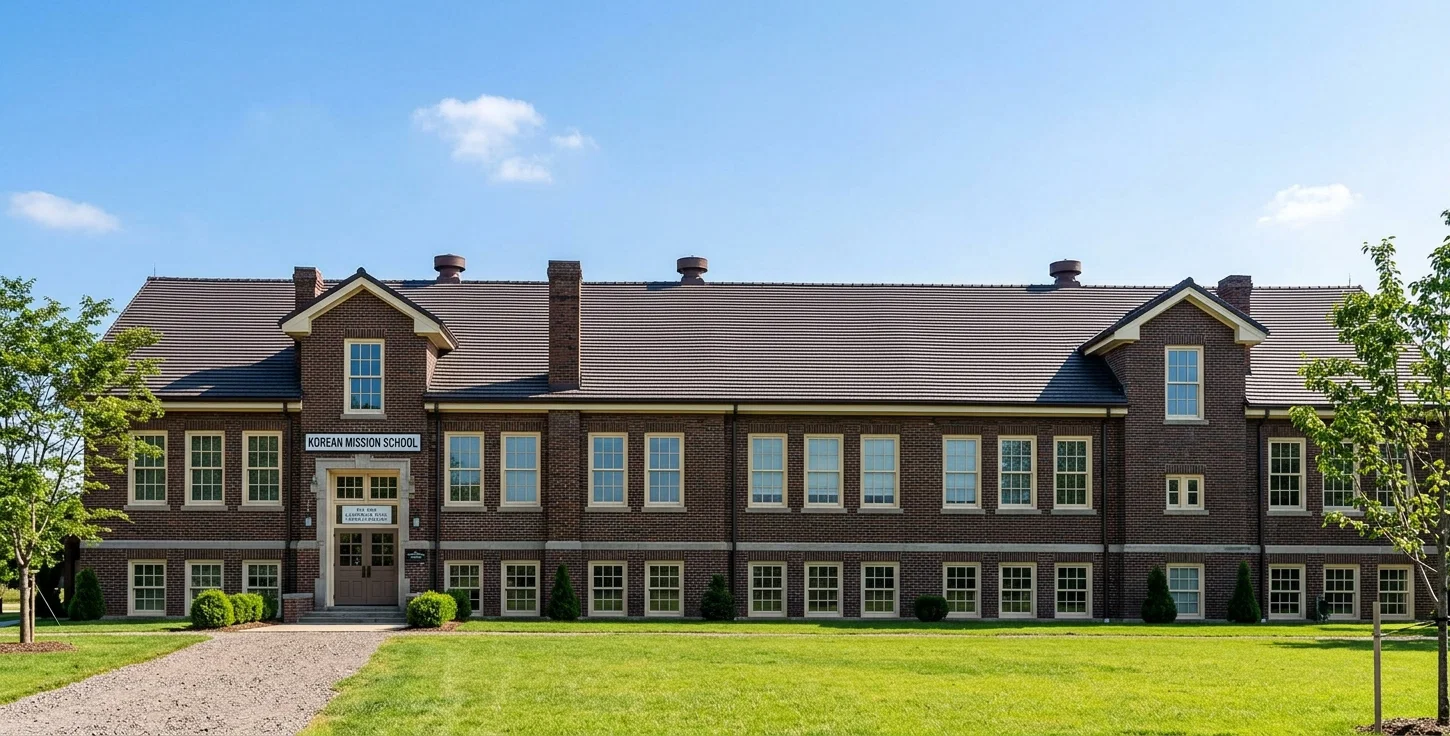
KOREAN MISSION SCHOOL
Our teachers purchase land and establish permanent homes in these rural sections. They open day schools for the children, and often night schools for the older people. Besides the common school branches, they teach agriculture also, by employing up-to-date methods on their own farms. The schools are free, and are appreciated by the people, as there are no others near; for they are usually located in remote mountain districts, where public schools are not yet established.
These rural schools naturally and readily become centers of culture and uplift; and in time, the devoted, self-supporting teachers have the pleasure not only of seeing improved conditions in the general life of the community, but also of seeing the gospel message which is so dear to them, fixed in the hearts of those who are willing to give thought to matters of eternal interest.
Health with Education
In all our mission schools, as indeed in all our schools, health instruction and practice are combined. The teachers are able to give simple treatments and remedies, and they teach these in their schools. This is of large value in those lands where physicians and nurses are few. Ministrations to the bodily needs of ignorantly helpless ones bind them to the hearts and teachings of those who thus help them.
Medical work is a fundamental feature of the enterprises of Seventh-day Adventists, and hence finds a natural place in their schools. They have a medical school located at Loma Linda, California.
As has been said above, our schools in such mission lands as China and Japan are of a nature and take on a form similar to our schools in the United States. We have the elementary or local church school for the instruction of the children of the members of the church. However, more children not of our faith attend these elementary schools in mission fields than in this land; and in some instances, schools are composed almost wholly
of pupils not of our faith. Of the schools having but few of our own faith, may be mentioned the girls’ school in Canton, China, and the Tamil school in South India. In this latter school, one hundred students enrolled in 1912 and the next year, fifteen were baptized.
We then have our higher schools, where men and women are educated, and specially instructed for evangelistic, colporteur, and other forms of gospel work. Christ did His work as a767teacher, and was so styled. For three and a half years, He conducted a mission training school which, in point of strength of teaching and extent of influence, has never been nor can ever be equaled. The daily teaching, “line upon line,” “precept upon precept,” is what fixes the lesson, and changes the life of the learner, and makes him, in turn, a missionary to others. The life and work of our Lord, that greatest of all missionaries and of all teachers, is an example for His church to follow. If aggressiveness and permanence are to mark the work of the church of God, then that church must educate its youth into its work; and, indeed, there is no nobler calling “under heaven given among men” than that of the Christian missionary. It demands all that is best, strongest, and most enduring in man.
Then why should not every professed follower of Christ train his children for such work, and commend it to them? In the ultimate, no work yields more generous returns in the durable satisfaction of life. The responsibility of giving to the children and youth an education and a Christian culture that will fit them for gospel service in mission or home lands, rests not alone on parents, but as well upon every member of every church.
The demands of God and the call of a perishing world are an inspiration for a great educational movement for life and service.