The Twenty-First International Eucharistic Congress of the Catholic Church
By C. M. Snow
At Montreal, Canada, September 6 to 11
By C. M. Snow, Editor of “Liberty”
A SIGN of the times indeed was the great Roman Catholic International Eucharistic Congress which convened at Montreal, Canada, September 6 to 11. No such gathering had ever before been held in the Western Hemisphere, and it is certain that in no part of the Old World had there ever been displayed a greater amount of pomp and pageantry in any of the twenty similar congresses held by the Catholic Church.
Money there was in practically unstinted amounts from all over the Dominion of Canada, the United States, and Mexico. It was the evident intent of the Catholic hierarchy to make this demonstration the greatest in the history of the church. The purpose also was evident from the time that the PLACE of this congress was announced, and the purpose was a twofold one. France had but recently struck a most severe blow at the Roman hierarchy, and England last year refused to allow the “host” to be carried in the eucharistic procession through the streets of London. THERE was formed the plan to have the greatest eucharistic demonstration in the history of the church in the French city of Montreal under the flag of Great Britain, and thus to show to the governments of both England and France the power of the Roman Church in the New World in a British possession among French people.
This double-headed purpose was not left for the people to surmise, but was openly declared in the one case and openly demonstrated in the other. Said Monsignor Montez de Oca, bishop of San Luis, Mexico: “This Eucharistic Congress in Montreal will be the vindication of the London congress when intolerance made it impossible to carry the holy eucharist through the streets. It is only fair that such a vindication should take place on British soil.” That was the declaration of one half the purpose. The other half was not openly declared, but was openly demonstrated, as the following incident will show.
On the city hall are five towers, three on the front of the building and two on the rear. The middle tower on the front of the building is larger and higher than the others. From this, during the Eucharistic Congress, flew the flag of the nation. On its right flew the papal flag and on its left the green flag of Ireland. On one of the rear towers flew the flag of the United States, and on the other rear tower the flag of France. Inasmuch as the city of Montreal is predominantly French, and Ireland is not an independent nation, there were many strong protests made against the position of the flags. The question was repeatedly asked, “Why is the flag of France retired and the flag of Ireland put in front of it?” No real attempt was made to answer the question. No one was found who would admit the responsibility for the placing of the flags as they were, neither would any one in authority order them changed, and so they continued to the end of the congress. The reason for this is made more apparent by the attitude of Monsignor Touchet, archbishop of Orleans, who is reported by the Montreal press as being surprised at seeing the French flag on churches during the Eucharistic Congress, and as declaring that the tricolor, being the flag of the
Revolution, could not rightly be placed on a church. This explains the placing of the French flag behind the Irish on the city hall, and explains also Rome’s reason for desiring that this Eucharistic Congress, held in Great Britain’s French province, should be the most successful and spectacular ever held. The Mexican bishop, Monsignor Montez de Oca, who has attended every Eucharistic Congress thus far held, declared that the Montreal congress would “eclipse all the others, as the display of riches there and the cooperation of all would make it the greatest of all.”
The Elements Not Propitious
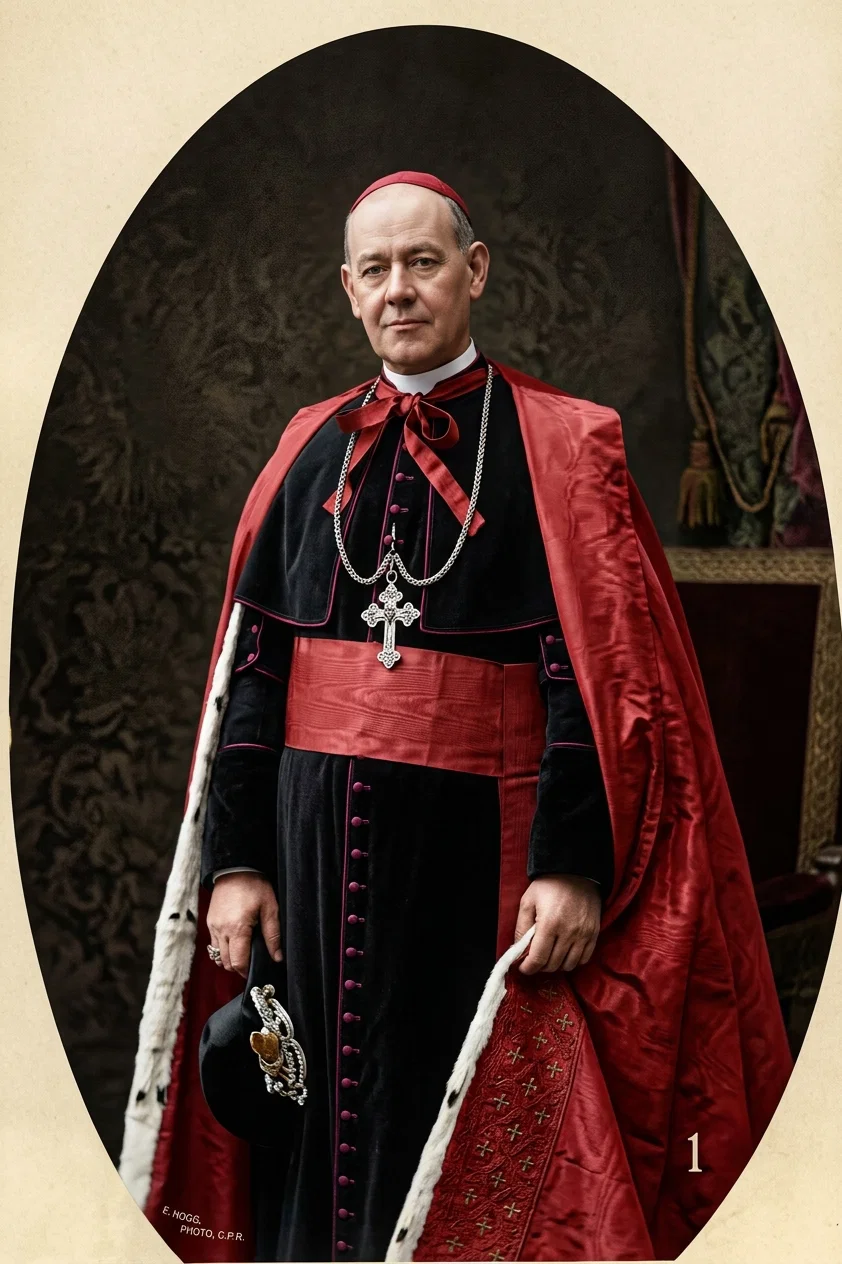
Cardinal Vannutelli, the Chief Figure at the Congress
That it might be the most successful of all, all the Catholic churches of Montreal began a “solemn triduum” on the night of September 1, the congregations joining in prayer for the complete success of the coming Eucharistic Congress.
After the enthusiastic receptions at the cities of Quebec and Three Rivers, the cardinal legate, Vincenzo Vannutelli, arrived at Montreal on Saturday afternoon, September 3, at 4:30 P.M., on the Canadian government steamer Lady Grey, which had been despatched to Quebec by the federal government to bring him. The government steamer was escorted by numerous other vessels, and was to have had an additional escort of sixty-one yachts; but the tempest raging at the time prevented this.
A special wharf seventy-five by one hundred feet had been constructed for the papal envoy to land upon, and a gorgeous throne had been erected at the wharf for him to occupy while listening to the mayor’s address of welcome and while delivering his reply. All the vessels in the harbor were decked out in their gayest bunting in honor of the occasion, and
steam sirens were screaming and guns booming their welcome from the time the Lady Grey, bearing the pope’s envoy and flying the papal flag at the masthead, hove in sight, until the landing was accomplished. But in spite of the “solemn triduum” and the prayers for propitious weather, the worst storm of the season was raging, and the special wharf became an impractical landing-place, and the gorgeous, rain-swept throne was not an inviting seat for the papal legate. He was accordingly whisked away in the mayor’s carriage to the city hall, where the reception ceremonies were carried out. The specially-invited but rain-soaked “one thousand gentlemen,” consisting of cabinet ministers, consuls, senators, members of parliament, ecclesiastical dignitaries, and prominent citizens, who were at the wharf to add impressiveness to the reception, followed as best they could.
The Legate’s Reception
At the city hall, on an improvised throne, the papal legate was seated, with the mayor on his right and Archbishop Paul Bruchesi of Montreal, the organizer of the congress, on his left. The mayor’s address of welcome was an eloquent eulogium of the Catholic faith and of the loyalty of the people to the holy see. It closed with an application to the papal legate of these words of Scripture which properly apply to our Lord Jesus Christ: “Hosanna in the highest! Blessed is he that cometh in the name of the Lord!”
The legate’s reply thanked the mayor and the population of Montreal for the magnificent reception tendered him as the pope’s envoy, congratulated the Catholic portion of the population upon the ardor of their faith, the prodigality of their devotion and generosity, and the magnificence of their religious demonstrations. He voiced the sentiment that all who had contributed toward this congress were helping to exalt “the blessed sacrament of the holy eucharist.” Many so-called Protestants who contributed of their means for this demonstration, may not enjoy the light in which the papal legate placed them; but he was perfectly justified in placing them there. One prominent citizen, a professed Protestant, had headed the list of private contributions with a donation of $5,000, and many others had followed his lead with lesser amounts.
The papal legate’s official reception occurred on the 3d, but the congress did not open until the night of the 6th. In the meantime the city was a scene of the greatest activity. Everywhere the work of decorating public buildings, churches, dwellings, and streets was in progress; and Father Bernard Vaughan of England, seemingly impatient of delay, opened up a war of words with the representatives of Protestantism. In a public address, he stigmatized Protestantism as “a soulless religion,” a “religion without sacrifice,” because of its rejection of the dogma and ritual of the mass. Many Protestant leaders accepted the gage of battle, and the Canadian papers published many columns of the controversy. This attack seemed to stiffen the back of Protestantism in the dominion for the time being, and some very pointed things were said.
Father Vaughan’s attack did not meet with universal approbation among the Catholics themselves, some of the more far-seeing of the clergy taking the position that Rome’s hopes of winning Protestantism lay not in denunciation, but in setting forth, without harsh invective, the positive principles of Catholicism. This latter mode of operation, which was strongly advocated by Rev. A. P. Doyle of Washington, D. C., was the more generally approved one, and the one which will be acted11
upon wherever missions to non-Catholics are carried on.
The Meaning of It
On the afternoon of September 4, the papal legate was advertised to address a gathering of Catholic women in the church of Notre Dame. Long before the hour set for the address every seat was taken and the aisles were full. It was estimated that 20,000 women were inside the edifice two hours before the time for the address, and hundreds were unable to gain admission. To avert a panic, Bishop Bruneault ascended the pulpit and held the attention of the women until the arrival of the cardinal legate. A squad of police and firemen was also summoned to the church to be on hand in case of panic. In Bishop Bruneault’s address occur these words, referring to the procession of the eucharist which was to take place on the following Sunday:
“Jesus is preparing to leave the tabernacle in which He is held captive to rest on the throne of glory to pass through the streets of your city as a king of splendor and triumph, to receive the honors of a whole people.”
The piece of bread over which a priest had uttered the words, “Hoc est corpus meum” (this is My body) was to take the place, to them, of Jesus Christ Himself. The costly monstrance in which that piece of bread was to be borne, and which was made especially for this occasion, was the throne referred to; and the people, as it passed, were to fall down and worship that piece of bread as if it were very God Himself. It was declared over and over at this congress that the consecrated wafer did not merely represent Christ, but was Christ Himself; the real presence was there, the priest had created God so soon as he had uttered the words, “Hoc est corpus meum.”
More than that, on the badges worn by the delegates was a gold chalice, and over the chalice a circle representing the consecrated wafer, with the initials “I. H. S.” stamped upon it. These initials stand for the words “Iesus hominum Salvator,” Jesus the Saviour of men; and under the chalice are these words: “Pain celeste reconfortes moi!” which, being translated, is, “Heavenly bread, comfort me!” — a prayer to the bread — not as representing Christ, but to the bread as the real Christ Himself. That idea — the real presence of Christ in the consecrated wafer — was declared by many Catholic prelates at this congress to be THE VERY SOUL OF THE CATHOLIC SYSTEM. This is that doctrine which the English coronation oath for several centuries has declared to be idolatry; and beyond a shadow of a doubt, so it is.
The bishop concluded his address by stating to the women that in the evening there would assemble in that church an army of men — their husbands, brothers, and sons — who were “ready to shed their blood for the defense of their religion and their country.”
Seated on a Throne
At the conclusion of this address the papal legate, “from his throne on the sanctuary, addressed the vast audience and imparted the papal blessing.” It is worthy of note that wherever the cardinal legate appeared in public he was seated upon a throne, with high dignitaries of the church on either hand, occupying lower seats. How different is this from the teachings of Jesus in reference to having respect of persons. Matt. 20: 26, 27. The expression, “from his throne on the sanctuary,” instinctively brings to the mind of a Protestant those words of Scripture relating to “the man of sin,” who “sitteth in the temple of God, setting himself forth as God.”
In the evening another vast assemblage, consisting of 15,000 Catholic working men, gathered in the same church to hear a sermon by Archbishop Langevin of Manitoba, and to receive the papal blessing at the hands of the cardinal legate.
(Concluded next week)
Despatches from Berlin are to the effect that the emperor’s declaration that he rules by divine right has not taken so well with the people as it might have a few years ago. The Socialists over all Germany are prophesying that the emperor’s utterances will win them fifty more seats in the next national legislature; and it is further asserted that if Chancellor Bethmann von Hollweg is with the emperor in such utterances, he will find in the next Reichstag a decided majority combined against him. The Socialists’ organ declares that “the kaiser’s idea of rule is the conception of Asiatic despotism. He has of his own authority torn up the sheet of paper Von Buelow wheedled out of him and thrown the scraps to the German nation.” So far, it is said, in not a solitary newspaper have appeared his utterances. Of course the logic of the emperor’s speech would be the abolition of constitutional government; but some of his friends say his speech is merely the enthusiasm of the emperor under the inspiration of the moment, and must not be taken seriously. It shows, however, just what effect it would have if spoken at a wrong time.
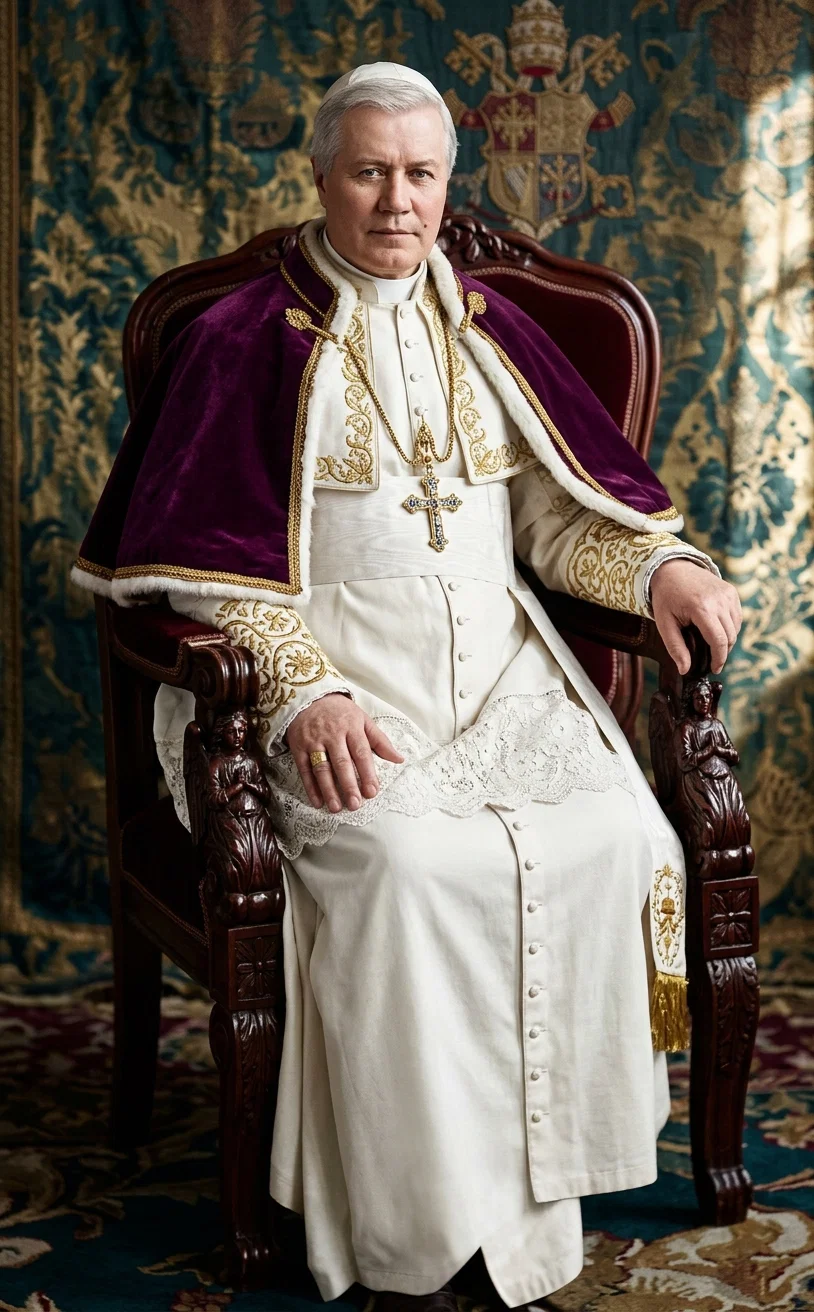
Pope Pius X, who sent special delegate and blessing to the congress
The Roosevelt and Storer quarrel has been revived by the publication of letters which review the controversy concerning the ex-President’s alleged authorization of the former ambassador to Austria-Hungary to visit the pope and ask as a personal favor to the President of the United States that Archbishop Ireland of St. Paul be made a cardinal. Roosevelt has hitherto publicly denied that Storer was ever authorized to represent him in this manner, and the Archbishop Ireland letters now published by Mrs. Storer tend to make the question of veracity more keenly felt by the contestants.
Two years’ imprisonment and a fine of $5,000 is the penalty imposed on Ernest W. Gerbracht, former superintendent of the Williamsburg refinery of the sugar trust. The charge is that of conspiring to defraud the Government by means of short weights. What would have been the penalty of a bank robber who took $5,000, say? The sugar trust has stolen millions.
Sixteen persons lost their lives in a train wreck two miles east of Clayton, Kansas, September 23, where a cloudburst washed out 1,000 feet of track, and caused the plunge of a passenger train into the raging stream.
John Webb Keith, the last of a group of pioneers who came around the Horn from Boston, landing in San Francisco in June, 1849, died in the latter city, September 21.
Homeless, and a refugee from his country, Dr. Madriz, late president of Nicaragua, fled before the conquering arms of Estrada, the revolutionist, and temporarily found refuge at Amapala, the Pacific seaport of Honduras, with his principal generals and advisers. The Honduras government permitted him to remain only two days before peremptorily ordering him and his party to depart on penalty of imprisonment. There was no steamer in port, nor any aeroplane in Amapala, and he dared not go inland. What could he do? In this dilemma Dr. Madriz learned of a steamer due to arrive the following day, and cabled a request to the captain to pick him up in a small boat a few miles at sea from Amapala. This is the last that has been heard of him; for the captain of the boat to which Dr. Madriz signaled reports that, though they have made diligent search, the little boat has not been sighted and the deposed ruler cannot be found.
To Evangelize Chicago.— Four hundred Protestant churches of Chicago are ready to unite with the Chapman-Alexander campaign plan for the evangelization of their city. 400 churches, 600 ministers, 60 groups of six to ten churches, 60 evangelistic music directors, 1,000 evangelistic singers and soloists, and 5,000 evangelistic services, are figures which indicate the magnitude of this proposed campaign to begin October 16. Dr. Chapman and his associates are looking forward to the Chicago campaign as the most important step they have ever taken.
Shark’s meat has been dyed and sold for smoked salmon in San Francisco markets. The shark meat, originally white, was ingeniously given a “smoke brown” hue by the use of anilin dyes, such as the health office has already put under the ban. The manufacture of the “salmon” has been traced to Seattle, Washington.
One of the most vigorous, progressive, clear-thinking, up-to-date men in the Congress of the United States, is Senator La Follette of Wisconsin. This is not only true of his public life mentally, but he is giving his great mental ability the best of working bases; he is a vegetarian, temperate, and clean.
A woman police officer, probably the first woman in the United States to serve in that capacity, is actively engaged in the city of Los Angeles, California. Her work is confined to public resorts, where her especial work is to look out for the welfare of girls who might come under evil influences.
A schooner arriving at Seattle, Washington, September 12, from the Kuskokwim River, is reported to be covered with ashes from Mount Shishaldin, on Unimak Island. The mountain, twenty-five miles away, could not be seen for the dense smoke and cinders.
The senate of the state of California has disapproved the report of Labor Commissioner John D. Mackenzie regarding Japanese labor in California, on the ground that he has misrepresented the wishes of the people by favoring Japanese labor in this state.
The expulsion of the Jews still goes on in Kief, Russia. In three days eighty-four were driven out after a brief period had been given for their exit, while thirty-two left voluntarily.
Four persons were killed and three seriously injured in the wreck of a special train at Delorme, West Virginia, when two coaches jumped the track and crashed into the depot.
Three post-card dealers in St. Louis, Missouri, have been arrested for selling post-cards of obscene pictures. Only three! And in one city only!
Forty-two excursionists were killed in a wreck on an interurban car line near Kingsland, Indiana, September 21.
Reports say that an immense field of bituminous coal has been discovered by prospectors near Cook’s Inlet, Alaska.