SOWING FOR PHYSICAL AND SPIRITUAL HEALTH

4%

Seventh-day Adventist Publishing Association · Battle Creek, Mich. · Jul 24, 1900

FromReview and Herald, Vol. 77, No. 30.

Read the full edition

SOWING FOR PHYSICAL AND SPIRITUAL HEALTH

David Paulson & W. S. Sadler

THE STARCH FAMILY.

(Concluded.)

HELPS TO STARCH DIGESTION.

Starch in the raw state is scarcely, if at all, acted upon by the saliva, and only with difficulty by the pancreatic and intestinal juices. If it were not for this latter provision, no doubt multitudes would practically starve; for it is extremely rare that starch, whether in the form of mushes, biscuits, cakes, or piecrusts, is properly cooked; hence the integrity of the pancreatic juice should be regarded as one of the life-saving elements in the human system. Like the rounds in a ladder, there are a series of steps through which starch passes in being transformed into sugar, so that it can be utilized by the body. The first of these steps, as noticed in a previous article, is known as starch as ordinarily cooked, or the pasty stage, and is called “amylo-dextrin.” In this form it is only slowly acted upon by the digestive juices.
If, however, it is subjected to ordinary baking heat, as in the case of common bread, it is still more readily digested. At this stage, it is known as “erthro-dextrin.” But when it is subjected to such a high degree of temperature as to become thoroughly browned, as in toasted bread, it reaches a stage known as “achroo-dextrin,” and in this form it needs, as it were, only a touch of the digestive fluids to transform it into maltose, or sugar.
An important portion of the real digestive work that is required to convert starch into sugar can be accomplished by the process of thorough baking; and, as cook-stove energy is much more economical than digestive energy, foods containing starch should, whenever possible, be subjected to sufficient heat thoroughly to brown them before they are eaten. Many persist in compelling their digestive organs to do for them what the cook stove might just as well do; just as there are persons who are trying to accomplish for themselves, spiritually, what the Lord is willing and anxious to do for them.

HINDRANCES TO STARCH DIGESTION.

Starch digestion is hindered not only by water-drinking at meals, but its activity is almost entirely annihilated by strong acids. Careful experiments have demonstrated that one teaspoonful of strong vinegar is enough to spoil the digestion of a whole dinner, so far as the starch is concerned. “What an absurd thing, also, is the use of pickles,—a vegetable product containing starch to be digested by the saliva, and which is saturated with vinegar so that the starch can not be digested at all. How absurd also to put vinegar upon vegetables, or any kind of food requiring salivary digestion.” The only rational use of vinegar seems to be to create a pond for its eels to swim in. Some of the stronger acids of fruit, particularly the acid of rhubarb and lemon juice, have, to a certain extent, the same effect. This accounts for the indigestion so often produced by the eating of lemon pie, or puddings served with strong lemon dressings.
The following is an extract from a report of observations made by Dr. J. H. Kellogg, in the Laboratory of Hygiene connected with the Battle Creek Sanitarium:— “Dr. Wm. Roberts showed, a number of years ago, that certain substances possess the power of strongly inhibiting, or entirely preventing, salivary digestion. Among the principal substances investigated by Dr. Roberts were vinegar, tea, coffee, and beer. All these substances were found to be inimical to starch digestion, even in very small quantities,—a very interesting observation when considered in connection with the great frequency with which cereal foods are taken with tea, beer, coffee, wine, and similar substances. In repeating and extending these observations, I have found most complete confirmation of the observations of Dr. Roberts.”
Insufficient mastication is another hindrance to the proper digestion of starch. During hasty eating the saliva does not have opportunity to come in contact with the minute starch granules, and so the starch will receive no further attention whatever until it reaches either the pancreatic or the intestinal juice.
Again: saliva has no action whatever on fried foods, because the fatty substance surrounding the food furnishes an insoluble envelope for the small particles of starch, so that it is impossible for the saliva to come in contact with them, as the saliva has no power to act on fat; and, as a consequence, various fermentations are likely to be produced in the stomach, thus accounting for the severe “heartburn,” from which many persons suffer after eating hot, buttered toast.
The activity of the saliva is also discouraged by great extremes of temperature. It is not a good practice to sip liquid foods almost boiling hot, or to partake of iced foods or drinks. We should endeavor to avoid extremes in the temperature of our food, as well as in all the habits and walks of life.

DIAGRAM SHOWING THE AMOUNT OF STARCH IN MAN’S AVERAGE DAILY FOOD SUPPLY IN PROPORTION TO THE OTHER PRINCIPAL FOOD ELEMENTS:—
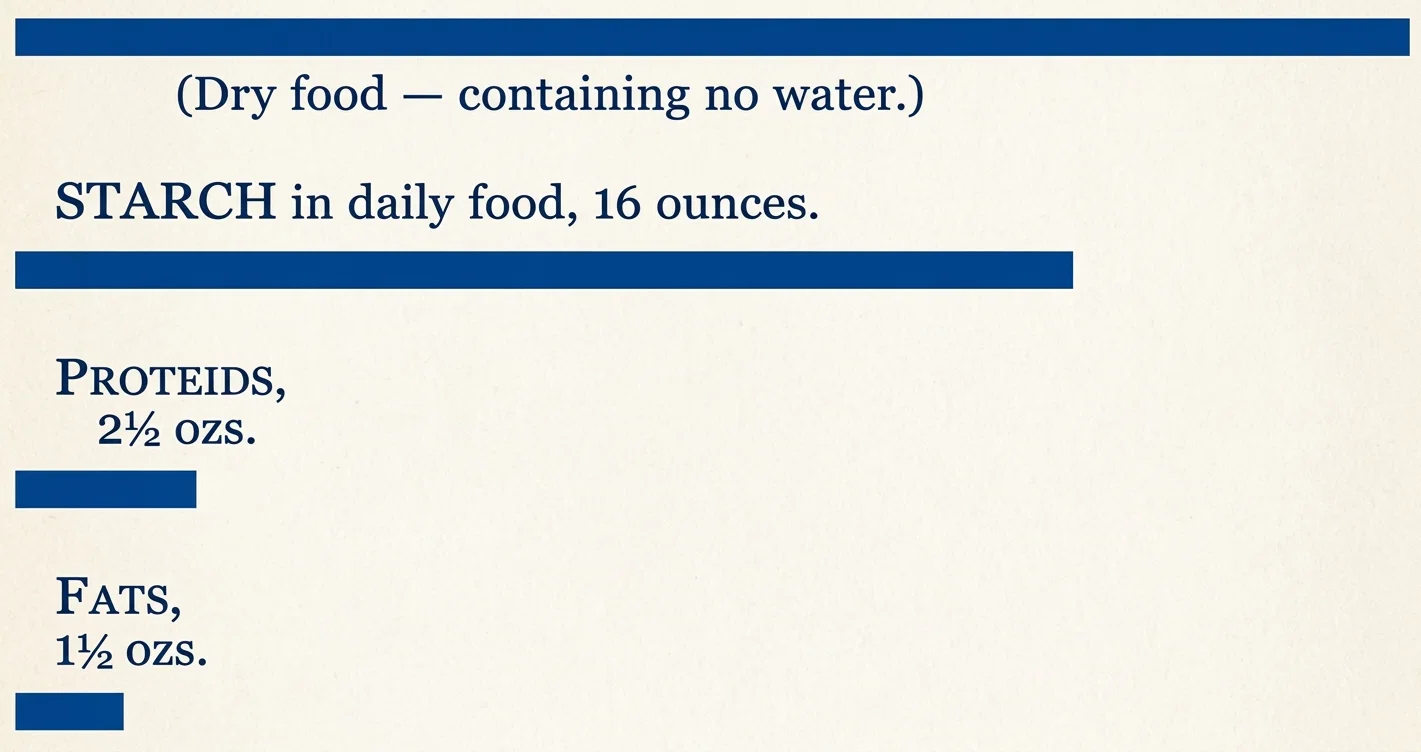
Average Daily Food for One Person, 20 Ounces.
(There is a small per cent of salts,—mineral element,—together with cellulose,—woody matter,—etc., which is not shown in the preceding diagram.)

TABLE SHOWING THE PER CENT OF STARCH FOUND IN VARIOUS FOOD SUBSTANCES.

FLOUR.
Food Per cent Food Per cent
Graham 69.9 Spinach 4.3
Wheat 75.4 Head Lettuce 2.2
Rye 69.7 Potato 21.
Barley 71.2 White Turnip 3.
Oat 67.2 Beet 9.
Corn 69.5 Parsnip 7.2
Buckwheat 74.3 Sweet Potato 25.3
Bean 59.4 Cucumber 1.4
Pea 57.2 Asparagus 2.3
Banana 77.9 Cauliflower 3.4
Arrowroot 82. Squash 5.2
Macaroni 76.8 Onion 8.
Pumpkin 5.1
Peas, green, garden 12.
String Beans 5.5
NUTS.
Nut Per cent
Chestnut 69.
Walnut 13.
Hazelnut 7.2
Sweet Almond 7.8
Peanut 1.8
Cocoanut 8.
LEGUMES.
Legume Per cent
Peas, small 52.6
“ African 57.8
“ Green, shelled 57.7
Beans, field 48.3
“ French or Kidney 55.6
“ White 48.8
“ Lima 60.6
Lentils 53.
Copyrighted, 1900, by David Paulson and W. S. Sadler.