In Newer Brazilian Fields

7%

Review and Herald Publishing Association · Takoma Park Station, Washington, D. C. · Aug 2, 1906

FromReview and Herald, Vol. 83, No. 31.

Read the full edition

In Newer Brazilian Fields

WHILE our boat is spending two days in the fine harbor of Bahia, I will send on a message regarding the newer fields in Brazil, which now we must help our brethren to work.
As the conferences in the southernmost part of Brazil are aiming at self-support, our mission funds for Brazil are now to be used to press the work in newer fields. What has been done in the portions already organized into conferences must be attempted in other States.
We may hopefully expect good results; for wherever the seed has been sown thus far, the fruits have appeared. In fact, so far as the work among the Portuguese-speaking Brazilians is concerned, the most promising fields are these States of the middle south Atlantic seaboard.
One after another we must locate workers in these States, which have all too long been left unentered. It is in these very portions of the country that the Bible Society colporteurs have had most success in selling the Bible. This splendid effort of the colporteurs is placing about sixty thousand copies of the Book of books in priest-ridden Brazil every year.
Elder Westphal and I have just visited the State of Sao Paulo, generally spoken of as the most progressive of the Brazilian States. It is now set apart as a mission field under Elder Hoelzel’s direction. The truth has but a very small representation in this new mission. But the smaller their force, we may depend upon it, the greater will be their earnestness in labor. It will be a great encouragement to the believers to have some one in the field to lead them in service.
In the city of Sao Paulo we visited Brother A. B. Stauffer and his family. Brother Stauffer is the pioneer worker in Brazil, having entered the field in the first canvassing campaign in South America, and he has remained in the country ever since. For the sake of his children, and for the pioneering of anew part of the country, he has decided to turn for a time to industrial work in the newly opened far west of the State of Sao Paulo, on the borders of the Indian country. He promises to report his experiences in this effort to demonstrate the possibilities of self-supporting mission work as a pioneer farmer in this almost unknown region. This effort means a new part of the country entered, and it is with the thought of establishing light in a dark place that our brother moves on into regions beyond.
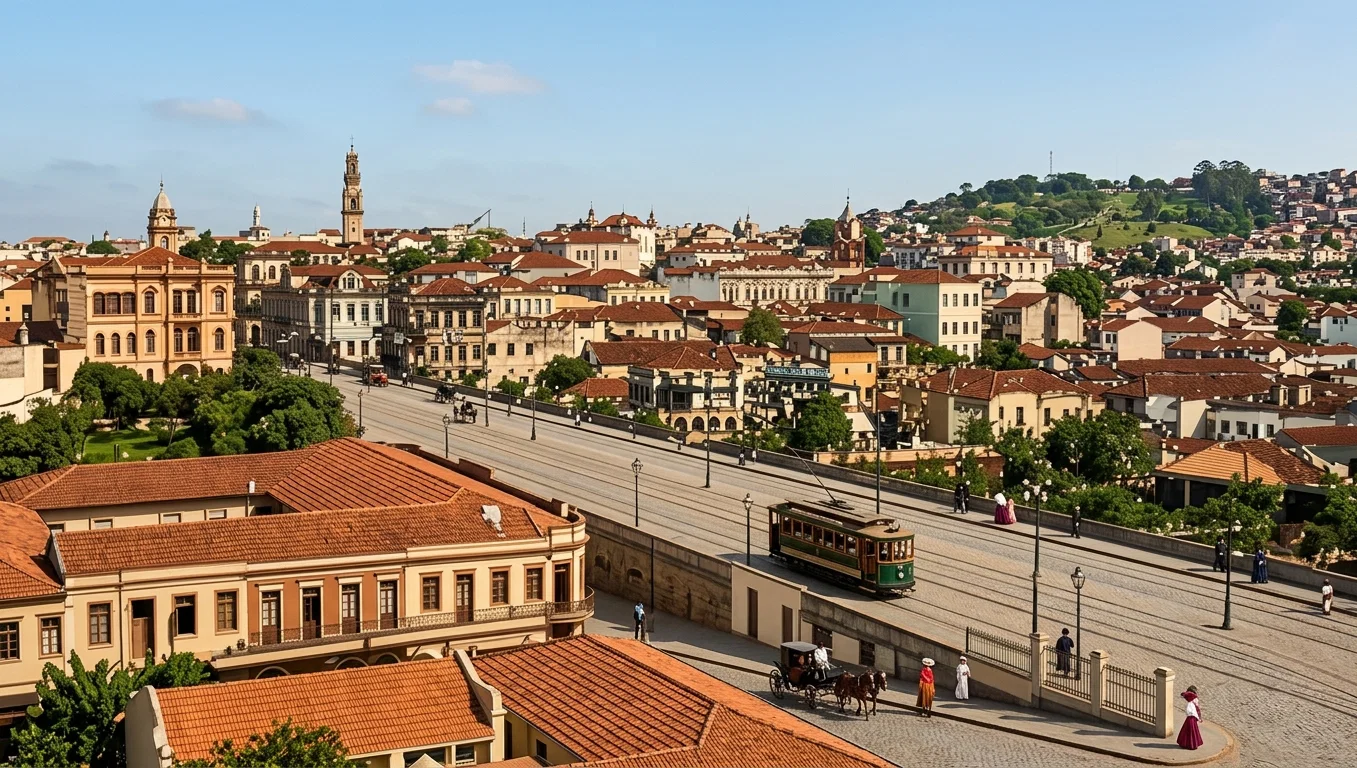
The city of Sao Paulo, with over a quarter of a million, is perhaps the most modern and European city in South America. It is an educational center in Brazil, and all the appointments of the city seem quite up-to-date. About half the population is Italian, and as soon as we have Portuguese literature to sell, such cities as these ought to be worked with Portuguese, Italian, and German literature together.
Our work is turning now toward those States where there are railway facilities, and where the larger masses of population are found. Now there is a more urgent call than ever for us to stand by our brethren in these countries, as they seek to open new fields, and actually to occupy all their territory.
About a hundred miles northwest of the city of Sao Paulo we visited Brother William Stein and his wife. Brother Stein has been editor of the Portuguese paper in Brazil for seven years, and now, on account of his health, is working on a farm; but he hopes erelong to get into the evangelistic field, and to be able to give all his time to direct work for the message. Away across the valley from his home, he pointed to a blue ridge of mountains, marking a district where the anti-Protestant prejudice is so strong that no known Protestant traveler can get food or shelter. This is exceptional, however. Nearly everywhere the way is open for the evangelistic colporteur or preacher, though he may expect to meet more or less opposition.
Our brethren have their eyes upon the next State northward, also — Minas Geraes — the great mining country of Brazil. It is the most populous State of all, with 4,360,000 inhabitants. It is hoped to locate a worker there soon.
And here is the State of Bahia, waiting for the sower of the seed-corn of the kingdom. Years ago, I believe, some of our German literature was put out here in the city of Bahia. It is not a bad-looking city, and is open to Protestant effort. The Baptists, Methodists, and others are here. We ought to be here also. It is a city of churches. There are three hundred Catholic churches, a missionary told me. This means one church for every thousand persons, according to the population claimed. As I write, I can count over twenty churches along the water front. The harbor is full of ships. Electric cars and electric lights give the place an up-to-date appearance, but religiously these multitudes are living in the darkness of the Middle Ages. The light must stream in — is coming in. The situation appeals to us to seek somehow to supply workers for these needy fields.
VIEW IN SAO PAULO, CAPITAL OF A NEW BRAZILIAN MISSION FIELD
As it is, Elder Spies is director of the Northern Brazil mission field, which means everything in Brazil north of Sao Paulo. But with the work in Rio de Janeiro and the companies in the State of Espirito Santo, he has all that one man can do. The harvest truly is great, and the laborers are few. Here again is the call to prayer to the Lord of the harvest.
W. A. S. Bahia, Brazil.