In a former article on mission work in Sierra Leone, I referred to the advantages taken of the natives by those professing to be missionaries, and the sad experiences that followed. This trafficking has increased, and with it added difficulties. The man who poses as a missionary, and at the same time carries on a trading business of any kind, is looked upon by the natives with suspicion.
Some honest, faithful workers have struggled on, fighting hard against the tide of heathenism in its different forms, and the evils brought in by unsanctified laborers, professing to be working for the Lord, and at the same time filling their own coffers. The time will come when such work will meet its reward.
Prior to the year 1855 mission work was carried on by the Baptists, Methodists, and the Church Missionary Society of England. Just what time the Sudan Mission was established, I am unable to say. Rev. Smith, superintendent of that mission, informed me that he had labored in this field for more than thirteen years. Their work extends farther into the interior than any other missionary society. It was while laboring with this society, that Brother Chaney, now working in Basutoland, accepted this message. He was opening a mission at Falaba on the head waters of the Niger River. He began work here in 1892, and in 1895 accepted the message for this time. The Sudan Mission is under the direction of the society of the “Christian Alliance” of America; and has accomplished something in the hinterland of this colony.
In the year 1855, the United Brethren of the United States began work on the island of Sherbro, on the southwestern coast of this colony. Their principal efforts were to establish industrial schools. Success attended their labors, and they soon had missions established along a line about twenty miles from the coast, for quite a distance. Several industries were started, such as a sawmill, farming, and other enterprises.
They had, however, many trials to encounter, and there was shown on the part of the natives much dissatisfaction at times. Opposition to Christianity has increased among the natives, and but few, comparatively, ever truly accept Christ. The large number of those in this colony that accept the gospel, are descendants of those who were once slaves in the United States and other countries, and have returned to their home land.
In the city of Freetown churches are numerous, and there are large gatherings. Preachers may be seen on nearly every corner, and from an outward appearance one would think that everything was favorable to Christianity. But not so. Paganism and the faith of Islam are making headway here in the city of Freetown, and the professed church seems unable to cope with this tide of evil which is sweeping down upon it. The atmosphere itself seems impregnated with the terrible influence of evil. Heathenism has set itself like solid walls of brass against Christianity, and their object is to stamp out its influence from their shores. This will appear from the efforts made by the different tribes only a few years ago.
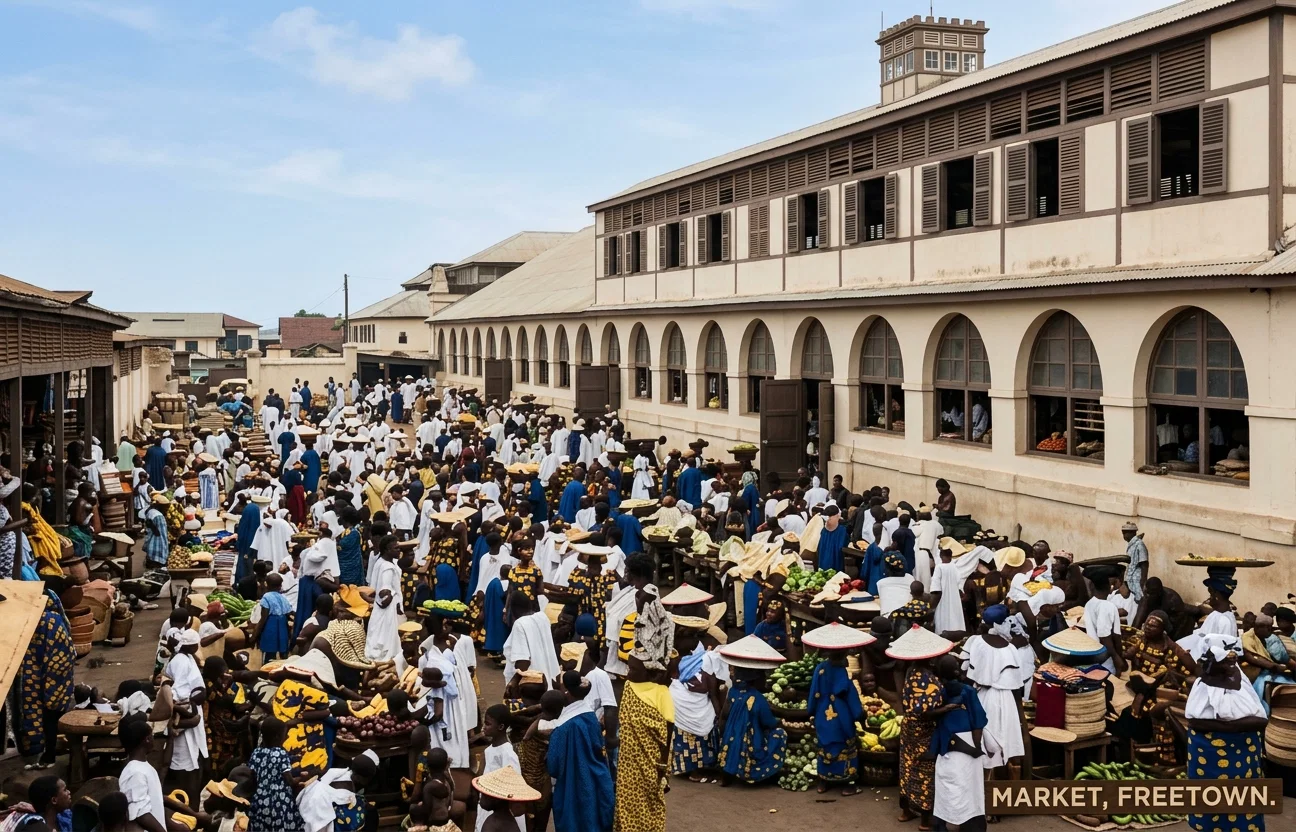
PUBLIC MARKET, FREETOWN, SIERRA LEONE
From the time this colony was taken over by the government of Great Britain, there have been unceasing difficulties with the natives. War has been its history. At one time Freetown was entirely burned, and its inhabitants scattered, but they rallied, and the town was rebuilt, but over and over the records show difficulties.
Probably the saddest experience, not only to the civil government of Sierra Leone, but to the different missions, was in the months of April, May, and June, in 1898. A tax had been levied on all houses throughout the colony, including the native huts, of three shillings each (about seventy-two cents), but the natives refused to submit to the requirements of the government. Some, however, paid the tax. All the Mendie tribes south and west of the Rokelle River promptly paid when the government called on them, but the Timnies, north and east of the same river, utterly refused to pay. This brought on war, and Biabura, king of the Timnies, stood his ground against the British soldiers so successfully for a time that it seemed they would not be subdued. This gave courage to the Mendies, and they, too, sounded the battle-cry. Their object was, however, even greater than that of the Timnies.
The Timnies opposed only the taxation; but the Mendies decided to obliterate Christianity, stamp out the English language, capture all valuable stores, and fully reinstate their former religion. To accomplish this end, they decided to kill not only the white man, but also the creoles of the colony, including their own children that had accepted some of the customs and habits of the white man. Merciless were their efforts. Their own offspring many times were their victims. I have been informed by the Mendie boys working for me on our mission building, who took part in the conflict on the part of their own people, that if any one was found wearing a garment made of English cloth, he was at once killed. More than three thousand met their end during this short conflict.
The United Brethren probably suffered more than any other missionary society. Their mission stations were all destroyed, and nearly all their missionaries, including three men and five women from America, were brutally murdered. A man who was a prisoner with Rev. and Mrs. L. A. McGrew, but escaped the hands of the slayers, personally gave me in detail the several days' experiences they were compelled to pass through. I do not relate these things simply to tell what has occurred, but that you may know the great need of a Saviour for this poor benighted land.
I will mention one other devoted worker, who lost his life during the conflict, the Rev. W. J. Humphrey, M. A., principal of the Fourah Bay College, Sierra Leone. In his last letter to the bishop of Sierra Leone, he gave a thrilling account of the experiences they were passing through at Port Lokoh, in the Timni country. The next report that was sent, gave the account of his sad death when he was trying to get relief12to one of their mission stations. After making the third effort, he was met by a band of Timnies, and his head was almost severed from his body.
Shall we be discouraged, and give up these poor people to the enemy of all truth? There is power in the third angel's message to meet the situation. We need men and women who have faith in God, who believe this message with all their hearts, to help us in this dark land. We need the prayers of our dear brethren and sisters, who are acquainted with God; we need means, so that the work may soon be finished in this dark, dark corner of the earth.
We are thankful for the kind care of our Heavenly Father since coming to this field, and for the liberal supply of means to start the work. It seemed for a time that we would be compelled to leave the field on account of failing health, but that fear is all past. One month's time in our new mission home, although unfinished, has been a great help to us healthwise. By the time workers can reach us, we shall be prepared to receive them in the new home.