C. E. RENTFRO

6%

Review and Herald Publishing Association · Takoma Park Station, Washington, D. C. · Jul 19, 1906

FromReview and Herald, Vol. 83, No. 29.

Read the full edition

C. E. RENTFRO

Portugal

C. E. RENTFRO

Probably no country has done more in opening up the world for the “running to and fro” than has Portugal. While within her borders the truth has been suppressed, yet she was used of God to prepare the way for enlightening the world. In the days of discussion about the round-world idea this country stood foremost in her discoveries.
In the end of 1484 a man whose surname is the name for God, accompanied by Martin Benhaim, the inventor of the astrolabe and maker of the famous globe of Nuremberg, with two ships started from Lisbon on a voyage of exploration. In their discoveries the Portuguese raised crosses, many times of wood, or wrote on the bark of cork trees. Up to this time their discoveries stopped at one degree and fifty-two minutes south latitude. At the sixth degree Benhaim came to the Kongo River, called “Zaire” by the natives, some of whom he carried home to teach him the language. In 1486 he returned and went as far as twenty-two degrees south. He also left marks at the cape of Santa Maria, and at Cape Negro and Cape Cross.
Aug. 2, 1486, two ships under the command of Bartholomeu Dias sailed from Lisbon, in order to find a certain powerful African king. On the way south they passed all marks into unknown seas. He found Spencer Bay. After fighting with the wind and waves for five days, the tempest became the pilot, and took them on south. The weather became very cold, which frightened them much. Finally changing their course north, they sighted land which enclosed a small bay, which they called “Bay of the Cattle Herders,” known to-day as Flesh Bay. Going eastward, they encountered what is known now as Mossel Bay. A little farther was Algoa Bay, which he named Santa Cruz. Here the sailors refused to go farther, and on their return discovered the Cape of Good Hope, named by King John II and by Dias, Cape Tormentoso, or stormy.
Some may be interested to know how Portugal was connected with the discovery of America by Columbus in 1492. He had been fighting the Venetians by sea off the coast of Portugal. His ship catching fire, he leaped into the sea, and made his way to shore. Joining himself to Portuguese fishermen, he finally married a daughter of an owner of a small island. Although the king of Portugal was prejudiced by preconceived ideas of a western sea route to India, the Portuguese had a not unimportant representative in the discovery of America—a woman, the wife of Columbus.
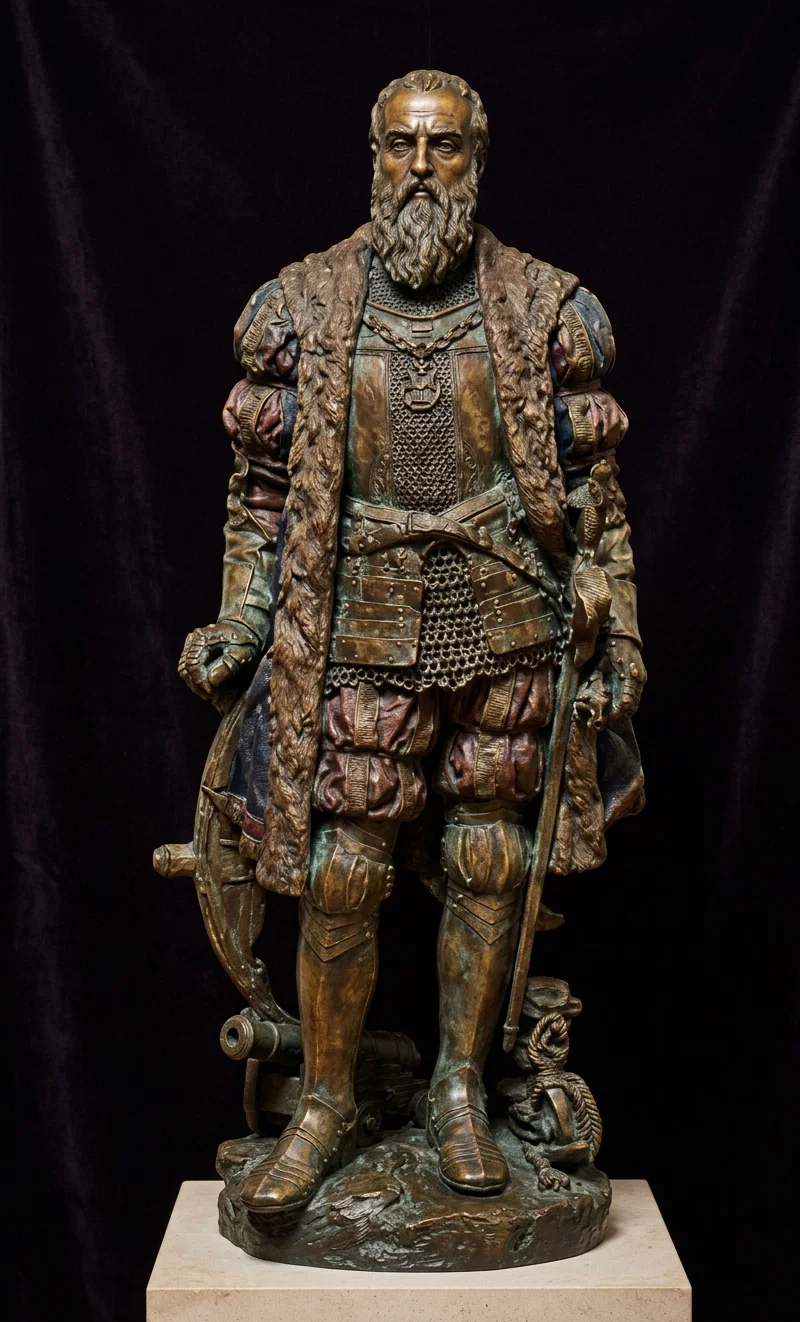
STATUE OF VASCO DA GAMA IN LISBON
July 8, 1497, Vasco da Gama embarked at Lisbon with four ships for a voyage to find the way to India by a western route. In seven days they arrived at the Canary Islands. A fog scattered the flotilla, and they united at Cape Verde. They were three months in reaching St. Helena, and November 19 they saw the Cape of Good Hope, or Tormentoso, both names verified, after battling three days with wind and waves. They rounded the Cape, November 22, and anchored in Mossel Bay. Here calm weather kept them until December 7. On leaving this place, their route changed from the known to the unknown. Reaching Inhambra and Quilimane, on the west coast of Africa, they thought they had reached the place all desired. After they learned differently, they captured some Moors, whom they forced to act as pilots. On April 14 they arrived at Melinde, and on the twenty-fourth set sail for Calcutta. On May 17 they sighted India, and on the twentieth anchored in an Indian port, some distance from Calcutta.
From this place they sent a man to Calcutta, who caused great surprise. The people took him to the house of a Moor who spoke Portuguese, Spanish, and Italian. This man, on seeing the Portuguese, said, “Whom did you bring here?” Great was the surprise of the Portuguese to hear his native tongue in that land. This Moor accompanied the man aboard, and on arriving, said, in Portuguese, “Good venture! Good venture, many rubies, many emeralds. Many thanks you must give to God, who brought you to a land where there is so much riches.”
Great was the happiness of Vasco da Gama in hearing these words in his own tongue. Eleven months he had fought wind, waves, fears, and mutiny, and to hear these words brought tears of rejoicing to the eyes of all. Well they might rejoice for “a great act,” wrote another, “finished, to be realized not only for Portugal, but for all the countries of Christendom.”
Many times King Don Manuel climbed the mountains of Cintra, a few miles from Lisbon, to look for the sails of Vasco da Gama, thinking of the glory to the name of Portugal. His return was hailed with great rejoicing. He was given three hundred dollars as a donation, a heritage to himself and posterity of a rental of sixty dollars a year in one place, one hundred and thirty dollars in another, forty dollars in yet another, and seventy dollars by the king. He was also named Admiral of the Indian Sea. The Portuguese raised a monument in his memory, and a statue in the Geographical Society, which is shown in the illustration. On the four hundredth anniversary, money was coined in honor of the event.
In 1498 ships went to America, and in 1500 Pedro Alvares discovered Brazil. In 1519 a Portuguese, whose name in English is Magellan, having left Portugal and connected with Spain, left Europe for the first circumnavigation of the globe. Nov. 27, 1520, he passed through the Straits of Magellan.
Japan was first visited by the Portuguese, says the history of P. Chagas, Volume VI, and some say that they were the first to discover Australia. They furnished the name “China,” and “Mandarin” comes from the verb mandar, meaning “to send.”
The everlasting gospel is sadly needed by the more than nineteen million inhabitants of Portugal, its islands and possessions in east and west Africa and India. May God hasten the day when this shall be accomplished.
Carcavellos, Portugal.