Mission work in Sierra Leone upon organized plans, began about the year 1792, when the first settlement was made on the present site of Freetown, by the Baptists and Methodists.
The negroes who had left the slave plantations in the Southern States during the Revolutionary War, and associated with the British army, went to Nova Scotia, expecting homes to be given them, upon promises made; but never realizing the fulfilment of the promises, they became dissatisfied, and applied to the British government to send them to their native land.
The request was granted, and in the early part of 1792 several ship-loads landed in Sierra Leone. Some of these had become Baptists, and some Methodists, while in America, and immediately upon their arrival in Africa, they organized, and at once built churches. The Methodists have made some advancement, and have several churches. Here in Sierra Leone was the first effort made to plant the gospel in West Africa, but now mission stations may be found all along the coast, from the Bight of Benin to Senegal.
The Church Missionary Society
Probably the first systematic organization for real missionary efforts made in West Africa, was organized in England in the year 1799. The society took the name, The Church Missionary Society for Africa and the East.
The question at once arose, in what part of Africa should they begin work. Circumstances pointed out that West Africa should first be entered. Probably the greatest inducement to begin on the west coast was brought about by a Scotch missionary, a Mr. Brunton who had performed some labor among the Soosoos.
As Mr. Brunton had acquired the Soosoo language, he offered his services to the Church Missionary Society, and was employed by them to prepare a grammar and vocabulary, and such other books as could be used among the natives.
At the African academy at Clapham, England, were several Soosoo boys, who had been brought from their native land to be educated. When portions of Mr. Brunton’s books were read to them, they understood them perfectly. Thus the accuracy and value of his writings were fully tested.
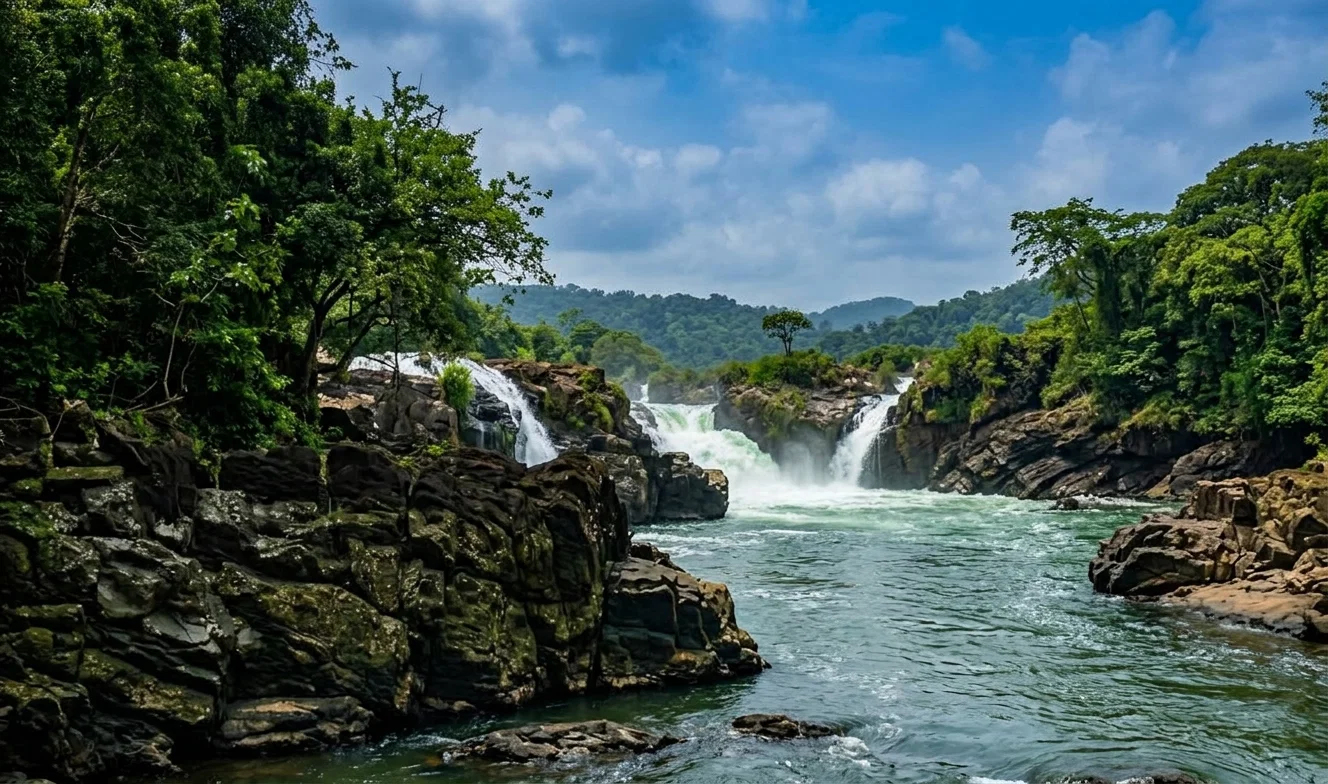
KIRIMA FALLS, FREETOWN, SIERRA LEONE
This was the first effort ever made to reduce the native languages of West Africa into writing, the Soosoo language being largely spoken in the territory lying to the north of Sierra Leone, and understood by the Foulah and Mandingo natives, and the vernacular tongue of the country of Jollonkadoo (a large kingdom in the mountains on the head waters of the Niger River).
The next step taken by the Church Missionary Society was to find suitable men to go to this dark land, to open mission stations. This was no easy task. Calls were made throughout England for men who were willing to take up the work of the Lord in this distant land, which meant a life of sacrifice, hardship, and perplexities. Bishop Ingham in his book “Missionary History of Sierra Leone” makes the following statement: “Men, however, were not to be found. The climate of West Africa was known to be generally fatal to Europeans; missionary work was known to be difficult and trying, even under the most favorable circumstances; and an opinion prevailed very extensively that the negroes of West Africa were by nature so nearly allied to beasts that all attempts to elevate them in the social scale must prove fruitless, and all attempts to convert them to Christianity must end in grievous disappointment.”
Bishop Ingham here makes a forcible comparison. He says, “At the time of which I am writing, our country was waging war in another part of Africa, against the great military despot who had usurped the supreme authority in France.
“Sir Ralph Abercromby had landed an army in Egypt to oppose the plans of eastern conquests that had been formed by Napoleon Bonaparte. For this expedition there was no difficulty in procuring volunteers. Thousands were willing to die in defense of their king and country. But not one came forward to risk his life in western Africa, in defense of the Christian faith.”
All efforts having failed to find men willing to face the difficulties necessary to be met among the tribes of western Africa, the Society turned to Germany, the birthplace of those noble defenders of the faith of Jesus, Luther, Melanchthon, and other faithful men to the cause of God.
In the city of Berlin there was a school to educate young men wishing to enter the missionary field. At the time that the missionary society for West Africa became acquainted with this institution, there were only six young men in training.
Correspondence was opened at once with the professor, Rev. John Jœnick, to secure help for the new missionary society in West Africa. Two young men out of the six were ready to heed the call, Melchior Renner, a native of the Duchy of Wurtemberg, and Peter Hartwig, a Prussian.
They at once went to England, and for some time studied the Soosoo language at the school of Mr. Graves at Clapham. In 1803 they returned to Germany and received ordination after the order of the Lutheran Church. On their return to England, they sailed from Portsmouth, landing in Freetown, Sierra Leone, March 8, 1804. The next missionaries, three in number, were also secured at the same school in Berlin. They were Gustavus Nylander, a Pole, Leopold Butscher, a Suabian, and John Prasse, a native of Lusatia. They sailed from Liverpool on the twelfth of February, 1806. They soon encountered a severe storm, and were stranded on a sand-bank off the coast of Ireland. The Lord saved them, and on April 22 they sailed again from Bristol.
The vessel stopped at Falmouth, and waited for some time to be taken under convoy. While the missionaries were on shore at Falmouth, the convoy came in sight, and without notice or warning the captain set sail.
The young men secured a small boat, hoping to reach their vessel, but everything seemed against them, and they were compelled to return to Falmouth. No sooner had they reached the shore, than the wind suddenly changed, and the whole fleet was compelled to return to Falmouth, and the young missionaries were, by God’s special providence, permitted to get on board again.