Philippine Islands

7%

Review and Herald Publishing Association · Washington, D.C. · May 10, 1906

FromReview and Herald, Vol. 83, No. 19.

Read the full edition

Philippine Islands

E. H. GATES
MANILA, being the capital of the Philippines, is worthy of a little consideration. It is located on the east shore of the Bay of Manila, in the western part of Luzon, the largest island of the group. Its population is about two hundred and twenty thousand. It is located on a low, flat land, which gives poor drainage. Until American occupation the city was indescribably filthy, it never occurring to any one, seemingly, that it was necessary to keep things clean. But in the past few years great changes for the better have been made. The American government is spending vast sums in improving the condition of things, both in the city and in the country.
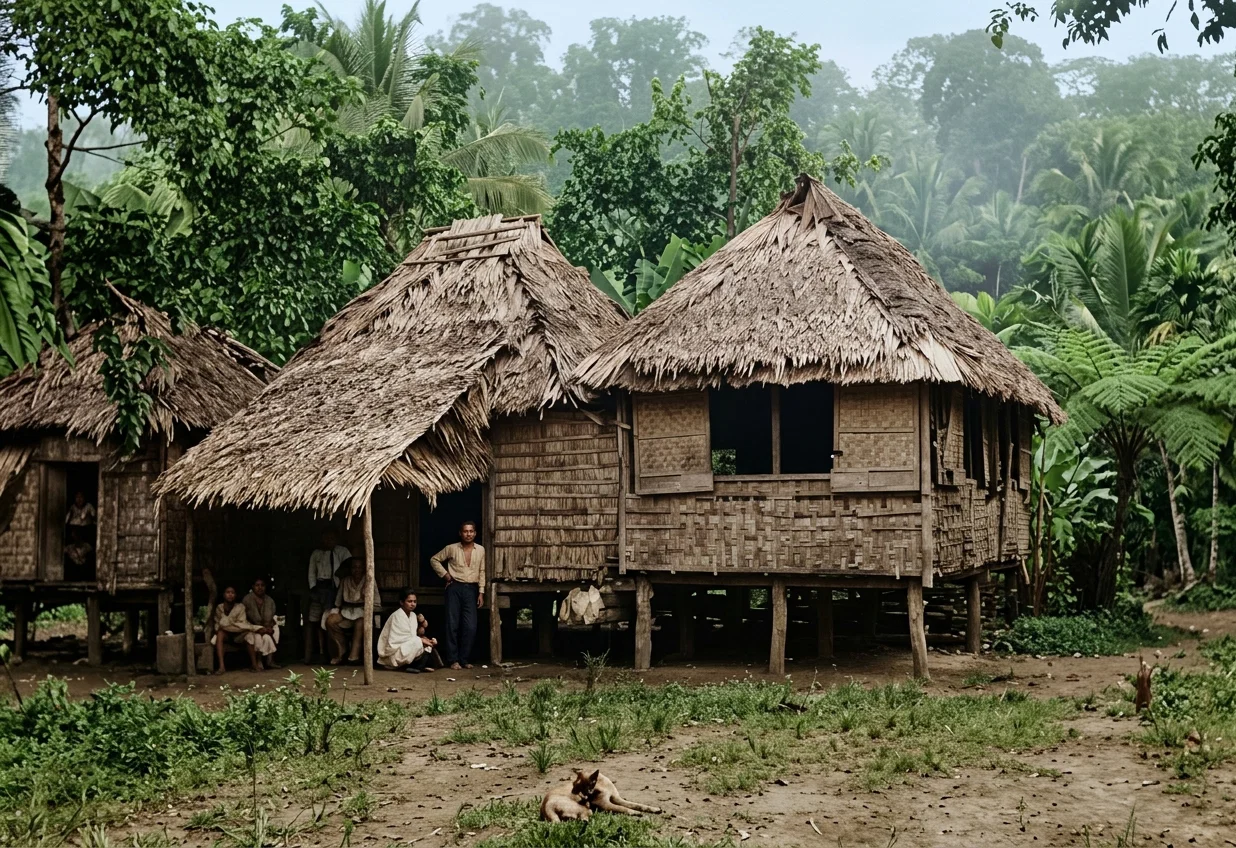
A NATIVE HOUSE
A NATIVE HOUSE
Manila has been the capital of the archipelago for the past three hundred and thirty-five years. From the time of the discovery of the group it was nearly fifty years before anything was known of Manila by the Spanish. In 1571 Legaspi transferred his government from Cebu to Manila, and declared it to be the capital of the Philippine Islands, and proclaimed the sovereignty of Spain over the entire archipelago. At that time the city was governed by two princes bearing the Malay title of rajah, and was a city of considerable size. Legaspi also began the building of the walls of the city, which, however, were not finished till 1590. These walls still stand, apparently as strong as ever. At one time it was decided by the American government to break down these walls, and the work was even begun; but finally on account of the opposition of some because of the historical associations, the work ceased. The moat, however, outside of the walls has been filled up, and in time the space occupied by it will be made a public park and promenade. This will add much to the beauty of the place. Everything pertaining to the walls and the city has a distinctively Spanish and medieval appearance. There are the immense gateways, the draw-bridges, and the sally-ports; for it must be remembered that this city had to be in constant preparation for attack, from Chinese and Moro pirates, as well as from Portuguese and Dutch enemies.
The view to the westward from the walls at sunset is very fine. The sun, as it sinks into the bay, burnishes the sea and sky with great bands of gorgeous color, and forms a picture never to be forgotten. Manila in its restricted sense implies the part known as the Intramuros, or the walled city, which is probably less than half a mile square.
The streets are all quite narrow, and the houses are built contiguous to the street, there being no front yards. On account of the danger of invasion from their enemies, the walls of the buildings are all very thick, with heavy iron bars to the window. They resemble forts more than homes. The prevailing style of architecture is that of the Spanish-Moorish. In order to withstand the typhoons to which they are periodically subjected, the houses are built low, and on account of the numerous earthquakes, they are solidly constructed. The roofs are usually covered with heavy and picturesque tiles, but corrugated iron is being substituted for them to some extent. In the houses of the better classes, a portion of the lower floor is used as a stable and carriage house. In the interior of the houses are small open courts called patios, into which all the rooms open. By this means space was economized, and everything made snug and compact in case of an attack.
The most notable edifice in the city is the Cathedral. The building was first erected soon after the city was founded, but the frequent earthquakes have several times necessitated its entire reconstruction. The present building is built on the site of the one destroyed in 1863. It is a fine building, very heavily built, and cost about one hundred thousand pounds. The archbishop of Manila celebrates mass in this building, and the splendor of the service is equal to anything of the kind I ever saw. The music at the celebration of mass is superior to any music I ever heard in a Catholic church before.
Within the walled city are eleven other churches, one or two of which have stood during the earthquakes that have leveled almost everything else in the city. The palace of the archbishop, many convents and monasteries, the university, a number of schools and colleges, the Palacio (palace), now used for offices of the government as well as of the municipality, are all within the walls of the city. Formerly large numbers of Spanish friars occupied the buildings owned by the church, but many of them have since gone to Spain and Mexico. Much of the property in the city is owned by the friars. These religious orders are immensely rich. Vast sums have been spent in building the immense numbers of churches both within and without the city, for which the people have had to be taxed.
Outside of the walled city I have never seen a city where it is so easy to get lost as it is in Manila. The streets run in any and all directions, and are generally crooked and narrow. Most of the sidewalks scarcely admit of two persons walking abreast. Church buildings are seen every few squares all over the city, and are generally large, massive structures, having been built almost as much for fortresses as for religious uses. One of the most recently built is the church of St. Sebastian, or, as it is usually known, the “steel church.” On account of the liability of earthquakes, this one was built wholly of steel, which was shipped from England in sections. The cost must have been very great.
Scattered through the city are small open spaces hardly large enough to be called parks, which are known as plazas. The streets and plazas generally have names suggestive of Spanish and Catholic influence. The names of some of the streets are as follows: Dolores, Miseracordia, Urdaneta, San Gabriel, San Pedro, Madrid, while among the plazas are Plaza de Cervantes, Plaza de Espana, etc. The city has a small botanical garden, and a fine driveway and promenade along the old sea wall, called the Luneta. Here on pleasant evenings are given army and constabulary band concerts,which are very popular and largely attended. On the Luneta many tragedies have been enacted, as during the Spanish régime it was used as a place of public execution. On account of the great power of the archbishop of Manila, any one falling under his displeasure could, with no chance of appeal, be taken to the Luneta and shot to death. A few fairly good statues adorn the public places, among them being those of Magellan, the discoverer of the group, Queen Isabella of Spain, and that of Legaspi and Urdaneta on the Luneta.
The houses of the working classes are generally built of bamboo, and thatched with nipa palm. Some of these are very neatly built, and are as comfortable as any other houses. But during the typhoons that visit the archipelago, these light structures go down by the hundreds.
As far as the temperature is concerned, Manila is fairly comfortable. When the time shall come that Manila has good drainage, there is no good reason that Manila may not be a fairly healthful place for our missionaries. All over the city schools are being established where English is taught, and considering the length of time since their establishment, it must be acknowledged that many excellent changes for the better have been made. While a little has been done to teach the students the dignity of honest labor, much more should, and probably will, be done.
If the present plans shall be carried out, within a few weeks we shall have a missionary and his wife in this important center. Brother and Sister McElhaney, of Australia, are expecting to start to-day (March 7) for that field, and I am sure the prayers of many will follow them. Brethren at home, it is no child's play to go into such a field as the Philippines. While we have no fears for their safety, we know there will be difficulties innumerable to meet. But God will give success as he has done in every other field where the truth has been planted in our foreign mission territory. It should be a matter of great rejoicing that we are permitted to occupy one more post, this time almost on the confines of China. While all our brethren and sisters can not go to the front and occupy a position on the “firing line,” the same reward will be given to those who faithfully sustain the foreign missionaries by their prayers and means as is given to the soldiers who meet the enemy on the battle-field. So let your prayers go up unceasingly for those who shall soon be in the thick of the fight in the Philippines.