Earthquake Experiences

4%

Review and Herald Publishing Association · Washington, D. C. · May 3, 1906

FromReview and Herald, Vol. 83, No. 18.

Read the full edition

Earthquake Experiences

The Pacific Press Plant Wrecked
Last Wednesday we received the first detailed information concerning the results of the earthquake to our institutions on the Pacific Coast. A letter written the day of the disaster, accompanied by photographs, conveyed such particulars of the catastrophe as could be given in reasonable space. The mental strain under which this communication was prepared may be appreciated in a measure from the fact that while confronted with the desolation wrought by the main shock, there were not less than six additional shocks felt while this letter was being dictated. We know that all our people will read this statement with painful interest. It runs as follows:—
“MOUNTAIN VIEW, CAL., “April 18, 1906. “To the Officers of the General Conference.
“DEAR BRETHREN:
You have doubtless learned through the papers and from telegrams of the appalling disaster which visited the Pacific Coast this morning. We hasten, however, to give you definite information at our earliest opportunity, knowing how anxious you will be to learn how the Pacific Press, among other institutions on the Coast, has suffered. We have the following telegram written, and will send it as soon as the telegraph lines are sufficiently repaired:—
“General Conference, Takoma Park Station, Washington, D. C.
“Cities and towns on Coast largely wrecked by tremendous earthquake five fifteen this morning. Pacific Press building practically ruined. Machinery mostly safe. No lives lost. Great calamity. Need counsel and help. Particulars by letter.”
“Our information up to the present is meager except from our own immediate surroundings. We will tell you briefly that which we know, and shall be able to write more details in a day or two. However, words can not describe the experience, nor can the loss in property and life be estimated. The loss of property is probably almost beyond computation.
“At precisely fifteen minutes past five this morning we heard the awful roar and rumble of the earthquake, and the shaking began. It lasted probably about one minute, and when it was over, nearly all brick and stone buildings were pitiful wrecks.
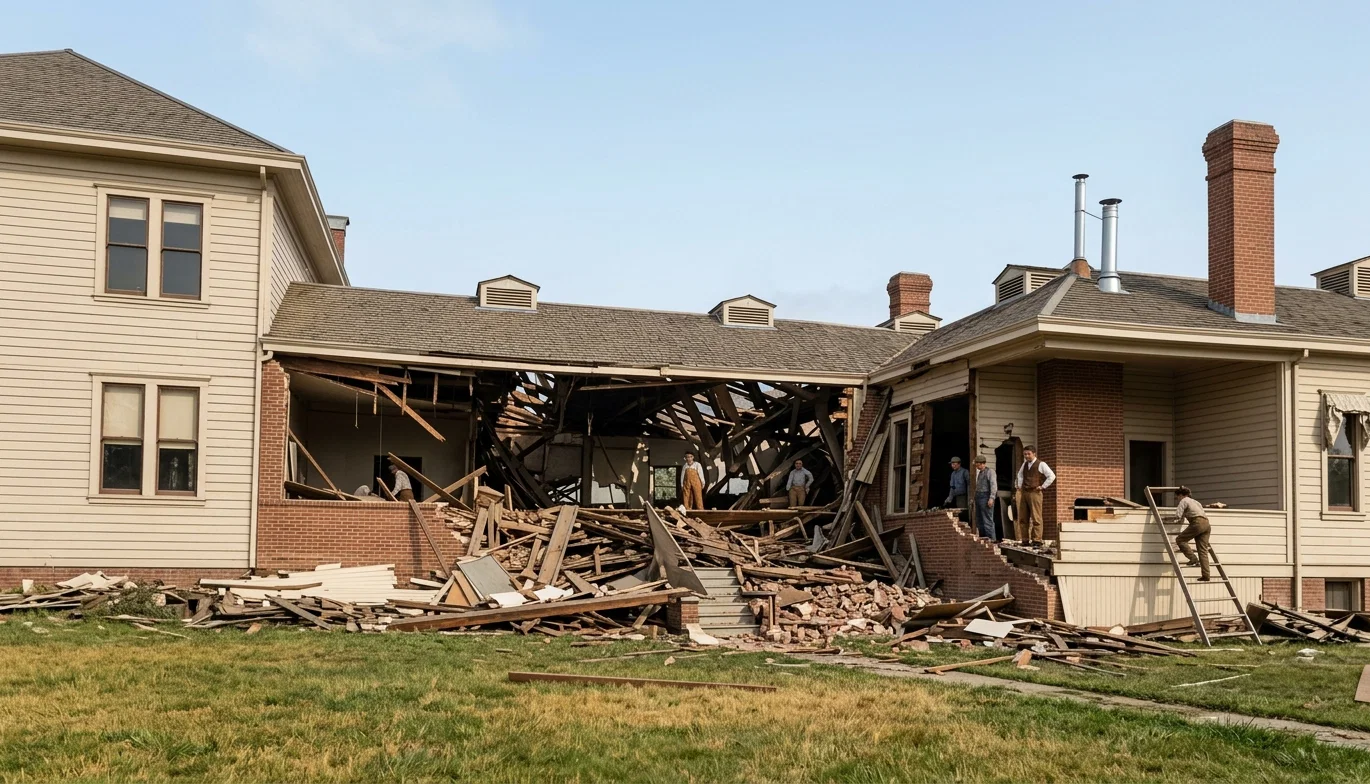
WEST END OF PACIFIC PRESS OFFICE AFTER THE EARTHQUAKE
“Here in Mountain View, the post-office, the largest general store, a rooming-house and restaurant, and a large brick building under construction were smashed together into a heap of ruins. A large saloon and theater across the way also crashed into a shapeless heap.
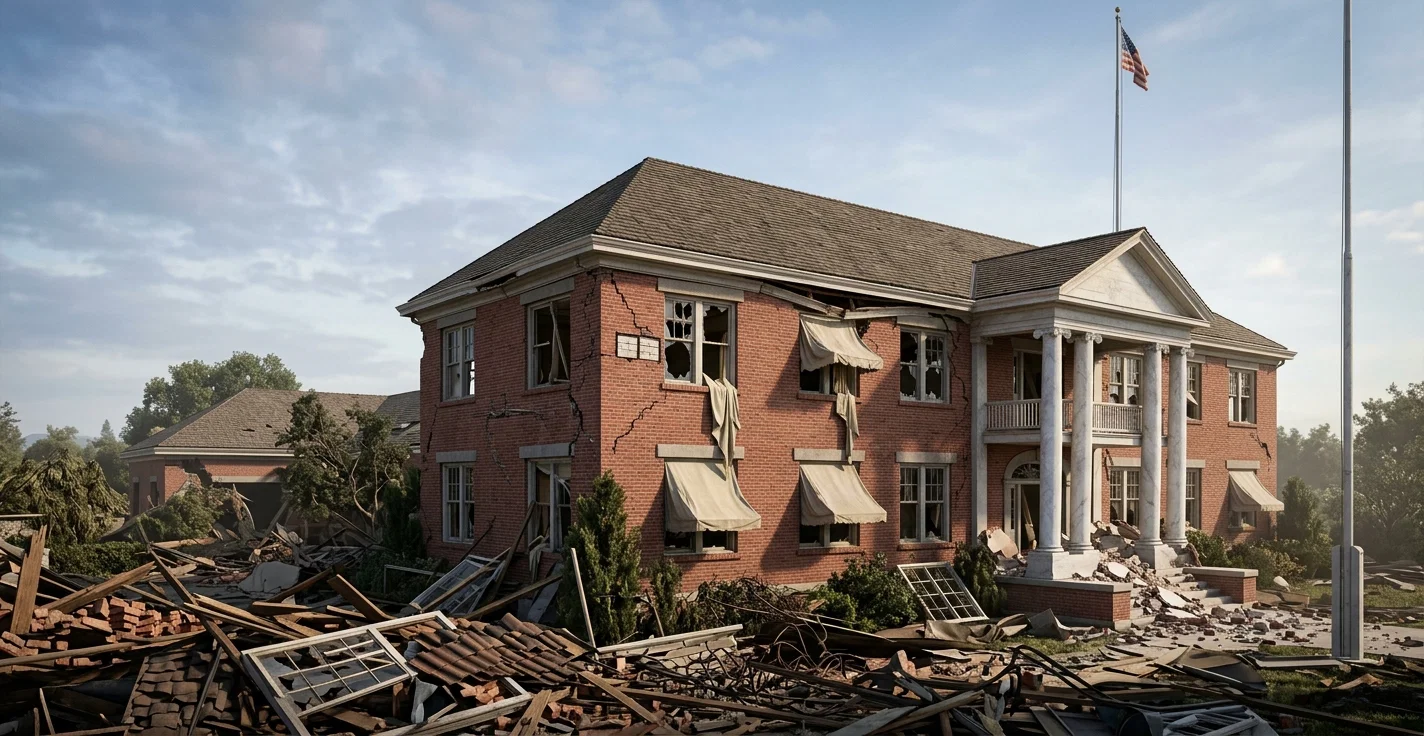
EAST END OF PACIFIC PRESS OFFICE AFTER THE EARTHQUAKE
A furniture store was so demolished that hardly two bricks were left hanging together, and there is not so much as a piece of a wall standing. The large fruit exchange, and many other buildings were also wrecked. Nearly every house in town lost one or more chimneys, and even the strongest and best houses were moved from one to six inches on their foundations. The water-tower which supplied the town, fell with a tremendous crash, and is only a shapeless heap of splinters. Scores and scores of water-towers and windmills are demolished.
“There is no evidence that Mountain View has suffered the worst. From towns all around we hear that the devastation has been fully as complete as here. Stanford University is in ruins. The chapel, which cost two hundred thousand dollars, is a part of the heap of waste. San Jose, eleven miles southeast, which has a population of about thirty thousand, is very largely leveled.
The Hotel Vendome fell, burying many sleeping inmates beneath the ruins. Up to the present the bodies are still being removed. Nearly the whole city, with the exception of strong, low frame buildings, is a shapeless wreck, and a portion of the city is on fire.
“The Agnew asylum for the insane, six miles from here, is a total wreck. Nearly all the inmates were buried in the debris. Seventy-five not seriously hurt escaped, and one was caught in Mountain View a few minutes ago. Up to two o’clock a hundred bodies had been removed from the wreckage.
“All the wires are down, so we can not hear from towns farther away. No trains can get nearer San Francisco than San Mateo, for the track is piled high with the wrecked buildings. Telephone connections have just been restored with central at Oakland, but we are unable to get connection with any private residences. Central informs us that San Francisco and Oakland are wrecked beyond description, and that probably all the rumors are true. Quite a large section of the city is on fire, and great clouds of smoke are pouring down over this valley forty miles away. We hear that it is impossible to hire sufficient conveyances to carry away the dead fromthe streets of San Francisco. This may be wild rumor, but it is all we have at the time of writing. This we know, if San Francisco was shaken as this section was, few buildings are standing. Naturally we would fare much better than such a town, for the most of our buildings are just one-story frame structures.
“Your hearts will be made sad as we tell you of the damage to the Pacific Press. The building is practically ruined. Only a portion of it has fallen, but the rest of it is so strained and wrecked that it will have to be taken down. Of course the ground floor and the foundations are all right. Fortunately the machinery was in the one-story section, the roof of which remained standing. Both ends of the building fell. The corner near the manager’s office and the editorial rooms is split off, and stands in a very precarious position. The libraries and bookcases fell. Much of the plaster was shaken off the walls. The books were emptied from their bins, and nearly everything movable was thrown into a heap. Fortunately, little damage was done to the machinery. It all being on the ground floor and strongly anchored, it stood the shaking very well. The linotypes were probably ruined. A brick wall fell on them, and smashed them both seriously.
“Fortunately, the water-towers remained standing. It seems almost a miracle that they did. The engines also are in working order. Of course the brick chimney fell. No brick chimney could stand such a rocking; in fact, nearly everything made of brick went to pieces. We feel very thankful indeed that so much can be saved from this wreckage. The books are mostly all right, and by propping up portions of the building a part of the work can go on. But the loss is a great calamity, particularly coming to the Pacific Press as it does after two years of financial struggle following the moving from Oakland to Mountain View.
“A meeting was immediately called, and a committee was appointed to write up particulars and furnish them to the General Conference, to Brother and Sister White, and to others who will be particularly interested. It was also decided to send telegrams to several places.
“We do not know what the extent of this disaster may be, nor how many of our institutions along the coast may have suffered. We hope that it is comparatively local, and that the St. Helena Sanitarium and the sanitariums south have escaped. We dread to hear from St. Helena and Healdsburg and other places where, if the earthquake was as severe as here, many at that time of morning would surely be buried beneath the ruins of those old buildings.
“We are hardly in a condition to write you of this catastrophe, and it seems almost impossible to put it in words. Neither is it easy to write when the house is being shaken by earthquake tremors every few minutes. The building has been shaken no less than six times while this letter was being dictated. It is probable, though, that these tremors are the return waves of the great shock. We hope that the worst is over.
“As we have walked around the ruins of the Pacific Press and seen what devastation has been accomplished in only one short minute of time, we feel that the weight of this loss is almost too much to be borne just at this time, and naturally we ask ourselves the question whether our people all over the United States, as they hear of this calamity, will not come to the rescue and help to restore this institution. Only a few months ago in the very chapel which is now such a wreck, the ‘surprise party’ movement was started. It has occurred to some, and particularly to us who are outside the Pacific Press, that this would be a timely opportunity for the wave of liberality to roll back from the East to the West in behalf of a loyal institution which lies in ruins.
“Of course we can recover nothing from insurance companies for this damage. It is classed as one of the acts of God for which the insurance companies are not liable.
“We do not make this suggestion to the General Conference definitely as a request, for we do not know how great the needs may be in other places; but if conditions would justify such a course, it would be a great blessing if the facts concerning this situation could be placed before our brethren, by special communication, in all the churches, and if they could be asked to come to our relief. And not only do we need financial help, we need counsel. We have invited Brother and Sister White, by telegram, to come to Mountain View, if the needs are not greater elsewhere, and advise as to the course that should be followed. The managers are endeavoring to know what the Lord wants them to do in this time of distress, and every member of the Board will stand loyally by the counsel of the Lord. We are very thankful that no lives were lost. Many people were in danger in their homes, from chimneys falling through the roofs, but there are no serious casualties among our own people.
“Petitioning most earnestly an interest in your prayers that we may be guided by the Lord’s unerring counsel, we are, dear brethren,
“Yours in Christian love, “M. C. WILCOX, “E. R. PALMER, “I. O. CORLISS, “W. T. KNOX, “E. A. CHAPMAN, “Committee.”