The people of Japan to-day are, with small exception, adherents of three systems—Shintoism, Buddhism, and Confucianism—with no distinct demarcation between the three in the minds of the common people. Many worship deities, and observe rites, without knowing or caring whether they are of the Buddhist or Shinto kind. So far as the differences between Shintoism, Buddhism, and Confucianism are recognized however, Shintoism is the cult for the living, Buddhism is for the dead, and Confucianism is the moral code. For worldly prosperity, people pray to Shinto household gods, or at Shinto shrines; for things pertaining to the dead, or for prospect of death and the future life, they pray to the Buddhist idols, or go to the Buddhist temples; for moral guidance they study the literature of Confucianism, since neither Shintoism nor Buddhism has for the Japanese people any moral import.
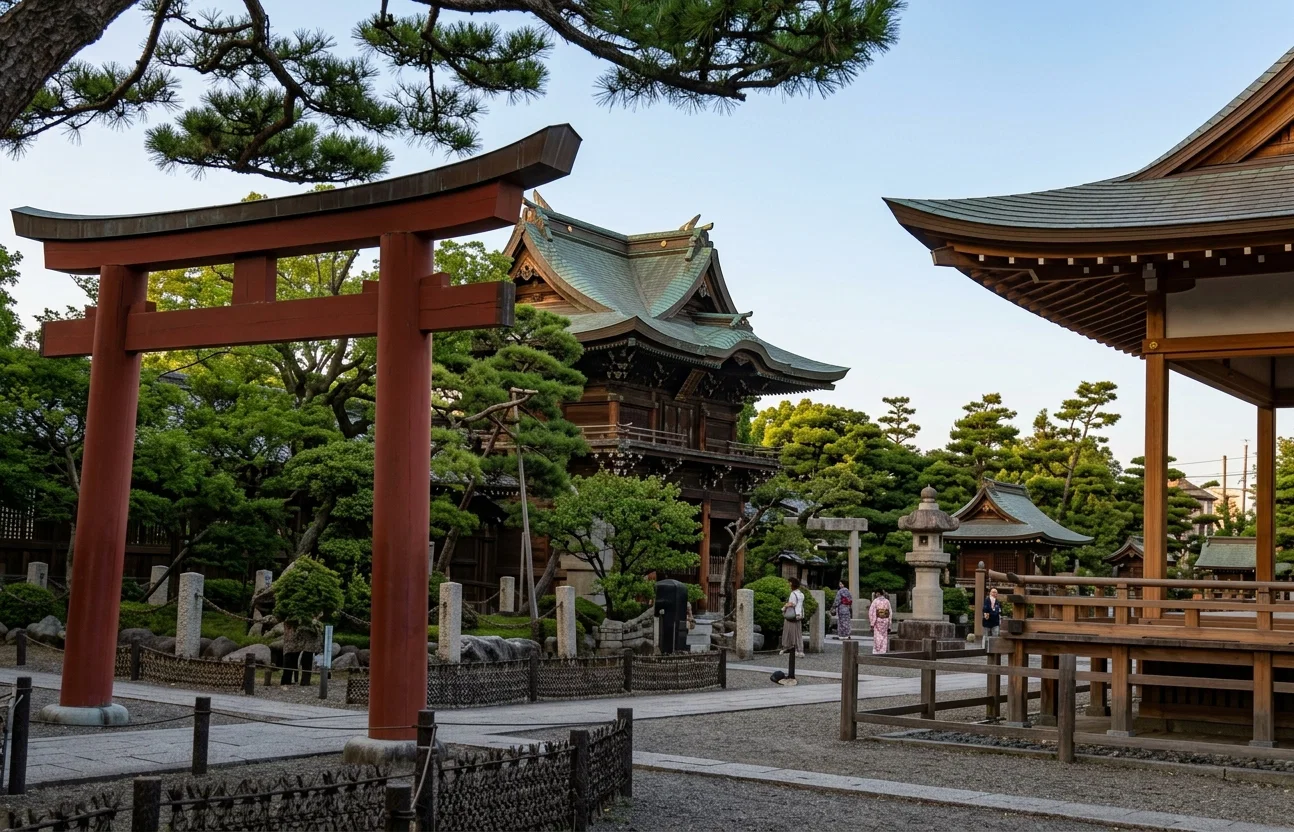
SHINTO GATE, AUSAUKSA PARK, TOKYO
The two classes of temples are to-day everywhere seen. In Tokyo you will not cover a distance represented by two or three blocks, without passing some temple, with its beautiful and neatly kept grounds. If it is a Shinto temple, there is always over the path in front a peculiar square, high gate, and as the worshiper steps up in front of the shrine to worship, he throws his money into a large receptacle, covered by grating, and then pulls a rope, which hangs within easy reach of the worshiper. This rings a coarse bell above him, that is supposed to attract the attention of the gods. The individual then bows, or prostrates himself, according to how devotional his frame of mind, or how great his needs, and then mumbles his petition.
If it is a Buddhist temple, the gate is different, and after the cash offering, the worshiper attracts the attention of the gods by clapping his hands twice—never three times, as that would be very improper.
When we contemplate the immense amount of money that must have been consumed in the erection of all these temples,—for there are many, many of them, and some are most elaborately carved, and covered with gold,—it is no wonder that the majority of the people must live in what seems to us like poverty. The plainest and simplest temple, compared with the common house of the people, is very elaborate and beautiful, and it is almost invariably surrounded by grounds which are more or less extensive, while the homes of the common people are rarely surrounded by any ground.
The “medicine god,” usually at the right of the central shrine, is found in all the temples that I visited, and is so well patronized that often the features, and many times its members, have been worn away by the hands of the supplicant. The hand is rubbed over the god, and then immediately applied to the corresponding sick member, for relief from suffering, or, as seemed apparent by the acts of some, as a sort of security against future ills. One poor, ignorant mother that I chanced to observe, came up to the god, leading two children, and carrying one. She rubbed her hand over the god, and then over each of the little tots in turn, and also over herself, and then moved on, well satisfied with what she had done for her family.
In almost every house, if we do not find the complete seven gods of the household, part Shinto and part Buddhist, we are sure to find the two—the god of wealth, seated on two sacks of rice, and the god of pleasure, with his happy, jovial expression of the face.
Not all the people by any means go to the temples to worship, or pay much regard to the household gods; but at times of death, unless the person is a Christian, the priest, who controls the cemetery rites, must be called to dispel the evil spirits, which are supposed to congregate about a corpse, conduct the funeral ceremonies, conduct the spirit through the realm of shades; and, lastly, prayers for the dead must be said by the priest. For several successive days he comes to the house to burn more incense and say more prayers, and after that he comes once a week, for a year. At that time the deceased is supposed to have entered paradise, and become a Buddha. Now he must be honored as a deity, and the priest offers him food, and gives him news of the home whence he departed. The relatives must also have a part in the service for the dead. They must make visits to the temple where the ashes are buried, on the monthly recurrence of his death-day, for a year, to bring food and flowers, and to pray that he may truly be brought into paradise, and that the dead may keep in peace and prosperity the home from which he departed. These acts and ceremonies for the dead are probably more universally carried out than any other of the Buddhist requirements. So, although nearly the whole population is Buddhist, it is in large part only in name.
The people of the country to-day may be divided into three classes, on the question of their relation to the faith: First class, those who are independent or skeptical. They have nothing further to do with Buddhism than to have their dead buried, and, perhaps, prayed for, by the priest. A large portion of those crowding the government classes and two imperial universities, or who have gone forth from them, are of this class. The student class, of whom I met many at my sister’s, Mrs. F. W. Field, since she lives near the Tokyo Imperial University, were very bright, intellectual, promising young people, and also very interesting. To my mind, this is a most hopeful class for the principles of Christianity. They have become too enlightened and too intelligent to any longer trust in the heathen gods and traditions, and are feeling after something better. A very frequent reply for this class to make when asked if they are Christians, is, “Not yet; I do not know, I have not had a chance to study,” showing that they are open to conviction. Second class, those who, though they have no positive faith in Buddhism, yet give alms to the mendicants, support the temples, and occasionally pray to the idols as a mere matter of decency, or with an idea of being on the safe side. Third class, those who endeavor to fulfil14all their religious duties regularly, as prescribed by the priests. They worship the household gods faithfully, and visit the temples regularly, and show the spirits of all dead all due reverence. This class is very easy to recognize, and according to my observations, those composing it are the most ignorant. Taking it all in all, the impression made on the observer is that the day has come when the ancient religion sits very lightly on the Japanese heart.
Christian missionary efforts for the Japanese did not begin until the sixteenth century. The first European landed in that country in 1542, the same year in which firearms were introduced, with which the natives were very much taken; in fact, Christianity to many of them means big guns and powder. In 1549 two Jesuit missionaries and two interpreters landed. Trade flourished in some of the cities, and remarkable success attended the efforts of these missionaries, so that in 1581, two hundred churches, with one hundred and fifty thousand converts, had been numbered. The Catholic faith became exceedingly popular. Temples were changed to churches, idols to the image of the Virgin Mary, and nearly everything that had been used in heathen worship was adopted and utilized in some way in the new religion. In 1583-84 young noblemen were sent to the pope, delivering themselves to be vassals of the Holy See. Converts numbered six hundred thousand (some give the number as high as two million), and among them were princes, lords, generals, officers of the fleet, ladies of the royal household, etc. The missions flourished for a hundred years, when a reaction came, persecution arose, and the priests were driven out, and thousands were martyred for their faith. So in earnest were the authorities in crushing out this religion, that they decreed that never again, so long as the sun should shine, would any foreigner be permitted to enter their country.
For more than two centuries Japan’s ports were absolutely closed to foreigners, until the wonderful treaty made by Commodore Perry, in behalf of the United States, in 1854. While the edicts against Christianity have never been repealed, they were removed from the public edict boards in 1873. Since that time the work of the Protestant missionaries has gradually gone forward. Quite a number of the denominations have churches built, and in some cases they are presided over by native pastors. In Tokyo there is a very creditable and substantial Young Men’s Association building. The Woman’s Christian Temperance Union established a good work among the Japanese Christian women. Several Protestant schools have been established in the larger cities, and are doing a good work. The fact that it was vacation, and the teachers were up in the mountains for their summer’s outing, prevented my visiting these schools and becoming familiar with their methods of work. But the buildings and grounds of such schools, in both Tokyo and Kobe, had the appearance of success.
In some cases the Japanese who accept Christianity must endure a great deal of opposition, if not persecution, from friends and relatives. One little lady whom I met, belonging to the Presbyterian Church, has nearly been disowned by her relatives. She has learned to speak the English very well, and was kind enough to go with me to many places, to act as spokesman for the party. She asked very many intelligent questions regarding the truth, which we gladly answered, and supplied her with the best literature at hand.
It seems to me that God has prepared this field for the present truth in a variety of ways: first, the country is again open to foreigners; second, the English language is required in the public schools, and the people of the better classes are not only willing, but anxious, to learn all they can of the ways of the Christian countries; third, the distribution of literature is permitted in hospitals and such places where people can be reached in large numbers; fourth, the work that other Protestant denominations and organizations have done in establishing schools and distributing the Bible; fifth, above all, the mind of the most intelligent classes is longing for something more satisfactory than Buddhism, is open to conviction, and they are literally waiting for the truth to be brought to them.
THE JAPANESE INTERPRETER
Let us not omit to work and pray for Japan, before what seems to be God’s opportunity is past.