In my first article I stated that from the time when Magellan discovered the group in 1521, no special effort was made to conquer or colonize the islands till the time when Legaspi was sent out in 1564 as the captain-general of the expedition, accompanied by the friar Urdaneta, the leader of the spiritual forces. The object of King Philip in sending out this expedition was chiefly religious. This object is expressed in the monument which stands on the Luneta in Manila, on which are the figures of Legaspi and Urdaneta, the friar bearing aloft the cross, and the general carrying by his side a great sword. In speaking of this matter a certain writer says, “In examining the political administration of the Philippines, then, we must be prepared to find it a kind of outer garment, under which the living body is ecclesiastical. Against this subjection to the influence and interests of the church, energetic governors rebelled, and the history of Spanish dominion is checkered with struggles between the civil and religious powers, which reproduced on a small scale the medieval contests of popes and emperors.”
The work of Christianizing and civilizing the pagans of these islands was placed in the hands of the friars, large numbers of whom were sent out from Spain and Mexico. The letter of instruction given to Urdaneta and the friars who accompanied him in 1564 began as follows: “Very Beloved Sons: You are aware how Filipe, by the grace of God, King of the Spains and the Indies, and our Lord, has been greatly pleased with the news that some brethren of our order are to go with the expedition now being equipped by his illustrious viceroy, . . . to the end that, according to right reason, and the benign counsels of Christian piety, both at home and abroad as will best seem consistent with the purpose of his Royal Majesty, you may control the fleet and troops of the Spanish army,” etc.
In 1565 an order was sent to Mexico, containing the words: “Priests, and a goodly number of soldiers and muskets, so that if the natives will not be converted otherwise, they may be compelled to it by force of arms.”
When we consider the crude ideas of the Catholic Church as to what conversion means, it is not strange that the four centuries of the complete control of the education of the Filipinos has resulted in a moral condition but little if any better than the heathen. Like Xavier in Malacca and India, who counted as converts babes snatched from their mothers’ arms and sprinkled, so these Spanish friars made conversions by the wholesale. One writer says, “The king of Cebu accepted baptism at once. Crowds knelt and were baptized in rows. Where reluctance to accept the new faith was apparent, a large and influential party of the missionary friars were ready to employ force. In fact, one of the burning questions of early friar evangelism was whether it was right to use force in securing conversions to the Christian faith.”
In accepting the Catholic faith, little if any change was necessary in the lives, or in the forms of worship, of the Filipinos. The gods worshiped before the arrival of the friars were similar to those worshiped to-day in Java and Borneo. These were exchanged for the adoration of the virgin and other saints. As I visited the churches of Manila and saw the images before which the people bowed, and then sailed across the China Sea, only two days by steam, and visited the pagan temples of Canton, I could see but a slight difference between the forms of worship. In both there were altars and images, lights constantly burning, paintings on the walls, incense ascending, etc. On the outer walls of some of the churches were images of animals almost identically with those on the walls of the Buddhist temples. One thing that facilitated the conversion of the heathen Filipinos was their love of the beautiful in art as well as music. The Romish priests knew how to use these to advantage. On visiting the Manila cathedral on Christmas day I saw more clearly than ever the power of music and glittering display on the heathen mind. The priests were robed in rich attire, brilliant lights shed their radiance all around, while the ear was regaled with the richest music I ever heard. Almost in spite of himself a person begins to have a feeling of reverence for this heathenish ceremonial.
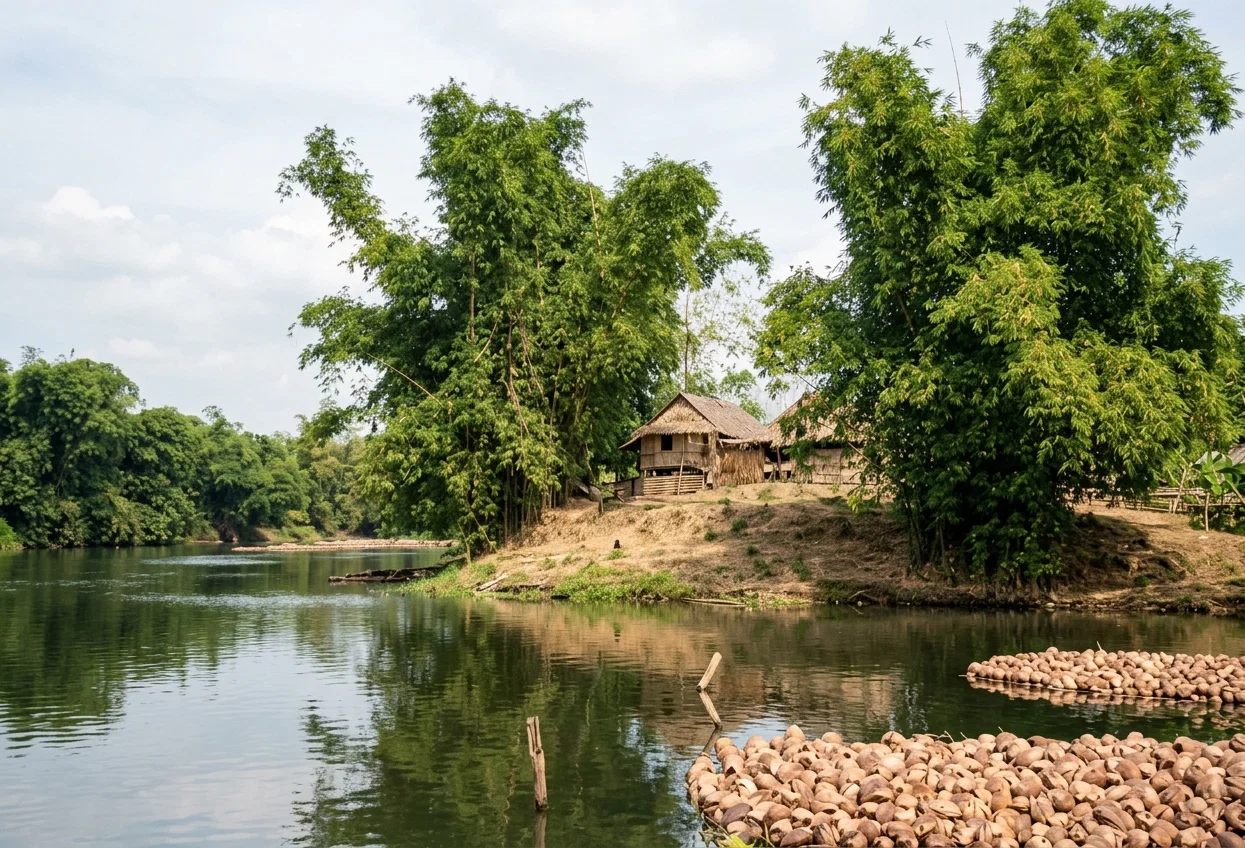
FLOATING COCONUTS TO MARKET ON PASIG RIVER
With the pressure brought to bear from so many sources, it is no wonder that within fifty years from the time of the arrival of the friars, a majority of the population exchanged their heathen deities for those brought by the Spanish teachers. To-day the Filipinos are very religious. Manila might almost be called the “city of churches.”
Within that part called intramuros, or the walled city, which is probably less than half a mile square, there are eleven large churches, including the magnificent cathedral; while in other parts of the city they are almost numberless. These have connected with them large buildings called conventos, the residence of the friars. Many of the friars have left the country since American occupation, but hundreds still remain.
Church feasts are often held in one or the other of the churches. At the time of these feasts, which continue for several days, temporary booths are set up all about the churches, where all kinds of eatables and all manner of trinkets are on sale. But the principal feature of the feast is the gambling booth, which has more patronage than all others combined. At night there is the religious procession on the street. Before that the people gather in the church and kneel in large numbers, while the priest recites his monotonous service. The procession then moves on, carrying flashily dressed images of the virgin and other saints, accompanied by bands of music, torches, illuminations, while the inevitable incense of tobacco smoke from thousands of cigarettes and cigars ascends like the smoke of a great furnace. At certain times in the
year the virgin is decked with the richest apparel, and adorned with jewels, pearls, and diamonds to the value of hundreds of thousands of dollars. At such times the poor virgin is carefully guarded by policemen who look after her financial interests. In the churches I have seen women walking on their knees the whole length of the immense churches, counting their beads, and saying their prayers.
But though the seeds of evil that have been sown for so long time in the Philippines will continue to bear their baleful fruits, it is hoped that a brighter day has dawned. After almost four hundred years in which the Bible has been a sealed book, God’s Word is now as free in this field as in America. The British and Foreign Bible Society and the American Bible Society have agents in this field, with prospects of good success. The agent of the latter society told me that he had himself placed thirty-four thousand copies of the Bible or parts of the Bible in the hands of the people during the past year. Of this matter I will write more fully in another article.