Immediately at the close of the services in Petersburg, Sunday, October 15, Elders Gaede and Wildgrube, and Brother Ising and myself, took the train for Alexandrodar, in the Caucasus, about fourteen hundred miles to the southeast. We had a nice tourist sleeper from the capital until we reached Moscow, where we arrived Monday evening. All seemed quiet here. The next day two of our party had the misfortune, while out buying supplies for the lunch basket, to get left behind, so I had to make the rest of the trip alone. In spite of the slowness of the trains, as they take not less than eighty-four hours to make this trip, our train was behindhand, so I reached Rostov several hours late, and barely had time to catch my train for the latter part of the journey. I found the cars overcrowded. It was my third night out, and I could get no good place to sleep until toward morning; so I fell soundly asleep, and when I awoke, it was daylight. I quickly packed my things. The train came to a standstill, and I inquired what station it was. I was informed that it was Boguslawskaja, the place where I wished to leave the car. It was a long train, and our car was near the rear, away from the station building, so I could not see the name. As I got out, the train pulled off. I then discovered that I had been misinformed, and that it was still fourteen miles to my destination. The station-master kindly allowed me to telephone to our brethren, so they would continue to wait for me at Boguslawskaja. Three hours later a freight-train came along, full of military reserves, but the last car, where the officers were, was third-class. The station-master told me to go back there, and try to get in to ride on to my destination.
As I entered the door, I found a sol- dier with planted bayonet, who asked what right I had to get into that car. I referred to the station-master's recommendation, and by the time the captain made his appearance, the train was already in motion, so it was too late for any remonstrance, and I must remain until the next stop. The captain and I entered into an animated conversation in French, and, as we were nearing Boguslawskaja, the captain told me that although it was against the law for any one to ride with a military train, yet he was glad to have met me. It was from him that I first learned that the entire Caucasian district had been placed under martial law, and that all the reserves had been called out, and even the married men had been suddenly marched off from farm and shop without even bidding good-by to their loved ones. As the men were not the best provided with food supplies, they demolished the restaurants in several stations, to get whisky.
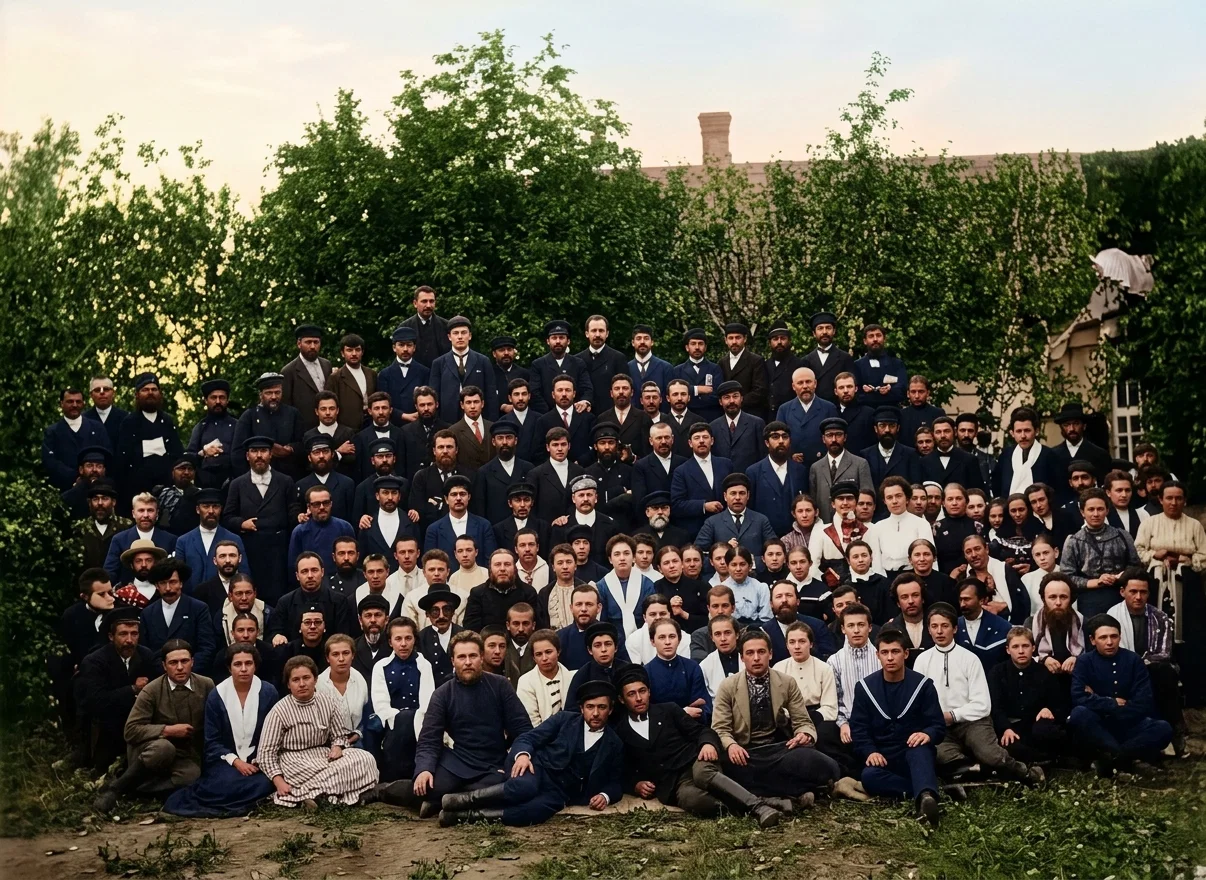
When I reached Alexandrodar, I found the meeting already in progress. The citizens of the two colonies had loaned lumber for the erection of a temporary booth, which comfortably seated the two hundred German and one hundred Russian delegates from the Volga and the Caucasian regions. (From the Azov region north of the Black Sea there was no delegation, as that part of the South Russian Conference was later to have its own local meeting, to form a new field—the South Russian Mission—to date from January, 1906.)
A GROUP AT THE ALEXANDRODAR MEETING
Among the Russian delegates there was a good representation of the native Russian churches in this field (the Russian members have heretofore belonged to the Middle Russian Mission). There were a few delegates from a Russian company of about twenty members, south of Baku, on the Caspian Sea, near the Persian border, in the territory belonging to the German Union District. There were also brethren present, sent by the German company at Suchum-Kale, a port on the Black Sea, south of the Caucasian Range.
The South Russian Conference to-day has about nine hundred and fifty members; the formation of the South Russian Mission from its territory will take from it about two hundred members; but it must not be forgotten that under the new arrangement the Russian Sabbath-keepers living within its borders will become members of the conference, so it will have practically the same membership after the division is made that it has now.
We had experienced considerable opposition among the Russian Sabbath-keepers in the Caucasus with regard to the tithing system. As for years the existing laws made it dangerous for the Germans to meet with the Russians, our ministers could visit the native brethren but very little, and they naturally kept aloof, and many of the Russians seemed opposed to uniting with the Germans in conference membership. Indeed, there was one man present in whose house an opposition meeting had been appointed, to be held a week after ours. As this was my first opportunity to meet openly and freely with our Russian believers, I gave them time for three meetings daily, Brethren Wildgrube and Perk acting as15interpreters. They had opportunity to state their objections, all of which I noted down. But instead of answering them in detail, we began to present to the people from the Bible the principles governing all these questions. As we set forth the tithing system, traced it back to Abraham's time, showing it to be a matter of faith and belonging to the Melchizedek priesthood, the Spirit sent conviction, and by Friday many began to make confessions, and others were glad to confess their mistake on Sabbath, during our experience meeting; and by Sunday morning, when the vote was taken, all the Russian delegates present desired to unite fully with the German Conference. I had also clearly set forth the principles of unity, as given in the epistle to the Ephesians.
We were pleased to have with us Elder D. Isaac, whom the brethren heartily welcomed to his new field in Russia. Elder H. J. Loebsack was again unanimously chosen president of the South Russian Conference. The other members of the committee are H. K. Loebsack, M. Fischer, J. Wuckart, and A. Gondar. At this meeting, we also passed resolutions of thanks to the Russian czar for the freedom which we now enjoy.
The evening meetings being visited by many of the German colonists, we conducted the services for the Russian brethren in a large room near by, and in this manner we accommodated about four hundred persons at these services. This was the largest and best meeting we ever had in Russia. Our collection for the German East African Mission on Sunday amounted to twenty-five dollars; the Sabbath-school collection was about fourteen dollars. Three were baptized at this meeting, among them one of the leading ladies in the colony.
The territory of the East Russian Conference, as the South Russian Conference will be called after Jan. 1, 1906, will extend north of the Caucasus, and up both sides of the Volga River as far as Orenburg, containing about fifteen million people. There will be two ordained ministers, two licentiates, a Bible worker, a nurse, and six canvassers in this district the coming year.
Our meeting closed the evening of the twenty-fourth. We then had but little idea that the trains had stopped running in all parts of Russia outside of the Caucasus district; the only peculiar thing we had noticed was that we did not receive any mail.
In our parting meeting every one praised God for the wonderful liberty enjoyed, and that for the first time Russians and Germans were permitted here to unite in full harmony, their voices praising the Lord.