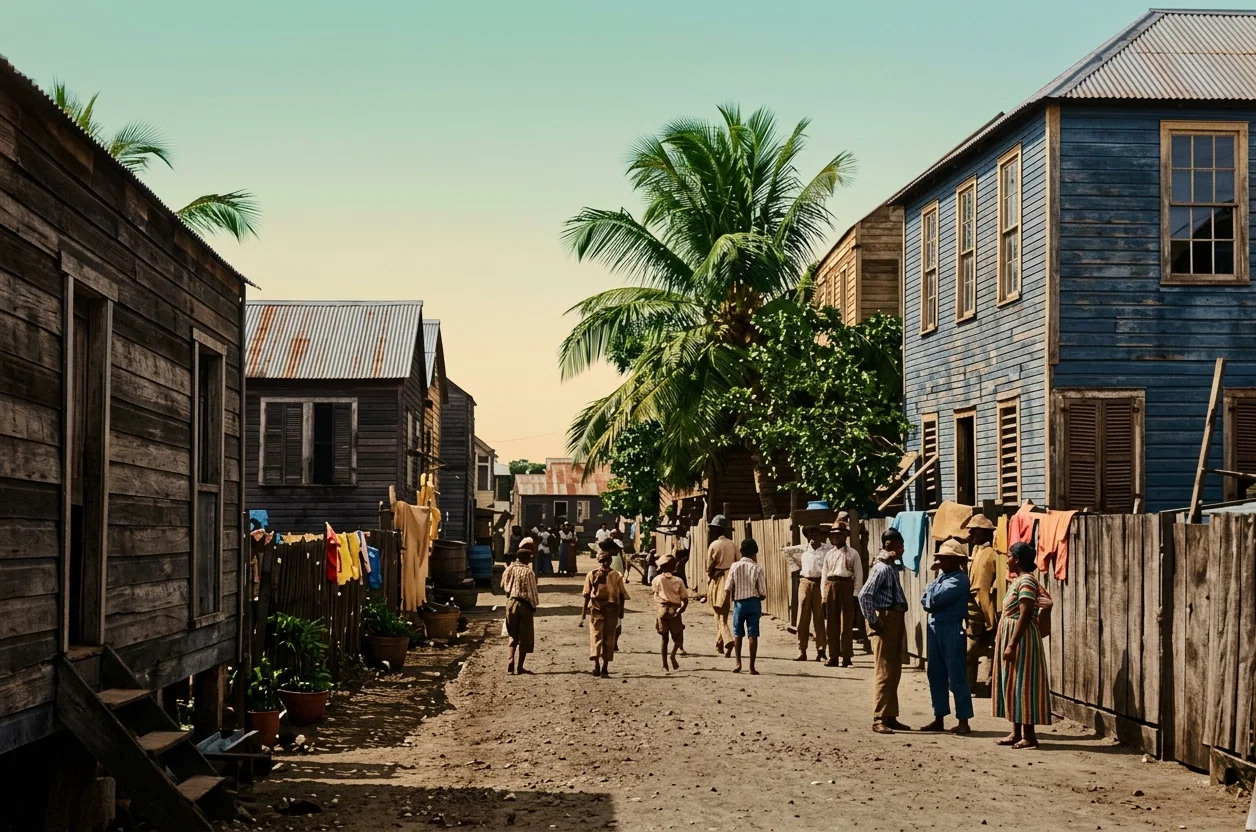
About two hundred years ago, as a logwood and mahogany camp of a company of shipwrecked English mariners, British Honduras began its existence. Having been first discovered by Columbus, in 1502, Spain has from the beginning regarded the settlement as an infringement of her sovereign rights. This made the early history of this colony of wood-cutters rather a checkered one, and their life a precarious struggle for existence. Finally, in 1798, the English obtained the ascendancy over their Spanish neighbors, who from the near-by States had made war upon them, and, under the fostering care of the mother country, they have enjoyed uninterrupted peace.
A BACK STREET, BELIZE
Wood-cutting is still the principal industry of the colony, the rivers being the only highways of commerce. The mahogany logs are floated down in rafts, and the logwood, which is too heavy to float, is cut into short pieces, and brought down in the native dory, or canoe, and loaded on to steamers for the English and American markets.
Agriculture has never made much progress in British Honduras, although rich and fertile lands abound. With most of the people, to raise enough for their own use is all that is attempted. The result is, that, not having enough to supply the market, the home product usually brings as large a price as the imported article. Rice grows here abundantly, and is of the finest quality, yet much the greater part of the rice used is American or Indian. The corn of this country commands a better price than that of America, yet much of this grain used here comes from that country; so also with beans. Yet all these grow well, and might more than supply all demands if greater attention were given to tilling the soil.
Most of the vegetables that grow here are scarce, and, at some seasons of the year, difficult to obtain, and about as expensive as American potatoes, which are four cents a pound; yet they might be raised in great abundance. Cabbage does well in the hills; yet very little is raised, and the imported article sells at from twenty to forty cents a head. In the market it is cut into slices, and sold at three or four cents a slice, to eat out of the hand like an apple. Oranges are plentiful, and of good quality, and are selling now at from thirty to fifty cents a hundred.
Grass does well on the lowland near the city, yet most of the horses are fed on hay brought from the United States. One piece of grass, of perhaps two acres, just outside the city, is the largest I know of. This is cut six times a year, and sells at ten cents a bundle the size of a sheaf of wheat.
Broom-corn does well, as has been proved by experiment, but no brooms are manufactured in the colony, nor in this country, that I know of, and brooms of third and fourth class bring the same price that a first-class article does in the States.
Dry hides are shipped in considerable quantities to the States, and then shipped back as tanned leather; while I am told that the red mangrove, which is one of the best tanning barks in the world, and costs here eight or nine dollars a ton, is shipped to America, where it brings forty dollars.
There are three things to discourage agriculture in this country: first, a lack of roads; second, destroying insects; and, third, a great lack of energy on the part of the people. With plenty of the latter, the two former would be readily overcome.
The city of Belize is almost literally built up out of the sea. All the streets are formed by broken coral rocks and mud taken from the sea, then covered with sand to raise them above tide-water. These streets are carefully cleaned every day, and are smooth and hard. The whole city, too, is built up in the same way, only no broken stone is used except on the streets. The condition of the yards is sometimes very bad.
The government has done a great deal to improve the sanitary conditions. Still, in the poorer portions of the city, where the people are closely crowded together, the condition is still bad, resulting in a great deal of sickness. Otherwise Belize is a healthful place. The low-lying land surrounding the city is sometimes overflowed by the tide-water of the sea, but from this salt water there is no danger. It is only when the place becomes filthy, and rain-water is allowed to stand under the heat of the tropical sun, that sickness is sure to result. Most of the diseases of this country are caused by the wrong, intemperate, and vicious habits of the people. The trade winds, or sea-breezes, as they are called here, which for more than ten months in the year blow steadily from the east, are the great health-giving boon of this country.
Belize has a population of about eight thousand. The remainder of the forty thousand people of the colony live along the seacoast, and on the rivers. They are a mixed population of negroes, Caribs, and East Indians, Spanish, English, Scotch, and Americans. Of these, the negroes largely predominate.
The influence of the clergy over this people is very much greater than in America. As a rule, the word of the minister settles a point of doctrine, without reference to the Word of God. And when God's Word is the basis of an unpopular truth, involving a life of self-denial, and often the loss of position, it requires an earnest determination to obey God to accept that truth. A large number who would really love to study the Bible are hindered by a fear of ridicule if seen attending public meetings. I believe this argument of ridicule, or of a sneering manner, or a slurring remark, is of more force here than in any other place I have ever been. For this reason, the work of the colporteur and the Bible worker should occupy a prominent place in our efforts. A Bible worker, in a kind and gentle way, can visit the people at their homes, and teach them the binding nature of God's Word, and the truths of that Word for this time. After one or two readings with a family, neighbors will be almost sure to begin to come in, and so the interest will spread. Since returning to this field, I have given more15prominence to this part of the work than before, and it has proved very successful. At one house where I called, the woman, after the first word of greeting, got her Bible, saying she would like to study it with me. She kept last Sabbath; and when I called on Sunday, I found her hard at work. This sister had never attended one of our meetings.
To show how easy it is to receive the word of man when it is in harmony with our own ideas, I will relate the following incident: A letter is being circulated here, said to have been found under a great stone, eighteen miles from Iconium, sixty-three years after our Saviour's crucifixion. Upon the stone was engraved, so reads the paper, “Blessed is he that shall turn me over.” A child of six or seven years accomplished, without assistance, what all others feared to undertake, and this paper was found. On it, among other things, was found written, “Whosoever shall work on the Sabbath day shall be accursed,” and the command to begin its observance at 6 P. M. Saturday. Hundreds of these are being sold at fifty cents each.
A Protestant family had borrowed one, and presented it as positive evidence from Christ himself that Sunday was the Sabbath. My opinion being asked, I replied that I would answer at our next reading. On that occasion the family were all present, and also the man who owned the paper. The Spirit of truth helped me to make it very plain that Christ was the active agent in the creation, that he rested on the Sabbath and sanctified it, and was also Lord of it; that the disciples kept it, according to the commandment; and that if we would enter the gates of the city of God, we, too, must keep his commandments.
After several objections had been answered, the one who owned the paper said, “This paper says that Christ wrote it with his own hand, and spoke it with his own mouth, and here I take my stand.”
But some are believing and obeying, and we expect a goodly number to be ready for baptism by the first of the year. Thus the Bible work is proving a strong factor in our labors in Belize. And I feel sure that, by the blessing of God, it is the very best way to reach the people here.
While in Michigan last summer, the West Michigan Conference very kindly voted to give an experienced Bible worker, with salary and expenses, for this field; but on account of her poor health, it was thought best for her not to go. Perhaps there is some other Bible worker who has a burden for this southern field, whose conference would esteem it a privilege to send free of expense to the Mission Board. Surely the Lord of the harvest must have some reaper somewhere for this field.