Over a quarter of a century ago the Pacific Press Publishing Company was incorporated, and established its business at Oakland, Cal. Since that time there has been a wonderful growth, both in the business of the company and in the city itself. When the buildings were erected at the corner of Twelfth and Castro Streets, they seemed to be out in the country, as there were but very few houses within several blocks. But the place has grown, and now they are in the heart of a large city, with San Francisco just across the Bay.
In the early stages of the work it seemed necessary to take in some commercial work in order to keep the employees busy and the machinery moving. This served a good purpose by way of instruction and financial assistance, but several years ago it was seen that the commercial work was assuming such large proportions that it was interfering more or less with our denominational business. More than that, it was bringing into the office a spirit of worldliness and commercialism, which was anything but desirable.
For over two years messages have been coming to the managers, urging them to “cut away” commercial work, and move the office to some rural district, away from the demoralizing influences of these large cities.
At the annual meeting of the stockholders, held in Oakland, Cal., April 28, 1902, the following action was taken:—
“Resolved, That we instruct the incoming board of directors to make a continuous effort to reduce commercial work, and to develop the publication of religious, educational, and health literature.
“We recommend that the incoming board of directors dispose of the plant as a whole, or in part, as Providence may open the way.
“We also recommend that in case the plant is sold, a smaller plant be established in some rural district convenient for our denominational work, for the training and education of missionaries.”
The foregoing action was reaffirmed at the annual meeting of the stockholders held last year.
Until quite recently we have felt that we could not move into the country until we sold this plant, buildings and all, but, the way to do this being hedged up, we finally decided to consider the advisability of moving the plant (machinery, etc.), and selling the buildings when we could. This plan was approved at the last annual meeting of the stockholders. As this question was agitated, different places were suggested by different ones, and all received careful consideration.
In making a move of this kind, several points had to be taken into consideration:—
First, we were instructed to establish our plant in some rural district, away from the large cities, with their temptations, surroundings, and trouble that is coming upon them.
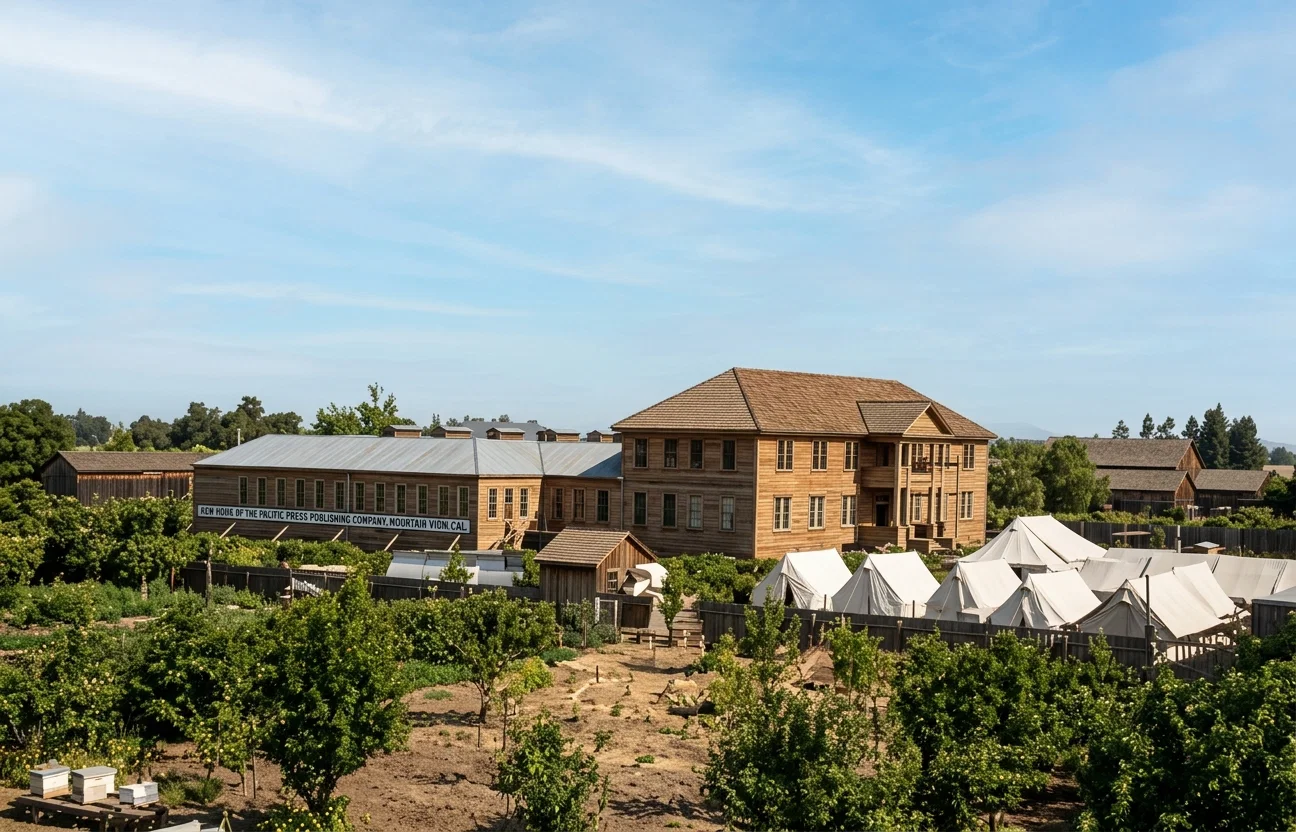
NEW HOME OF THE PACIFIC PRESS PUBLISHING COMPANY, MOUNTAIN VIEW, CAL.
Second, railroad facilities must be regarded; for at the present time we are using nearly two car-loads of paper a
month. Our mail and express business is also quite heavy, and must be handled promptly. Banking privileges should also receive consideration.
Third, while we are looking out for the interests of the institution, we must also bear in mind the interests and welfare of our employees. We might find some place quite suitable for the factory, so far as shipping facilities, etc., are concerned, but not at all desirable for our employees.
In the investigations that have been made, all these questions were borne in mind, and the directors finally decided to locate the plant at Mountain View, Cal. This is a small place about thirty-nine miles south of San Francisco, and eleven miles from San Jose, on the main line of the Southern Pacific Railroad running into San Francisco. It is a rural district, and a very desirable location, not only for the plant, but also for our employees, as it is right in the fruit belt of the famous Santa Clara Valley.
The incorporated town of Mountain View has only about eight hundred inhabitants, but it is surrounded by small holdings of five, ten, fifteen, and twenty acre tracts, and settled with a good class of people. Fruit of all kinds, and of the finest varieties, is raised in this valley.
We have been very fortunate in securing for the factory a tract of five acres, fronting on the main line of the Southern Pacific Railroad, and near the station. The citizens of Mountain View have raised money to purchase this land and put in a switch and side-track. This property has been donated to the Pacific Press Publishing Company. The citizens have also donated two hundred dollars toward purchasing a lot on which to build our church.
To further show the interest on the part of the citizens of Mountain View in this matter, we quote the following from a letter received from the board of trade of that place:—
“Pacific Press Pub. Co.,
“Oakland, Cal.
“DEAR SIRS: The board of trade of Mountain View desires to express to you its pleasure in the knowledge of the fact that your publishing plant is to be removed to Mountain View in the near future, and that you are to become permanent residents of our thriving town.
At its regular meeting held Thursday evening, January 21, the following resolutions were unanimously adopted:—
“Whereas, The Pacific Press Publishing Company, of Oakland, has decided to move its entire publishing plant to this city,—
“Resolved, That we hereby extend to them a cordial welcome as members of our community, that we shall at all times be ready and willing to extend to them every courtesy and consideration, collectively and individually.
“That the secretary be instructed to mail a copy of these resolutions to the Pacific Press Publishing Company.
“Respectfully yours,
“H. G. Copeland,
“Secretary.”
Mountain View is near the lower end of San Francisco Bay, and there is a little inlet that runs up to within two miles of the city, capable of floating two hundred-ton boats, thus giving us water competition. Ten passenger trains in both directions stop at Mountain View every day.20
After fully deciding to move our plant, much study and earnest thought were given to perfecting plans for our new building by persons fully acquainted with the demands of the business; and in the plans finally adopted, a view of which is given herewith, we feel that we have a model factory.
The main building is of brick, and is about one hundred and seventy-five feet square, all one story except the front, forty by one hundred and twenty-five feet, which contains the offices, editorial rooms, chapel, etc. The roof over the work rooms is built on the saw-tooth plan, with plenty of skylights, thus giving an abundance of light. There are but few partitions, and the rooms are so arranged that the product all moves forward from start to finish, thus effecting a great saving in time and labor.
We have a private switch from the main line of the Southern Pacific Company, so that stock, etc., can be unloaded directly from the cars into the factory, thus saving the expense and delay of hauling. All our machines are run by electric motors, and we have our own plant for generating electricity.
The contract for putting up this building was let to Brother W. E. Whalin for the sum of $26,800. We have sunk a well on this property to the depth of two hundred and eighty feet, and have an abundance of good, soft water. Indeed, it is really a flowing well; for when we are not pumping, the water runs over the top of the casing just above the ground.
For the past three months the work of moving our large plant has been going on. It was a tremendous undertaking, and the strain upon all our employees has been a heavy one; but all have taken hold of the work heartily and cheerfully, putting up with many inconveniences, believing we were moving in the order of the Lord. Car-load after car-load of heavy machinery has been taken from the building, and the work of moving accomplished with no serious accidents, and with but little interruption to our regular work. Surely the hand of the Lord has been with us, and we praise his name for his protecting care.
We are now comfortably housed in our new factory, situated in a rural district, away from the noise, confusion, and temptations of a large city, and where we can carry out the special instructions which have been given concerning our work.
Mountain View being a small place, there are but very few houses to rent, and at the present time many of our employees are living in tents, waiting for the boarding-house and other houses to be built. These tents are pitched in a group near the office, and look very much like a camp-meeting. In one of the large tents we have a first-class hygienic restaurant, which is liberally patronized, not only by our own people but by some of the townfolk as well.
It is our purpose from this time on to give special attention to our own denominational business, and make this institution just what God intended it should be—“a training-school for workers.”
In changing the location of the office, we have decided that it would also be well to change the form of organization from a stock company to a membership corporation, thus bringing our work into
harmony with the recommendations of the late General Conference; and steps have already been taken to bring this about.
As before stated, in moving our plant to Mountain View, it is our purpose to eliminate commercial work, at least to a great extent, and give our whole time and attention to extending and building up our denominational business. In doing this, it can readily be seen that it will be absolutely necessary so to arrange matters that this business will be placed upon a paying basis.
Heretofore we have depended largely upon our commercial work to furnish the funds necessary for carrying on the denominational business on which there was almost invariably a loss. This must now be changed; for we know that our brethren and sisters do not want to see the office running behind from year to year.
Plans have already been inaugurated with a view to placing the work on a paying basis, and we now ask for the hearty co-operation of our brethren and sisters and conference workers in helping to make them effective. And above all, we want your prayers and your counsel. The work is one, and we desire to unite our efforts with yours in trying to get this truth before the people in the shortest possible time. We believe that the “pillar of cloud is rising,” and it is time for God’s people to “move forward.”
One of the first great efforts we shall make at our new location is the publishing of the four special numbers of The Signs of the Times, on the subject of the Third Angel’s Message. In these numbers it is our purpose to cover all the leading points of present truth, and we hope and expect that our people everywhere will do their utmost to give them a wide circulation. This will not only be a great encouragement to the workers here, but will bring the truth to many souls.
In reference to the importance of moving our institutions out of the large cities, we quote the following from “Testimonies for the Church,” Vol. VII:—
“‘Out of the cities,’ is my message, . . . The time is near when the large cities will be visited by the judgments of God. In a little while the cities will be terribly shaken. . . . The ungodly cities of our world are to be swept away by the bosom of destruction.”
“For years I have been given special light that we are not to center our work in the cities. The turmoil and confusion that fill these cities, the conditions brought about by the labor unions and the strikes, would prove a great hindrance to our work. Men are seeking to bring those engaged in the different trades under bondage to certain unions. This is not God’s planning, but the planning of a power that we should in no wise acknowledge. God’s Word is fulfilling; the wicked are binding themselves up in bundles ready to be burned.”
“Light has been given me that the cities will be filled with confusion and violence, and crime, and that these things will increase till the end of this earth’s history.”
Already we see this prophecy being fulfilled in our land, and is it not time to heed the warning? We believe that our brethren and sisters everywhere will
rejoice with us in the move which the Pacific Press has made.