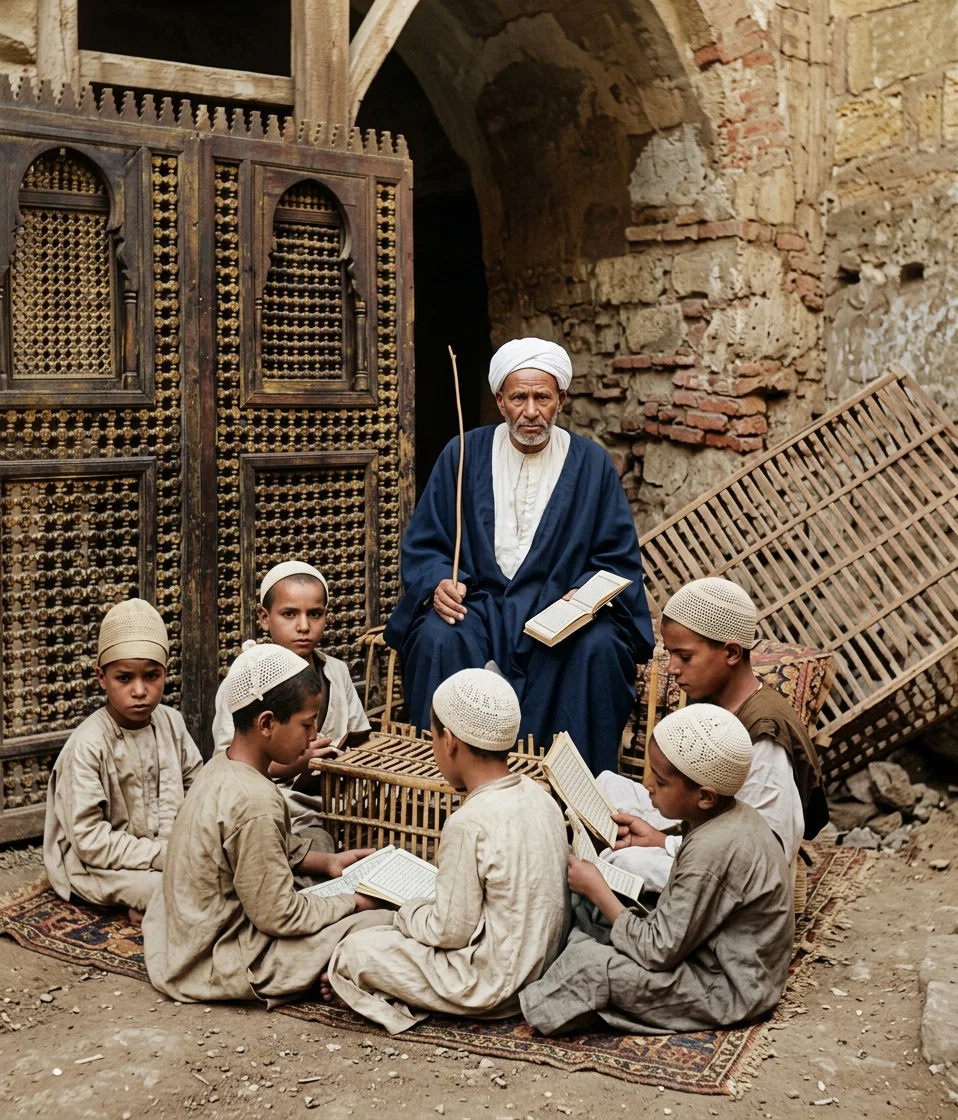
To be acquainted with a country is to know its needs. To know the needs of a given mission field is, to the Christian, to enlist his sympathies, his co-operation to supply those needs. So I believe that a brief statement of the educational work centering in Cairo, Egypt, will emphasize the importance of this place as a center for the third angel’s message, from which the everlasting gospel of the kingdom may go to the whole Moslem world.
A MOHAMMEDAN SCHOOL
Cairo is not only the metropolis of many Egypt, but it is by far the largest city in Africa. It is the political, commercial, and educational center of Egypt. Its influence is paramount not only in the lower and middle divisions of the country, but in Upper Egypt, through the Sudan, to the borders of Abyssinia. This being the case, anything coming from Cairo takes precedence over all else. To many of the natives in distant provinces, a trip to Cairo is the event of a lifetime. In all Egypt, if I am rightly informed, there is not a book or periodical published outside of Cairo or Alexandria. While visiting Kena, a city of about forty thousand inhabitants, some four hundred miles up the river from the capital, I inquired why some enterprising native did not start a daily or weekly paper in such a city. I was informed that it would not receive sufficient patronage to live, as everybody wanted news directly from Cairo, so that it would be “official.” And while the American Mission has its training college at Assiut, its native church paper is published at Cairo.
The Schools of Cairo
First is the so-called “University” of Azhar. Though having an attendance of from three thousand to four thousand every year, this institution is chiefly a conservatory of the Mohammedan religion, the principal studies being the Koran, Mohammedan law, and the Arabic language and literature. It is said that young men from all parts of the Mohammedan world, even from India and the Malay Peninsula, are drawn together here. A recent writer says:—
“The Azhar is indeed the university of Islam. Its influence is felt wherever the Moslem religion is known, and its disciples are collected from all parts of the Moslem world.”
To all students this school is absolutely free, no charge being made for anything the student receives. The teachers work without salaries. The attendance is not so large as formerly, as many young men of more progressive ideas prefer to attend the schools which afford a broader and more practical education.
Cairo has a fairly well-equipped “school of medicine,” under the direction of English physicians. It enrolled last year ninety-eight young men, many of them among the brightest in Egypt. There is also a law school, with an attendance of about two hundred, an industrial school with one hundred students, and a school of arts having about three hundred in attendance. The kuttabs, or intermediate schools, have an attendance of about twelve thousand children, of whom eight hundred are girls.
An advance move has recently been made toward the better education of Moslem girls. As nearly all the girls’ schools in Egypt are taught by European or Syrian teachers, a teachers’ school for Mohammedan girls has been opened with about sixty pupils. There are also about fifty native young women, mostly Moslems, taking a medical course. This would have been considered an innovation a few years ago; and, indeed, the old fanatics shake their heads. But the progressive view these advanced moves in educational lines with satisfaction and pride. There are a number of flourishing Mohammedan schools, supported by private individuals of wealth. One of these, which was established some years ago by a rich Moslem, now dead, has in its charter a clause forbidding Christians to ever set foot in its domains. And this spirit is not dead yet.
Besides the government schools, each church represented here has its own educational institutions. The largest of these is Coptic, with an enrolment of about one thousand. This is the principal Coptic school in Egypt, although that church has many others. Then there are the Greek Church schools, Armenian schools, Roman Catholic schools, and a number of private schools in which many hundreds receive some education. In the lower schools, however, and in many of the higher grades, the work done is very superficial. Especially is this true of schools taught by Oriental teachers. The young Egyptian is taught to memorize, but not to reason. The principles of logic find a very small place in his mental make-up; but his power of memory is wonderful. One young man who attended my English class for a time, could repeat every rule in the English grammar, but could not write a correct sentence in the English language. It is very unsatisfactory for a European to argue with the average native; for he never knows when he is beaten, and “e’en though vanquished, he would argue still.”
A word should be said concerning the schools conducted under the auspices of the American Mission (Presbyterian). As already stated, their training college is located at Assiut, about two hundred miles from Cairo. These pioneer missionaries have been a prominent factor in stimulating educational interests throughout Egypt. Aside from their college, their chief schools are in Cairo and Alexandria. Their course of study here is not advanced; but in those classes which are taught by American teachers, the character of the work is first-class, the teachers being both competent and conscientious. Their church in the United States has undertaken to raise one hundred and twenty thousand dollars to open a girls’ college in Cairo, also one in Alexandria. They have already secured a site for the institution in Cairo, at a cost of sixteen thousand dollars.
The English Church Missionary Society also has schools in Cairo, but I have but little information concerning them.
All this shows the importance of Cairo as an educational center, and should lead us to consider how this strategic point16may be used to advance the cause of present truth, and so hasten the coming of the King.
Although real estate is very high here, yet I am convinced that it would be a wise policy to secure, as soon as possible, a small property for permanent headquarters. We ask the brethren and sisters of the home land to pray for the advancement of the work here.