Travel by River

3%

Review and Herald Publishing Association · Washington, D. C. · Oct 13, 1904

FromReview and Herald, Vol. 81, No. 41.

Read the full edition

Travel by River

A. C. SELMON AND H. W. MILLER
Hauling goods across the country by cart is very expensive, and during the farming season it is almost impossible to hire carts of any kind.
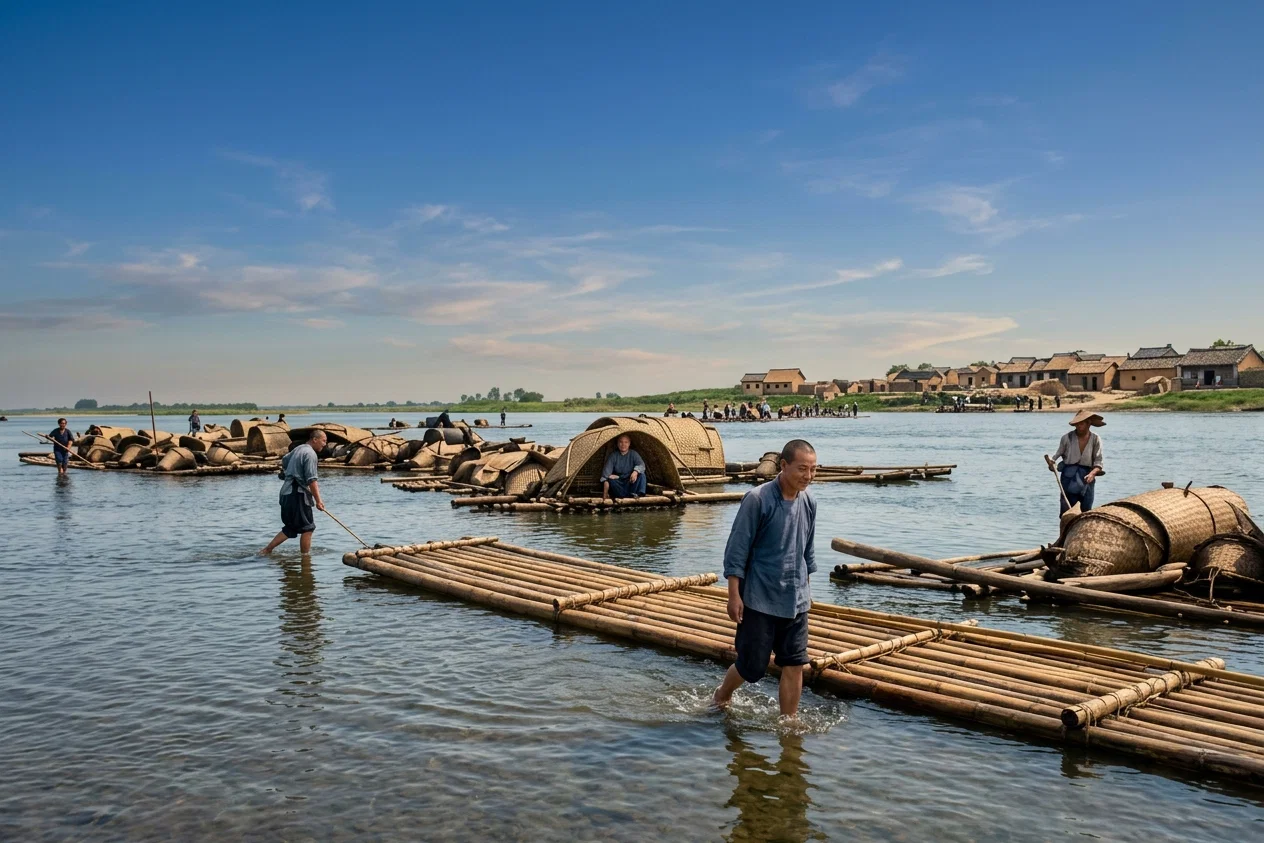
The rivers of China are very numerous; and although they are long, by reason of their crookedness, they form one of the cheapest avenues for travel. So upon returning from Hankow we left the railroad at a city about one hundred miles from our station, and decided to make the remainder of the trip by water. We engaged two pair of rafts to carry our goods. These are made of about twenty bamboo poles from four to six inches in diameter, fastened together with bamboo withes. Tworafts thus made are fastened together into an end to end, to form a pair. When the rivers are very low, these rafts are of service, because they draw only from five to eight inches of water. Where the water is shallow, the men wade alongside and pull them. In deep water a rope is attached, and the men walk along the river bank.
After hiring any kind of conveyance, it requires a great deal of time and patience to get started. In this case we were ready to start by noon; but they had an unlimited number of excuses why it would be better to wait till the next morning. After urging the men in vain, we finally took charge of affairs, and began pulling the two rafts ourselves.
It was a very slow way to travel. In many places the river was only two inches deep. Here a large shovel was used to make a ridge of sand across part of it, leaving only a narrow channel.
VIEW OF THE RIVER AND RAFTS
This would serve to dam up the water, and so float the rafts. Our living quarters on the raft was a little booth made of cane mats. Our two Chinese boys shared this with us.
The diet of the men consisted largely of boiled rice. They consumed immense quantities of it. With the rice they always had some coarse vegetables, usually onions or greens, and as a special delicacy they would occasionally buy a small piece of fat pork.
Sometimes a fish would leap out of the water, and land on the raft. This suggested a way of fishing. The rafts were fastened end to end in line across the river, and as they were pulled along, the men would make an uproar by shouting and pounding on the bamboo poles. The frightened fish would come up to the shadow of the rafts, and then leap out of the water to try to clear the obstruction. Landing on the rafts, they were an easy prey. In this way the natives succeeded in catching fifty or sixty pounds of fish.
Fishing is carried on so extensively in the rivers that very few large fish are seen, most of those caught being from three to six inches long. In addition to the numerous kinds of dip and drag nets, they make use of a novel method. A kind of large water-bird is trained for the work. A fisherman will have a flock of ten or more of these birds, a little larger than ducks. As he rows along in a small boat, the birds are taught to swim alongside and dive into the water for the small fish. When the bird comes to the surface, he is caught at the end of a long pole, and drawn together into the boat. The fisherman grasps him by the neck, causing him to disgorge the fish.
In order to prevent the rafts from making a long stay at Si Hsien, we decided that Dr. Miller should go ahead to make the purchases and have the supplies ready to load on the rafts, while Dr. Selmon should remain and push the raftmen along as fast as possible. It was sundown when Dr. Miller and one of the Chinese boys left the raft. The doctor gives the following account of their experience:—
We had a walk of fifteen miles before we could get any conveyance to take us to Si Hsien. Neither of us was familiar with the foot-paths in this part of the country, and we had to depend on the varied statements of the Chinese whom we could arouse. There were more whom we were not able to awake, however, for, it is claimed, China could raise an army of a million men each of whom could successfully undergo the test of sleeping across a wheelbarrow with his mouth open, and a fly in it. As a consequence, we lost much time by taking wrong foot-paths. About midnight we heard the report of two guns, and people yelling at a farmhouse. Believing it to be robbers attacking the house, we extinguished our light.

A Wheelbarrow Ride

Reaching Lo Shan at 2 A. M., we soon secured a wheelbarrow to convey us the remaining twenty miles. Having no bedding with us, we were compelled to sit on the bare boards of the barrow as the big wheel rolled over the bumps, with its musical squeak. We made good time, reaching our destination about noon. We spent the afternoon in buying charcoal. The next morning, hearing of the attack of the robbers, and that some of the men were badly injured on the rafts, I returned to meet the rafts, following back along the river five miles. After redressing all the wounds, we were all soon at Si Hsien.

Riding a Donkey

No sooner had we arrived, than a Chinaman from a neighboring city rode up with a note, requesting that one of us come at once to see a patient. As Dr. Selmon was disabled, the boy and I returned, he riding a horse, and I a donkey. We were also accompanied by a soldier to act as our guide. The night was dark and rainy, and it was with difficulty that the animals kept the road. We reached the city gate about two in the morning. After calling for the gatekeeper several minutes, we gave up trying to arouse him. Examining the lock, its frailty soon manifested itself, as it easily pulled apart, and we entered the city, fastening the gate as well as we found it. This again shows the ridiculous side of Chinese protection. They will spend years in erecting a wall thirty feet high around the city, and then secure the main entrance with a lock that can be pulled apart and put together again without detection.

Traveling in a Sedan-Chair

In the morning I was again on my way, returning to Si Hsien, hoping to meet the rafts there. The conveyance used this time was a sedan-chair, which is a chair made of bamboo, carried by two men, and supported upon two long bamboo poles. Reaching the city, I learned that the rafts had left in the morning. As I had no Chinamen with me, nor a single cash, I was obliged to call upon the mandarin for help in order to get a conveyance to carry me to the next village. No sooner had I reached the official's quarters, than a heavy rain dashed down, and this meant delay for me. But a missionary must learn to be happy under disappointment, and I saw before me an opportunity I had not heretofore had, to see how affairs were carried on among the officials of China.
The mandarin of a city corresponds to the mayor in the States, and around him are a large number of “hangers-on,” corresponding to the politicians in the United States. His rooms were very ordinary, being made of mud, with a dirt floor. His room had only two pieces of furniture besides the chairs, a table which served as writing-desk and dining-table, and a bed. The latter was curtained off, and he would lie on it and smoke opium during the day, and sleep during the night. I was given the seat to the left of the table, which was the seat of honor, and his best clothes were offered me, the best food, and, in fact, the best of everything.
Many of the officials called on me, telling me they were sick and desired foreign medicine. One of them has since come to our station after medicine. They were also interested in finding out all they could about American customs. The mandarin thought he knew a little more than the rest, so seized both of my hands, to show the officials how Americans shake hands. He next brought a picture of himself and son, which they considered a wonder. A Chinaman will never permit his wife to be in the same picture with him; that would be a disgrace. She must have hers taken separately or with her daughters.
His business did not occupy much of his time. He seemed most interested in the men that supplied him with food andprepared his opium for him to smoke. He seemed to have four duties, and these he must faithfully perform; namely, smoke tobacco, drink tea, smoke opium, and eat his meals. This required so much of his time that very little was left for other things. I was offered all these luxuries, but partook only of his sumptuous meal. I was treated with the greatest courtesy. During the night I was aroused every hour by the ringing of bells, beating of drums, and firing of guns, for five minutes. This noise was to drive the evil spirits away from the official's quarters.
In the morning a chair was made ready, and after two days' travel I again joined the boat.

Attacked by Night

The experience of those remaining on the raft is given by Dr. Selmon:—
The following night after Dr. Miller left the rafts, I told the men to keep moving all night. About midnight the rafts were in a very shallow part of the river. I was suddenly awakened by the report of guns at the rear end of the rafts, and above the noise of the fearful yelling could be heard the captain shouting, “Get up! get up! Strike the robbers!” I sprang from my bed, to find that we were being attacked by a band of robbers. At first sight the water seemed to be swarming with them, but a later count showed there were fifteen in all. They had planned to take us by surprise when the rafts were tied up at the bank, and we were all fast asleep. But, failing in this, they selected a shallow place in the river, far removed from any village. They were armed with guns, swords, and long spears, and greatly outnumbered the men with me. The robbers would make a rush at us, and try to climb on the rafts, striking at the men with their swords and spears. The only weapons we had were the long bamboo poles used for pushing and guiding the rafts. The robbers knew the goods belonged to foreigners, and they thought we had a lot of silver with us.
As soon as I saw our situation, I began praying to the Lord for help. Seizing a long bamboo pole, I ran to the side of the raft to help keep the robbers off. Although it was a dark night, their large lanterns enabled them to recognize me, and several of them made a rush toward the place where I was standing. After striking an effective blow on the head of the nearest robber, I was disabled by a blow on the arm; and had not some of our men come to my aid, I would have fared badly. After half an hour's fighting, the robbers left us. I felt thankful to the Lord for this deliverance; for had they continued the attack, we could not have kept them off much longer, several of our men, besides myself, being disabled. The Lord's deliverances are always at the right time, and his promises are the surest defense against the enemy, whether that enemy be Satan or men inspired by the evil one. After the robbers left us, we soon reached a village by the riverside, and waited there till daylight.
The report of this affair quickly reached the mandarin of the district, and the next morning, accompanied by a large number of soldiers and officials, he came to make inquiry of my welfare, and to express his regrets that such an outrage had happened in his territory. He at once sent out a company of fifty soldiers to search for the robbers. He also gave us an escort of six soldiers to go with us to the next city. He was quite a little concerned for fear the incident would reach the ears of the United States consul, and was very energetic in his attempt to bring the robbers to justice. After six and a half days' travel on the rafts, the shallow river which we had used thus far, emptied into a large deep river, and we exchanged our rafts for a boat.
The bickering encountered in engaging this boat will give some idea of the difficulty one constantly meets in doing any kind of business with the Chinese. Whether the Chinaman is dealing with a fellow countryman or a foreigner, it is just the same, with the exception that he will probably ask a much larger price of the foreigner; for the Chinese think all foreigners are rich. After looking at two boats, we finally engaged one large enough to carry all our goods. After making the bargain, the captain came to us and said that charcoal was too dirty, and that he could not carry it on his boat. He said that he had an old boat that would be very good for carrying charcoal. We told him that we would go with the charcoal and other goods in one boat. After thinking about it for a time, he decided that he could haul part of the charcoal. We had learned a few of the Chinese business tactics, and told him there were some other good-looking boats near by. He then decided that he could haul it all, and began loading our goods. After our boxes and about half of the charcoal were on board, he came to us with the information that the boat was loaded as heavy as it would carry. We knew from the capacity of the boat that it was not half loaded; and taking matters into our own hands, we soon found plenty of empty space. This little incident of hiring the boat and transferring our goods from the rafts took us about eight hours.
Travel on the boat proved to be slower than by rafts. During the first day we came to a likin (collecting station). Persons taking goods up or down the river must pay a tax of a certain per cent on all goods on board, before they are allowed to pass this point. The “likin tax” is a kind of revenue collected at various places in the inland of China to help pay the war indemnity. It is a very unjust method of raising money, and will go out of effect at the beginning of the new year. Our cards, showing that we were foreigners, served to pass our goods without tax. We had already paid a likin tax of two and one-half per cent on our goods before we started from Hankow.
In order to enforce the law there was a government revenue cutter stationed here. It could hardly be called modern, and it did not look as if it could do much harm if a boat refused to stop and pay the tax. It was an old river junk, whose only motive power was a square sail and “rice power” (a man walking along the shore, and pulling by means of a rope, fastened to the mast). In the stern end, almost covered up with old matting and ropes, there was a small muzzle-loading cannon, of the type used a hundred years ago.
From the city where we hired the boat to our mission station, the distance by cart road is one hundred and ten li (thirty-seven miles), but the distance by river is many times this. It required six and one-half days to make the trip by boat.
China has the most crooked rivers in the world, and we gave this one the credit of being the most crooked in China. After going all day, we would find that we were only two miles nearer our destination than in the morning. When the wind was favorable, we could make use of the sails, but the greater part of the way the boat was moved by “rice power.” In the course of our river trip we saw the bodies of three men floating in the water, and dead dogs and other animals in great numbers. No more attention was paid to the floating bodies of the men than to the dead dogs.
Not knowing all the superstitious beliefs of the Chinese, we threw some refuse over the front end of the boat. The boat people became frantic, and seemed to fear that some calamity would soon overtake us. Upon inquiry, we were told that the boat's spirit moved along in the water at the bow of the boat, and that throwing refuse into the water here would be treating the spirit in a very disrespectful way, and would bring misfortune.
We reached our station after an absence of three weeks, during which time we had many opportunities of studying the characteristics of the people.
There is but little joy or happiness in the life of the great majority—nothing to live for in this world but self, and nothing to look forward to in the next. These are surely they that now sit “in the region and shadow of death.”
Sin Tsai Hsien, China.