Travel in Honan — Notes by the Way

6%

Review and Herald Publishing Association · Washington, D. C. · Oct 6, 1904

FromReview and Herald, Vol. 81, No. 40.

Read the full edition

Travel in Honan — Notes by the Way

A. C. SELMON AND H. W. MILLER
DURING the three weeks of which we write, we had opportunity to make use of all methods of travel in China, including donkey cart, wheelbarrow, sedan-chair, railroad, donkey, jinrikisha, river raft, and house-boat.
THE FIRST RAILROAD IN CENTRAL CHINA
Accompanied by two of our Chinese boys, we left our station—Sin Tsai Hsien—Wednesday evening, June 1. We traveled the entire night, the next day, and the following night in a two-wheeled donkey cart, reaching the railway station only a few minutes before the train arrived.
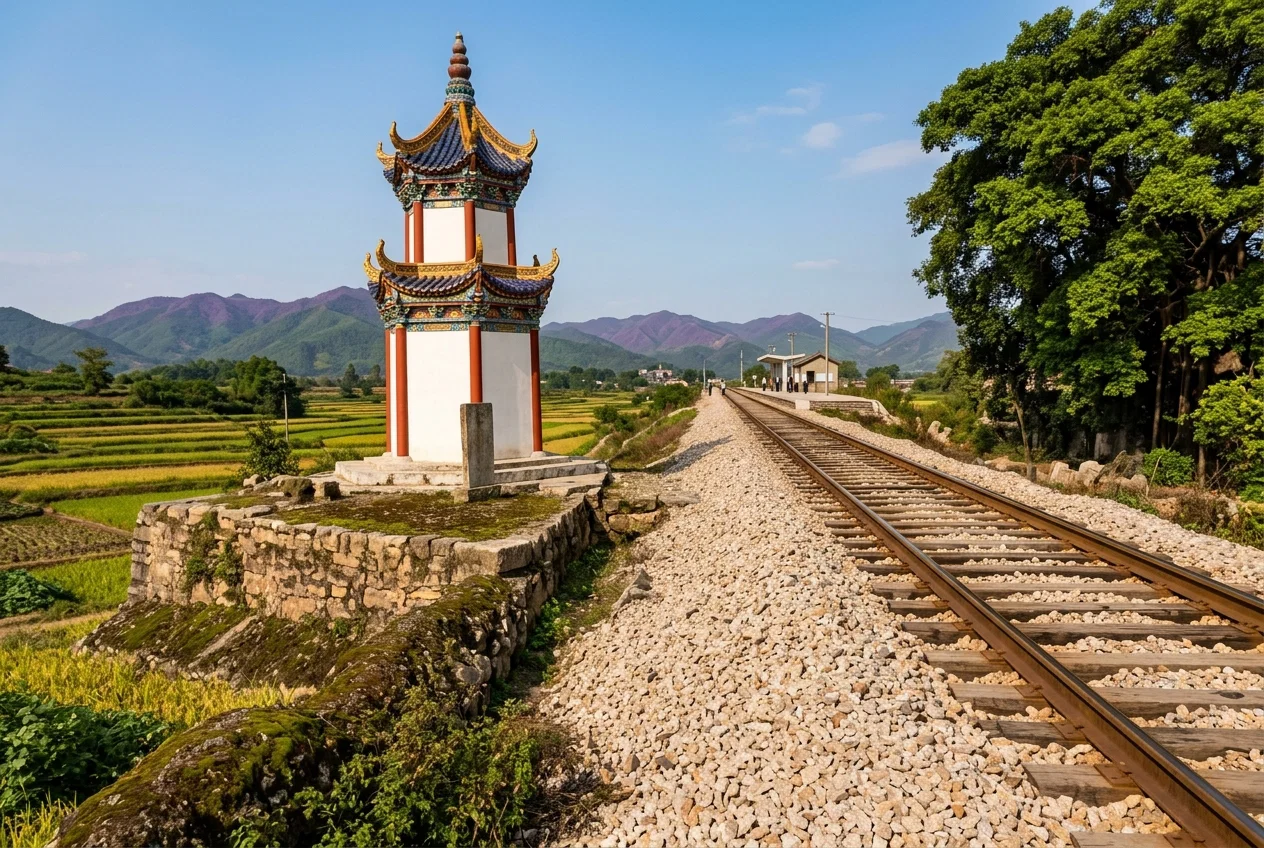
The illustration of the railroad station is a typical picture of all the depots on this line. The officials will not permit the railroad to come within one-half mile of the city wall. The reason for so doing is founded on the superstition that spirits travel in certain currents in the earth. These currents are located by “wind and water.” Doctors are called upon for advice in locating temples, pagodas, etc. They claim that if a tomb is so placed that the spirit dwelling there is comfortable, the deceased spirit will grant those who supply its wants all that the spirit world possesses.
By the side of the railway is a pagoda, which was erected to help the spirits of the dead ancestors to reach heaven easily. Most pagodas are higher than this one, being five, six, or seven stories.
Seated in the same car with us was a mandarin and his family and servants. He was transferred from this province to a city in Hu-nan. The old mandarin sat in one corner of the flat car, occupying the time in going to sleep, falling forward, and catching himself, or sometimes the servant would catch him, to prevent his getting hurt. His complexion was livid, and both his mental faculties and his physical form convinced us that they were rapidly degenerating from his almost constant use of opium. This is no unusual description of the officials in China. Most of them serve only as subjects to demand respect, and act as monuments to whom the people must pay taxes, the large portion of which they are required to hand over to higher officials to whom they are indebted for their office.
All along the way we saw the farmers harvesting the wheat and planting rice, thus raising two crops in one year. Although the fields were small, from one fourth of an acre to one acre, still the number of people busy gathering the wheat reminded one of thrashing or log rolling in the States. Men, women, and children were all actively harvesting the grain.
Each had his proper position, just as the cog-wheels and needle of a binder. One man would swing a bamboo cradle, throwing the grain on a large net stretched across the top of a wheelbarrow. The man pushing the wheelbarrow would keep it in the proper position to catch the grain, just as the sheaf carrier on a self-binder.
Following the cradle and wheelbarrow were the women and children, some having small sickle knives to cut the stray straws left by the cradle. Others followed with hand rakes, thus clearing the ground so completely that there was not a straw left to tell which way the wind blew. When the barrow was loaded, it was conveyed to the thrashing-floor. This is a level plot of land, about one hundred feet square, on which the grain was spread out and thrashed by wooden flails, and a stone roller, drawn by two donkeys, or by a donkey and a cow. This roller is two feet in diameter, and two and one-half feet long. Behind it is drawn a flat stone of about one hundred and fifty pounds. The Chinese children take great delight in riding on this flat stone behind the roller.
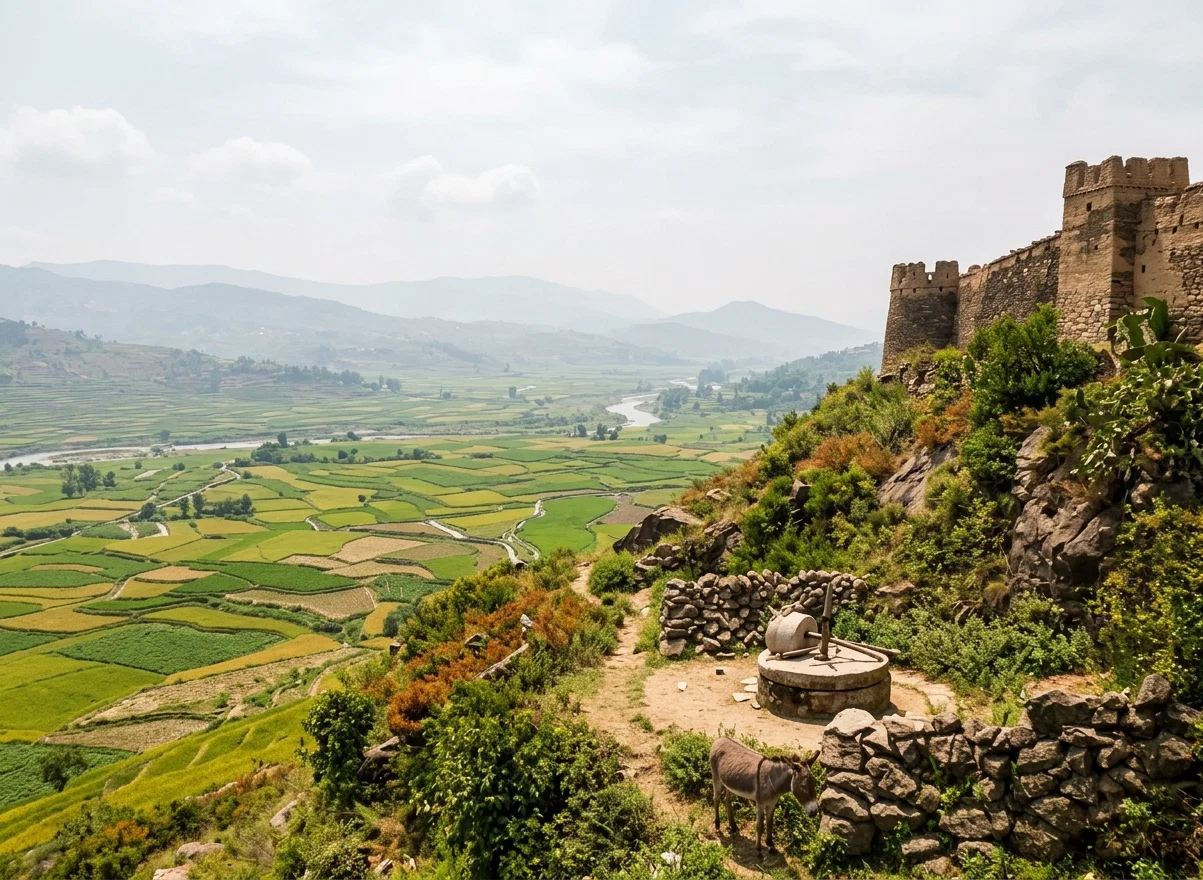
The straw is nicely stacked, and is used for fuel for cooking. The wheat is cleaned by fans or the wind, and ground into flour by the family mill. The accompanying picture illustrates this mill, so that very little explanation is necessary. It is composed of two circular stones, the lower with a flat top, and the upper with a flat bottom. These two plain surfaces are revolved upon each other, having the grain between. Either a man or a donkey turns the stone. The flour is not quite so good as that in the States, but by mixing the Chinese flour with foreign flour, light bread can be made.
No sooner is the wheat harvested than the plots of ground are inundated with water three inches deep, preparatory to breaking the land for rice. In the sections of country where the land is rolling, the water is obtained from a pond situated at the highest point, so the water can be easily drawn off on the plots of land beneath.
CHINESE FLOUR MILL
Plots of land in the valley are rice fields
CHINESE FLOUR MILL Plots of land in the valley are rice fields
In level districts the water is collected in reservoirs. The Chinese have used their ingenuity in devising plans to raise this water. One method is to attach a rope at each side of a pail, and two men standingon the bank revolve the pail in such a way that when it comes down, it fills, and when drawn up, it empties the water on the field. At some places the water is so low that they are unable to raise it by this method, so they have a deep trough, about eight inches in width, inside of which at each end is a wheel upon which a chain of wooden paddles is carried, and the water is raised in the same way that grain is raised in the elevators in the States. The top wheel is revolved by a pole, which has wooden paddles fastened to it similar to the levers of a windlass in the States. Four or five Chinamen sit on a pole and strike these paddles with their feet, thus turning the wheel. This they seem to consider play, and take great delight in it. It is much easier than swinging the pail. The land is broken and cultivated under water. The rice plants are first grown in a bed, and then reset. The rice requires about four months to mature. Wheat and rice are the staple products in this part of China.
(To be concluded)