Among the colonies of the German empire, German East Africa is the largest, and contains the greatest number of inhabitants. Its area is about one tenth that of the United States, or twice the size of Germany proper, while its population numbers six and a quarter millions. Thus it is somewhat more sparsely inhabited than the States. The most thickly populated districts are naturally along the seacoast in the east, and along Lakes Nyassa, Tanganyika, and Victoria Nyanza in the west, where the largest tribes live. Along the seacoast the tribes, except the Suaheli, are much smaller. Thus far, the greater number of the European plantations are in the Usambara Mountain region, just west of Tanga, in the northeast corner of the colony. The only railroad of which the country can boast is about fifty-three miles long, and passes just south of that range, along the Pangani River. About twenty miles northwest from the Usambara Mountains is the Pare range. A broad prairie in the midst of which runs the Mkomasi River, lies between the two ranges of mountains. The railroad is now being extended thirty miles further, to Momba. From this place it is about ten miles to14Masinde, a deserted government fort, and after a journey of thirty-five miles farther through the desert, we reach Kihuiro, the main settlement at the foot of the Pare Mountains. Nine villages, containing about two thousand inhabitants, lay grouped around here. The land along the river is very fruitful, but as there are many mosquitoes in this region, one meets with more or less fever. The place is a little more than five hundred meters above the level of the sea. From here we ascend for about three hours, to our station, which had been known as Momba, named after the creek passing through there, but the government allowed us to change the name to Friedenstal—the Valley of Peace.
Up to last winter there was no mission station in the South Pare range, which is about fifty miles long. At that time we settled there, and a little later the Leipsic Lutheran Mission, which has several stations in the Kilimanjaro district and in the North Pare Mountains, opened a station about eighteen miles north of ours.
While the country around Kihuiro is quite fruitful, and produces maize, rice, and bananas, farther north the foothills rise, where nothing but desert, covered with briars and a sort of cactus, is to be found. But as we ascend about three thousand five hundred feet above the sea, there appear very fruitful and well-watered valleys, and native huts are scattered throughout the mountains.
During my stay, I visited nearly all of the South Pare country, but did not find a single village there. These natives live thus scattered and hidden in the timber and in the valleys because they fear the Massai—a very strong tribe, numbering several hundred thousand, and living in the vast prairies south of these mountains, even extending across into British East Africa. These Massai are something like our American Indians in their manners. They do not till the land. They simply raise cattle. It took the German government a long time, and required a great deal of effort, to stop the inroads of this people into the surrounding hill country.
The Wapare tribe probably numbers, at best, about twenty thousand, and while their language belongs to the Bantu family, yet it differs so much from others that one must study the language for itself. The leading language in the colony, the language used by the government, and spoken by the coast people, and understood by the carriers, etc., is the Suaheli. This is somewhat related to the Arabic. The Bible and considerable other literature already exists in it. In Kihuiro, which lies in the caravan route, many people speak that tongue. In the mountains, only a few understand the Suaheli; for the mountaineers, as a rule, seldom leave their homes. While I was at the Leipsic Mission, I was able to secure from a man who had been studying the language for several years, a copy of the Lord's prayer in the Wapare, and as our people will be interested in reading something in this dialect, I quote that prayer. [See page 15.]
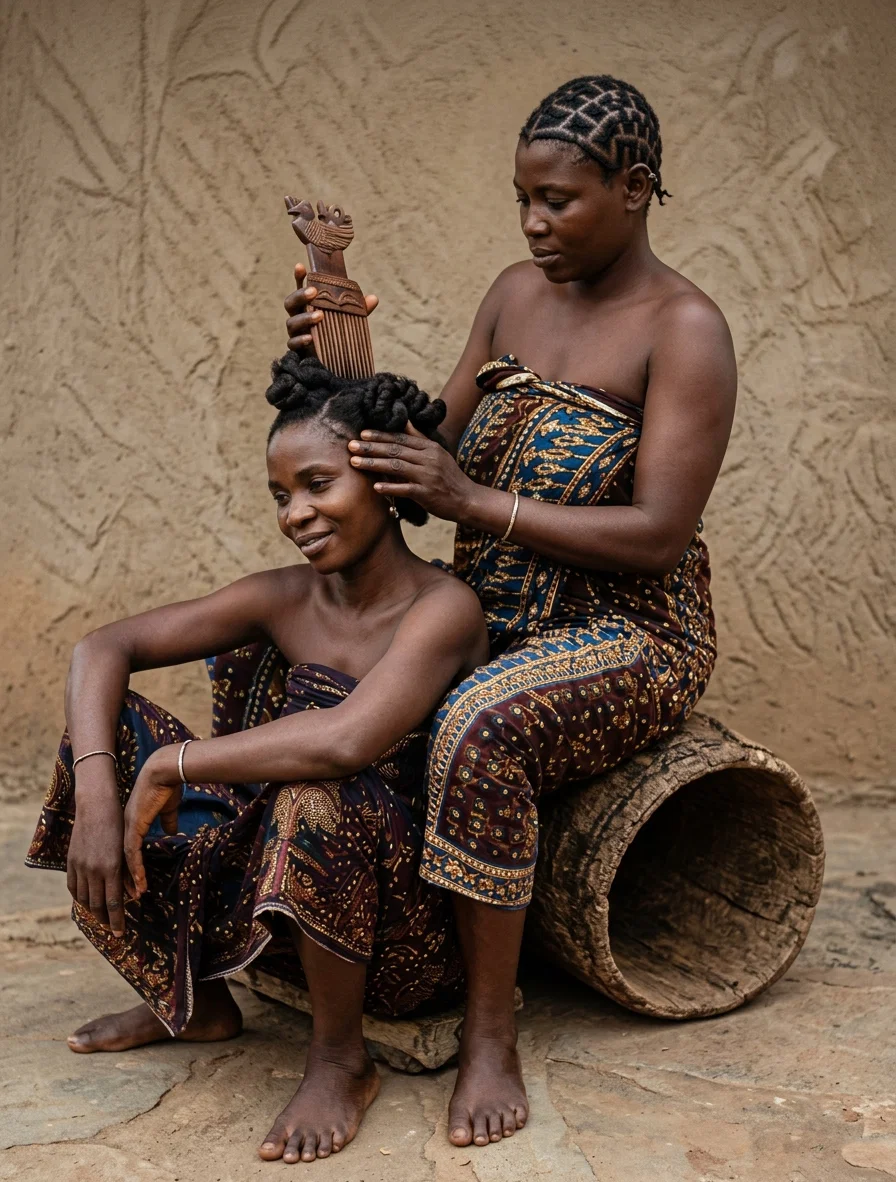
NATIVES DRESSING HAIR
When the missionary finds himself among an uncivilized and uncultured people, whose language is unwritten, and who have no literature, it is one of his hardest tasks to learn the native tongue, and commit its crude sounds to writing. The only way in which the work can be accomplished is for one to go among the people, asking them the name of this and that in their dialect, and then writing down the sounds as nearly as possible, and reading the words to them, to ascertain if they are written correctly. I myself thus acquired the knowledge of a large number of things and words. I gradually learned to put the words into sentences. One of the best ways to accomplish the desired object, is to associate with you a number of bright young men, who will work with you and for you. However, one other difficulty has to be met—the natives themselves often do not know whether the word they have just used belongs to their own or to another tongue. It requires quite a while to learn the characteristics of a heathen language. Again, it is hard to get the grammatical construction. The native can not very well tell you about the grammatical laws of his language. You yourself must learn what are the nouns, and what are the adverbs, and what are the pronouns; and how a sentence must be put together correctly. The native can not explain it to you any more than a little child could tell you why he speaks as he does. One must carefully observe the forms of expression they use, and construct his own grammar and dictionary.
The primitive condition of the native mind is shown by the average understanding they have of arithmetic. When the people first came to work for us, we paid them ten pesas a day; that is about three cents. For five days, they would receive fifty pesas. They did not count, saying five times ten, but they counted out ten (that is as far as they could count) for each day, and there were five days, so they had five piles of money, each containing ten pieces. That is the way we had to pay them.
When our brethren first came among the people in the country surrounding our mission, the innocent natives hid everything they had; for they feared we had come to take away all their cattle and grain and fruit. When our brethren tried to buy milk, the natives made believe that they had no cows—they kept the cattle hidden. When the women saw our brethren coming, they would flee; but as the people gradually learned that we had come only to do them good, they became more and more confident, until to-day they freely bring us their produce, such as maize, bananas, and milk, and are glad to work for us.
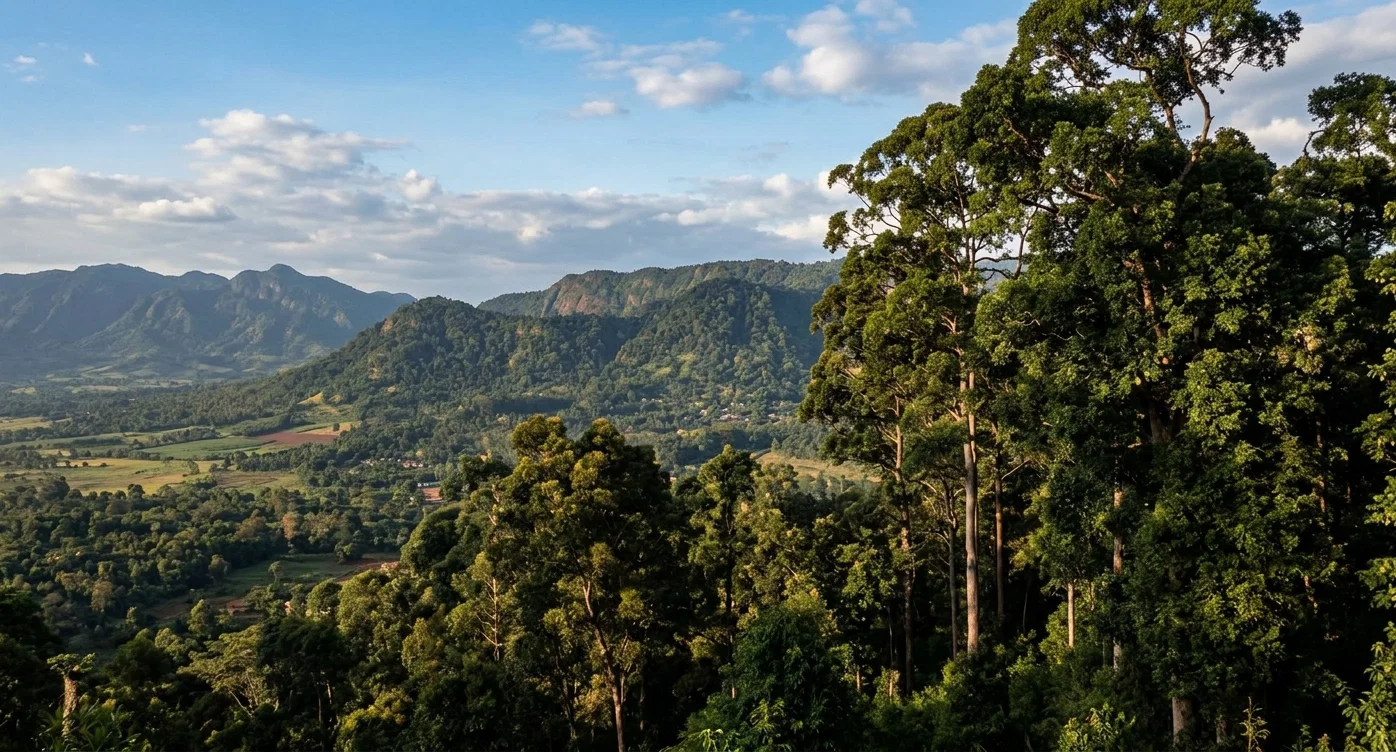
USAMBARA MOUNTAINS
In fact, the people of the Pare Mountains look upon us as their protectors.
As to the dwellings of the people, their huts are round; they are built of light timber, and covered with banana leaves, and have no chimneys. They often share their dwellings with the cattle and odors, and the darkness render such abodes anything but comfortable for the chickens. The smoke, the unwholesome white man.15
The great “staff of life” is maize, but the tribe for whom our mission has been established is not so very thrifty. They care to have only enough to live on. Of course this may change when they have a better market for their produce; thus far they really have had no great incentive to cause them to exert themselves in agricultural or other pursuits; for there was no easy manner in which they could find a market for their products. Bananas grow very luxuriantly, and where they are cultivated, an abundance of the finest and richest fruit is grown. They sold us seven medium-sized bananas for a third of a cent. They crush the maize in wooden vessels, with heavy wooden poles. They usually wet it a little, and as it is generally quite damp, it is not always the best tasting. They are very fond of meat. While they use the sheep for food, they are rather careful about eating their oxen. One great reason for this is that the oxen are a sort of medium of exchange, or money, as they are used in bartering for wives. Two oxen will often purchase a woman, but sometimes a wife is held at ten or twenty head of oxen. The women do the work, while the men smoke and take things easy. Nearly every one cultivates sufficient tobacco for his own use, and even young children have their snuff-boxes.
Their methods of cultivating the land are very crude. The one tool I found was a sort of native hoe, with a small ax-like instrument on one side; the handle to this small instrument is only about a foot in length. With this they cultivate the ground, and cut down and chop up their trees. I saw no sort of plow. As a tribe, the people are not very strong, and they are rather loath to take hold of European tools, like a spade or an ax, as they say that the tools of Europeans are too heavy.
When it comes to the question of roads, they are only narrow paths. If a tree falls down across the road, or if there is a stone in the path, a native will not think of taking that away, but will go around the obstacle, thus forming a new way, so the “road” is anything but straight.
As to arms, they have only bows, but they use poisoned arrows. In all the district I found but one blacksmith shop, and this had no roof, and was hidden back in the timber. The women manufacture their own earthenware and baskets.
Lord's Prayer in Wapare
Vava yetu nho hena wanga Izina
Father our who art above Name
lako li andzelve vufumwa wako vuze
thine be praised Kingdom thine come
Kintu kola we kikunda kivoswe
thing which thou lovest will be done
ma sa ngeni sa tsavu swaho hena
in the lands as it done is
wanga utwinke iyo tsala tsetu tsa mai
above Give us to-day bread our of the day
na we utusigie matesanyo etu sa
also thou forgive us transgression our as
na uswi twavasiga vala vetutesanya
also we those forgive who sin against us usitningye he kutegwa mira utukije
Lead us not into temptation but save us
he vuvivi vufumwa na uzinya na
from the evil Kingdom and power and
onbaha ni wako misi yose na yose
greatness is thine days all and all
Amen.
Amen.