A Witness for Truth

6%

Review and Herald Publishing Assn. · Washington, D.C. · Dec 31, 1903

FromReview and Herald, Vol. 80, No. 52.

Read the full edition

A Witness for Truth

FREDERICK M. ROSSITER, M. D.
DURING the past few years a number of huge animals, among them several of the mammoth type, have been found in various parts of the world. In all these discoveries the one feature that seems to interest scientists is the number of thousands or millions of years in the past at which the existence of these animals may be placed.
It might seem that our evolutionist friends would receive a sort of mental jar when they read of these gigantic creatures that lived twenty thousand or one million years ago, with which our present-day animals are mere pygmies in comparison. By comparing figures it is not necessary to be a very “great scientist” in order to see that present-day animals are very much smaller. It is passing strange how so many small elephants can evolve from such huge beasts! At first thought it might also seem strange that “scientists” always have these animals living at least twenty thousand years ago—but we know why.
A year or two ago the finding of a human skull in the soil of Kansas set the entire “scientific” world agog, speculating as to its age, and after “very thorough” speculation it was concluded that the owner of the skull did not live this side of twenty-five thousand years ago!
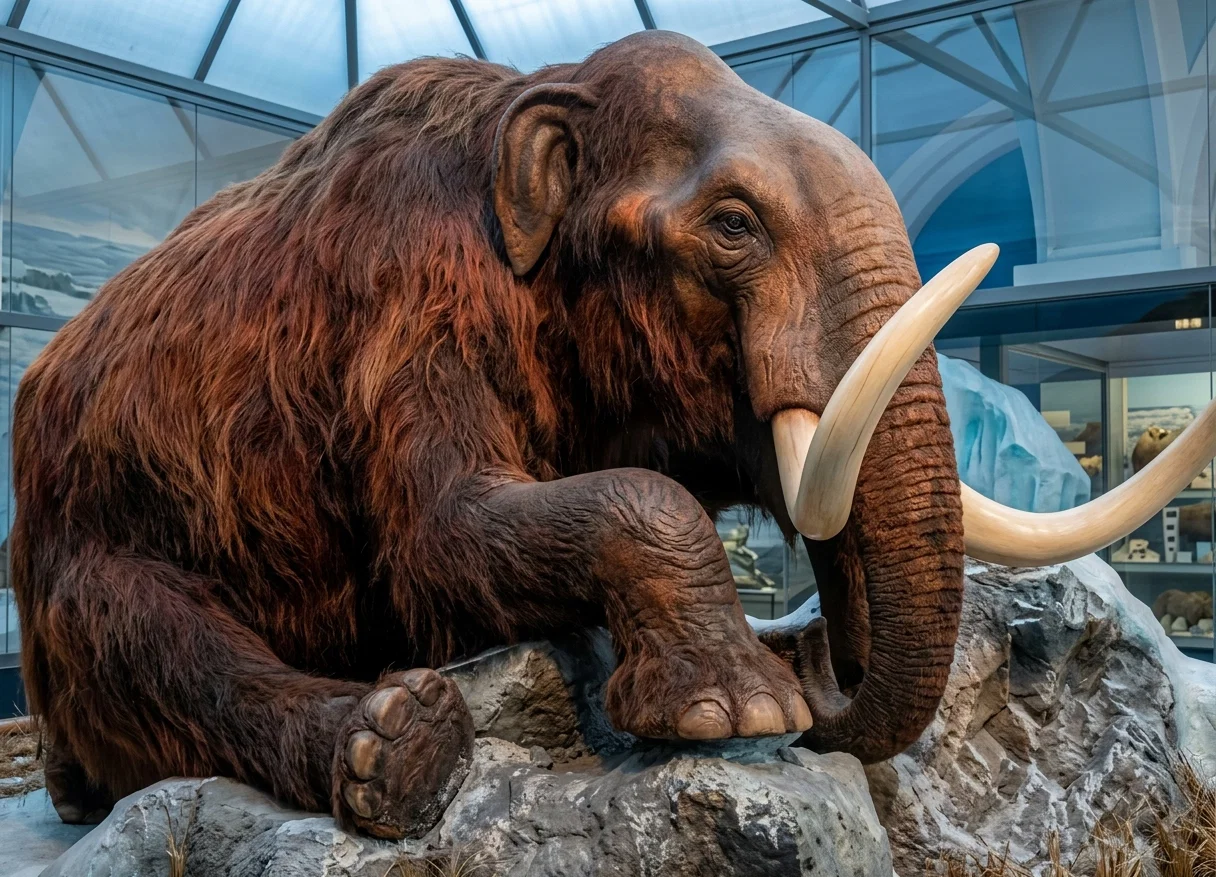
The greatest and most interesting find of recent years is the immense mammoth discovered by a Russian soldier in northern Siberia a short time ago.
From the daily press we obtain the following facts: “This new mammoth just dug out in Siberia is the most remarkable specimen of a prehistoric animal ever found. It is absolutely perfect. The wonderful processes of nature have preserved the gigantic carcass in exactly the state in which it lived. The hair, eyes, skin, and organs of the great beast are perfect.”
This mammoth was discovered by a Cossack who saw its great body through six feet of clear ice. Word was sent to St Petersburg, and an expedition was organized by Dr. Herz to secure the prize. The illustration here presented is from a photograph which he took. A Cossack stood guard over the animal fifty days, waiting the arrival of the party.
The animal was found in a perfect state of preservation; undigested grass was found in the stomach, and particles of grass were found about the teeth; the flesh was still red,—all showing that the animal came to a sudden death while eating, and was soon buried by some disturbance of nature.
Dr. Herz is quoted as saying: “The impromptu grave into which the animal plunged was made of sand and clay, and his fall probably caused masses of neighboring soil to loosen and cover him completely. This happened in the late autumn or at the beginning of winter, to judge of the vegetable matter found in the stomach; at any rate shortly afterward the grave became flooded, ice following. This completed the cold storage till further augmented by vast accumulations of soil, and hundreds of feet of ice about this.” “Thus the enormous creature was preserved for how long no one knows, through hundreds of centuries, perhaps, until not so many years ago some movement of the earth spat forth the fossil mausoleum, leaving it exposed to sun and wind until very gradually the ice crust wore off, revealing to the passing Cossack the long-hidden treasure.”
The following are some of the facts about the animal: It is eighteen feet high; weighs thirteen thousand pounds, or six and one-half tons; its hair is from seven to fifteen inches long; its skin three inches thick, and weighing eight hundred and twenty pounds; tusks fourteen feet three inches long; length of foreleg, twelve feet six inches. “Scientists calculate that the gigantic creature lived twenty thousand years ago.”
From the Scientific American THE SIBERIAN MAMMOTH
There are many interesting observations to be drawn from this discovery, but I will mention only two. First, at one time there was no ice in Siberia, but plenty of vegetation to feed great animals; and second, it must have been warm there, for elephants are tropical animals, and usually are found only in jungles or heavily wooded lands.
It is perfectly apparent that this animal lived before the flood, and who knows but that it was one of the animals named by Adam at the creation? for elephants are long-lived beasts. It was evidently killed at the time of the flood, and buried later, and preserved for a witness in these last days, to testify to the truthfulness of God’s Word.
God has seen fit to reveal some things to his people in these last days that their faith may be established. From “Spiritual gifts,” Vol. III, page 92, I quote:—
“Bones of men and animals are found in the earth, in mountains and in valleys, showing that much larger men and beasts once lived upon the earth. I was shown that very much larger, powerful animals existed before the flood, which do not exist to-day.” “Because the bones of human beings and of animals found in the earth are much larger than those of men and animals now living, or that have existed for many generations past, some conclude that the world is older than we have any Scriptural record of, and was populated long before the record of creation, by a race of beings vastly superior in size to men now upon the earth.
“God so ordered that men, beasts, and trees, many times larger than those now on the earth, and other things, should be buried in the earth at the time of the flood, and there be preserved to evidence to men that the inhabitants of the old world perished by a flood. God designed that the discovery of these things in the earth should establish the faith of men in the inspired history.”