After nearly two years of the most ferocious, crushing struggle of earth's war-stained history, a stupefied world asks, “What meaneth the noise of this tumult?” and in the words of a great metropolitan daily says, “Writers who can throw light on the great fundamental problems of the race, and give some idea of its destiny, will have an attentive and even an anxious hearing.”
We are glad to announce that beginning with this issue, Dr. Magan will give an extended series of articles discussing the titanic European conflict in the light of the Sacred Scriptures. Dr. Magan is now one of our regular editorial contributors.EDITOR.
EVER since that sultry summer's day in the year of our Lord 1914 when the hoarse-mouthed cannon around ill-fated Liege proclaimed to all the world that Europe at last had crossed the Rubicon, men and women the earth around have pondered to themselves, in the language of the ancient seer, “What meaneth the noise of this tumult?” The greatest military and naval powers of all time were hastening to the fray. A war the most costly, the most hideous, the most pentecostal in the sorrow and sadness which it left in its wake, at last was on.
It all came so suddenly that things seemed thrown out of their natural harmony and precipitated into a horrible, murderous melting pot. Men and women intuitively knew that the most fearful, the bloodiest holocaust of all times was about to be staged. Full well they understood that a killing, beyond question the most gigantic of all the ages, was now to soak war-sodden trenches with the sickening crimson stain.
Men asked themselves, Is this the baptizing wherewith all the twentieth century is to be baptized? All the hopes which had been so fondly built upon the peace societies, the Hague Tribunal, arbitration treaties, upon the religion, culture, and civilization of a refined and enlightened age, had been smitten into the very dust, and the Old World, in less time than is taken to tell it, had, in the language of Lord Rosebery, “rattled into barbarism.”
Long ago, an ancient prophet, in telling of days that were to be, had written: “The days of visitation are come, the days of recompense are come; Israel shall know it: the prophet is a fool, the spiritual man is mad, for the multitude of thine iniquity, and the great hatred.”
And when this welter of war commenced, serious hearts began to wonder as to whether or not the days of God's visitation had at last begun, and whether the days of recompense foretold so long ago were not indeed come; for, without question, since the days of Noah, when God destroyed the earth and all mankind save the few shut into safety within the ark, there has never been such a staggering and appalling judgment visited upon the earth as the titanic struggle in which the nations of Europe are reeling to-day in their death throes.
In some respects, the present struggle is a more terrible thing, more fraught with pain and anguish and woe, than was the destruction of the world in the waters of the Flood; for there, in a few moments of time, as it were, men met death, and passed out of existence. But it is far different to-day, where men are maimed and tortured and torn, where women's hearts are rent with life-long sorrow, where bodies famish for lack of food, and children die for need of milk. Yea, verily, this contains in many ways more awful elements than the Flood itself.
Gazed upon from the ordinary angle of vision, the story of mankind soon palls upon the mind, and the past brings only a sickening sensation, which in turn causes to be inborn (Continued on page 8)2
Europe in the Melting Pot
(Continued from page 1)
within us a deep desire for the awakening of a holier day. But there is a better angle from which to study the world-shaping events of history. After all, God is in all history, and the print of His hand and the mark of His stately step can be traced throughout its pages.
And the Bible, the revealed word and will of God, calls for and substantiates this view. Thus repeatedly in the book of the prophet Daniel, in slightly varying language, is the thought expressed that “the Most High ruleth in the kingdom of men, and giveth it to whomsoever He will, and setteth up over it the basest of men.”
And Job wrote: “With God is might and sufficiency: the beguiled and the beguiler are His. Counselors He leadeth captive, and judges He maketh distracted. The authority of kings He dissolveth, and bindeth their loins with a cord. He leadeth the chief officers of the state captive; and stout warriors He overthroweth. He bewildereth the speech of the trusty statesman. He taketh away the wisdom of the senators. He poureth contempt upon the nobles, and unstringeth the girdle of the stout-hearted. He discloseth the recesses of darkness, and draggeth the death shade into daylight. He letteth the nations grow licentious and destroyeth them. He enlargeth them and giveth them quiet. He bewildereth the judgment of the leaders of the people of the land, and causeth them to wander in a pathless desert; they grope about in darkness, even without a glimpse. Yea, He maketh them to reel like the drunkard.” Job 12: 16-25, translation of John Mason Good, London, 1812.
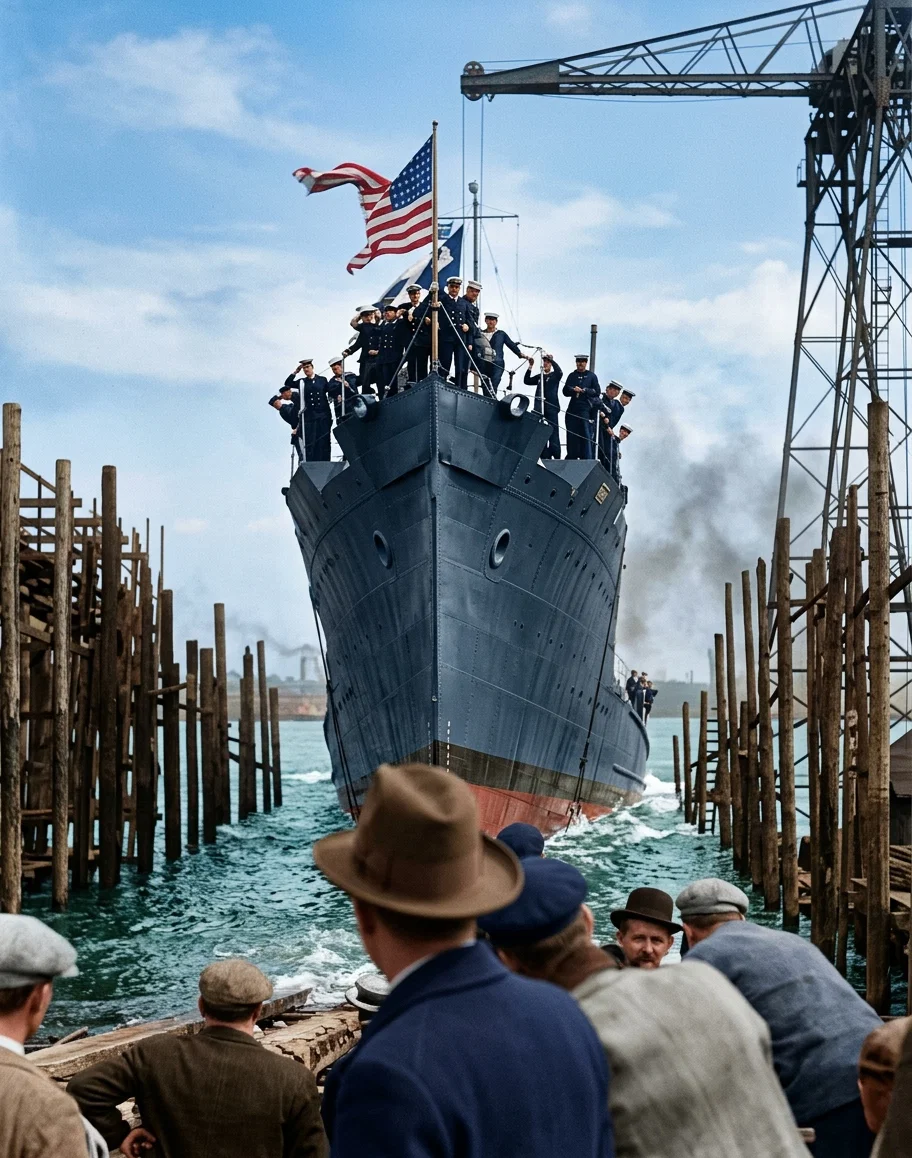
LATEST UNITED STATES TORPEDO BOAT DESTROYER LAUNCHED
To-day we are living in mighty times. We have fallen upon evil days, when, despite our boasted spirit of humanity and civilization, more flesh and blood has been sacrificed upon the altar of Mars than ever before in the carnage-stained history of this old, unhappy world. No war of Nebuchadnezzar compares in proportion or in importance with the mighty happenings in the western theater of strife, where the slain of Teuton, Frank, and Saxon have choked great waterways. The wars of the mighty Julius Cæsar pale into insignificance and are mere piginies as compared with those on that long front from the Gulf of Riga to fortified Saloniki. The campaigns of Napoleon Bonaparte almost lose their place in history beside that mighty line of battle which sways and rolls forth and back from Switzerland to the North Sea, from the waters of the Baltic to those of the Ægean, to say naught of the far-flung battle line on the Alpine heights, or of the hordes that are fighting in Persia, in Egypt, and in other parts of Africa.
“What meaneth the noise of this tumult?” What place has it in the great drama of earth's story? Did it escape the notice of the Almighty when, through His inspired prophets, He foretold the future of the world? Does God, who once said that He ruled in the kingdoms of men, and appointed over them whomsoever He would, pass carelessly by the greatest tragedy that has ever befallen the sons of Adam?—Nay, verily. If the wars of the ancients were of sufficient importance for mention in the book of God, this one, the most fearful welter of blood the world has ever seen, must also find its place on the inspired page.
Men of the world, the statesmen, at heart are wondering what it all may mean. Thus Dr. W. L. Courtney, the editor of the London Fortnightly Review, has the following significant paragraph, which is indicative of some of the thoughts which are passing through the minds of thinking men:
“The newspapers have lately been making large quotations from the poems of Mr. Rudyard Kipling. They might, if they had been so minded, have laid under similar contribution the Revelation of St. John the divine. There, too, with all the imagery usual to the Apocalyptic literature, is to be found a description of vague and confused fighting, when most of the kings of the earth came together to fight a last and desperate battle. The seven angels go forth, each armed with a vial, the first poisoning the earth, the second the sea, and the third the rivers and fountains of waters, the fourth the sun. Then out of the mouth of the dragon, of the beast, and of the antichrist come the lying spirits which persuade the kings of the earth to gather all the people for that great day of God Almighty into a place called in the Hebrew tongue Armageddon. Translated into our language, the account might well serve for the modern assemblage of troops in which nearly all the kingdoms of the earth have to play their part with few and not very important exceptions. It is almost absurd to speak of these events as though they were merely incidents in a great and important campaign. There is nothing in history like them so far as we are aware. In the clash of the two great European organizations—the Triple Alliance and the Triple Entente—we have all those wild features of universal chaos which the writer of the Apocalypse saw with prophetic eye as ushering in the great day of the Lord, and paving the way for a new heaven and a new earth.”
While Dr. Courtney's interpretation of the scripture referred to in the above citation may not be strictly correct, it is of value, nevertheless, in proof of the contention that men are beginning to believe that the Bible is not altogether mute upon the subject of the present war.
God's Account with the Nations
NOTHING is clearer from Sacred Writ than that the Lord keeps an account with nations and churches, as well as with individuals. Back in the days of Abraham, the Lord had said: “Know of a surety that thy seed shall be a stranger in a land that is not theirs, and shall serve them; and they shall afflict them four hundred years; and also that nation, whom they shall serve, will I judge: and afterward shall they come out with great substance. And . . . in the fourth generation they shall come hither again: for the iniquity of the Amorites is not yet full.”
Now the Amorites were not only a nation, they were also a church—a heathen church. With them, religion and the state were one and the same thing, indissolubly bound together3
Europe in the Melting Pot
(Continued from page 8)
Individual conscience was unrecognized by those heathen people. By the arbitrary power of the government, the creed and tenets of the form of worship which was thought best for the people, were formulated; and by law, every man was bound to worship according to a prescribed creed. There are two things, therefore, that stand out clearly from this scripture: first, that God keeps an account with nations and churches, for the Amorites could not be dispossessed of their land by the people of Israel until the cup of their iniquity was full; second, there comes a time when the question of nations and sects closes, and then that nation and that church are judged and dealt with by the Lord.
In this day and generation, as much as then, the King of kings keeps an account with all nations. While His mercy is tendered, with calls to repentance, this account stands open. But there comes a time when the figures have totaled a given amount which the God of heaven has fixed, and then the ministry of His wrath commences.
The Settling of Accounts
NATIONS and churches care little for God's word or law to-day. Great light has been shed upon the world; but how little has it been received and heeded! Holy living and unselfishness of soul no longer mark the nations and churches of the earth. Self-seeking, pride, arrogance, and greed many times mark the life of the church member as much as that of the sinner. In these days of material wealth and splendor, God is forgotten and gold is worshiped. On this point, the words of Mr. Sidney Whitman, a noted British writer, are of interest:
“Nature allows things to go on until they come to a head and disease breaks out. Then the body either throws them off, or the patient succumbs.
“This war comes as a divine judgment—the day of settling of accounts—and not to the Germans alone. It will punish us for our worship of the golden calf and the brazen image; will tend to shatter the self-complacency and the self-absorption of the university professor with his remoteness from the real human interest—the things which spring from the heart—and will scatter much of the shallow buffoonery of public life. For the soulless mind, the settlement is at hand.”
Can it be that through this fearful calamity, God is calling upon nations, churches, and men and women, to repent before all accounts are finally closed? Certain it is that God does send judgments in the hope that the very presence of these may lead men to turn to Him, for it is written by an ancient seer: “With my soul have I desired Thee in the night; yea, with my spirit within me will I seek Thee early: for when Thy judgments are in the earth, the inhabitants of the world will learn righteousness.” Isa. 26:9.420
A dreadful curse is upon the earth. What are the causes of it? Are not the words of Solomon, the sage of Israel, as true to-day as when he wrote his book of proverbs? “As the bird by wandering, as the swallow by flying, so the curse causeless shall not come.”
And not only are the root causes of this scourge well worth our thought, but so also are the real things which may establish themselves in the world when the strife is stilled. Will the close of the war witness the establishment of great and good reforms, or will it see the revival of old errors, put forth as panaceas bringing peace? Will churches call men to repentance of heart, or will they busy themselves with efforts to reform governments and establish religion on a civil basis? Remember that out of war there seldom come the things which men expected when that war began. It has been so in the past, it may be so again. These are the weighty problems well worthy of our thought. Let every soul ponder upon the mighty question, “What meaneth the noise of this tumult?”