THE APPETITE QUESTION

6%

Pacific Press Publishing Association · Mountain View, California · Jul 11, 1916

FromSigns of the Times, Vol. 43, No. 27.

Read the full edition

THE APPETITE QUESTION

The Wants of a Child Not Always His Needs
By LAURETTA KRESS, M. D.
“Teach the children that they should eat to live, not live to eat.”
PARENTS should make it their first object to become intelligent in regard to the proper manner of dealing with their children, that they may secure to them sound minds in sound bodies. The principles of temperance should be carried out in all the details of home life. Self-denial should be taught to children, and enforced upon them, so far as consistent, from babyhood. Teach the children that they should eat to live, not live to eat; that appetite must be in abeyance to the will, and that the will must be governed by calm, intelligent reason. To parents is committed the sacred trust of guarding the physical and moral constitution of their children. Those who indulge a child's appetite, and do not teach him to control his passions, may afterward see, in the tobacco-loving, liquor-drinking slave, whose senses are benumbed, and whose lips utter falsehood and profanity, the terrible mistake they have made.”
This quotation from a noted writer clearly portrays mistakes that are made only too frequently. Children should be taught self-control from their earliest moments; and when this lesson is taught, the child is satisfied to eat his meals at stated periods, and is also satisfied with a given quantity.
The digestive organs can be trained to desire food at almost every hour of the day, but this plan is not consistent with physiological action. The juices are made during the resting period of the digestive organs; but if there is no resting period, what about a supply of gastric juice? The continual crowding of food into an already filled stomach soon results in sluggish work in the digestive system. Fermentation and decomposition follow, poisonous substances are produced and thrown into the circulation, and serious troubles develop.

No Need of a Colicky Baby

It is not a difficult thing to train the appetite. If the baby's earliest meals are at regular periods — two, two and one half, or three hours apart, as the age may demand — and nothing but water is given between those periods, the child soon learns to sleep until the hour for its feeding arrives.
There will be no colicky baby if the mother attends well to her own diet; but gaseous vegetables and wrong combinations of food produce a bad quality of milk for the child, and colic is the result. The writer has seen it demonstrated frequently that with careful mothers, nursing children never have colic at all, and grow to young childhood without vomiting a meal.
If for any reason this care has not been given in infancy, and a conscientious mother finds her child developing wrong habits of eating, she can still begin, though with more difficulty, the process of training the appetite.
The child should masticate his food. He should eat slowly. To teach this important lesson, dry foods, which cannot be swallowed without mastication, should be given. A good plan is to tell the child a story of how the birds pick up the kernels of wheat, and have him count each piece as he picks it up. A piece of crust, or of zwieback, or a hard cracker — anything that must be thoroughly chewed before it can be swallowed — is best; and it must be some of the baked starches, for they are changed in the mouth, by the action of the saliva, into dextrose.
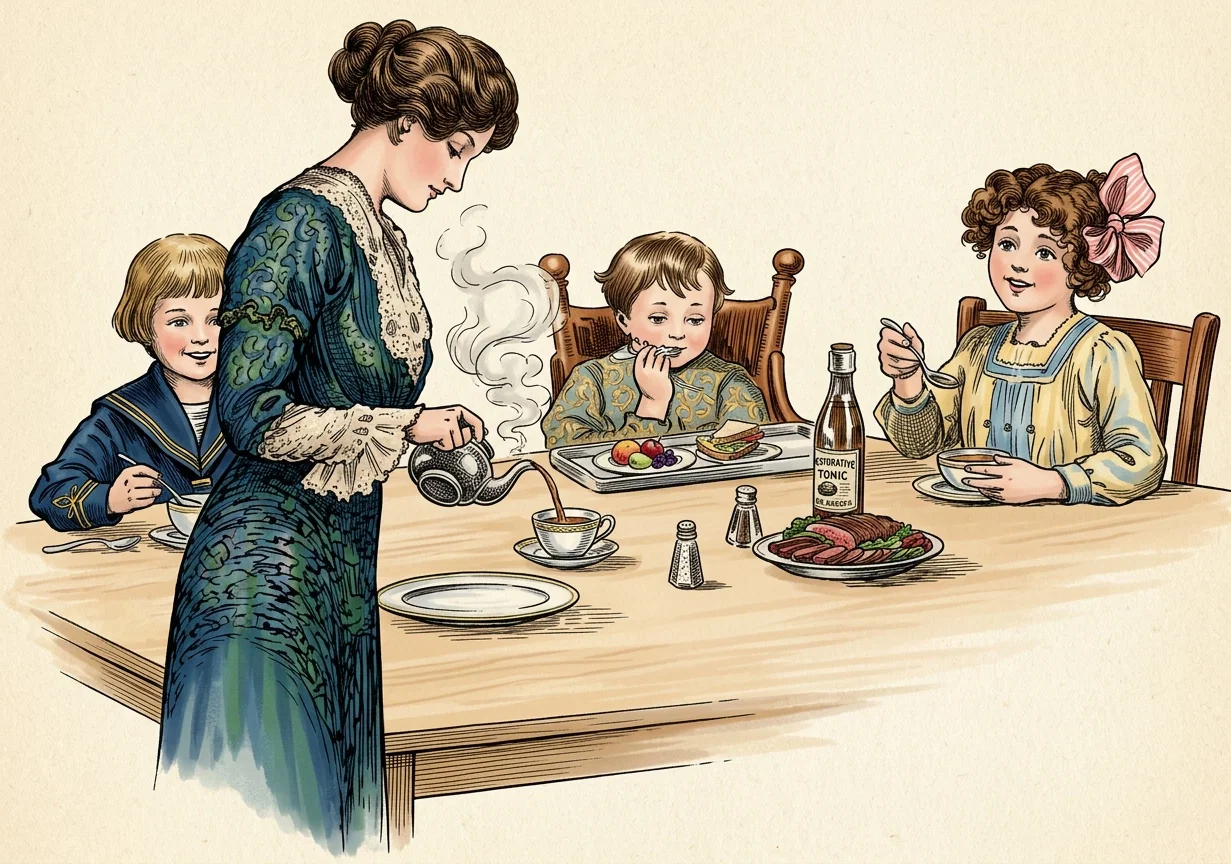
When the family is gathered around the table at mealtime, the children can be engaged in conversation to attract their attention, so that the food be not eaten too rapidly. Table topics can be introduced that will be both interesting and educational. Beginning with a, and running through the alphabet to z, familiar topics can be selected — apples, apricots, apes, antelopes, ants, bees, beans, buffaloes, bricks, etc. Then allow the children time to express themselves on the topic, while spoon and fork rest on the plate, and the mouth is empty.
The parents should serve the food to the children, that they may know what has been given. If the food is eaten slowly and masticated thoroughly, it will be more fully enjoyed, and less will satisfy them. Hurried eating produces irritation of the stomach, and causes, within a short time after the meal, a desire for more food. Thus the habit of eating between meals is developed — a most pernicious habit, laying, as it does, the foundation for many ills. Nothing should pass the lips between the meals — candy, peanuts, popcorn, apples, oranges — in fact, any kind of food. Children trained in this way will save such articles of food for the next meal — and save their digestive organs the burden of caring for the extra meals. In this way, better health is insured for their later life.

The Habit of Eating Dirt

SOME children develop habits of eating dirt, chalk, slate pencils, book corners, wood, etc. Usually lack of some element in their diet produces these unnatural desires. If the diet is carefully ordered, these habits are quickly broken. Often food is given to quiet children when they are worrying. This is a great wrong to a child, especially when he has been hurt, as by falling. For the mother to take time to soothe the impatient worrying by other means is much wiser, and she thus saves herself and her child from much trouble in the future.
A judicious mother will act, in training her children, not merely in regard to her own personal comfort, but for their future good. Parents should impress upon their children that in violating the laws of their being, they sin against their Maker. Children thus educated will not be difficult to restrain. They will not be subject to irritable, changeable tempers, and will be in a far better condition to enjoy life. Such children will more clearly understand their moral obligations. Children who have been taught to yield their wills and wishes to their parents will more readily yield their wills to God, and will submit to be controlled by the Spirit of Christ.
If the food is eaten slowly and masticated thoroughly, it will be more fully enjoyed.