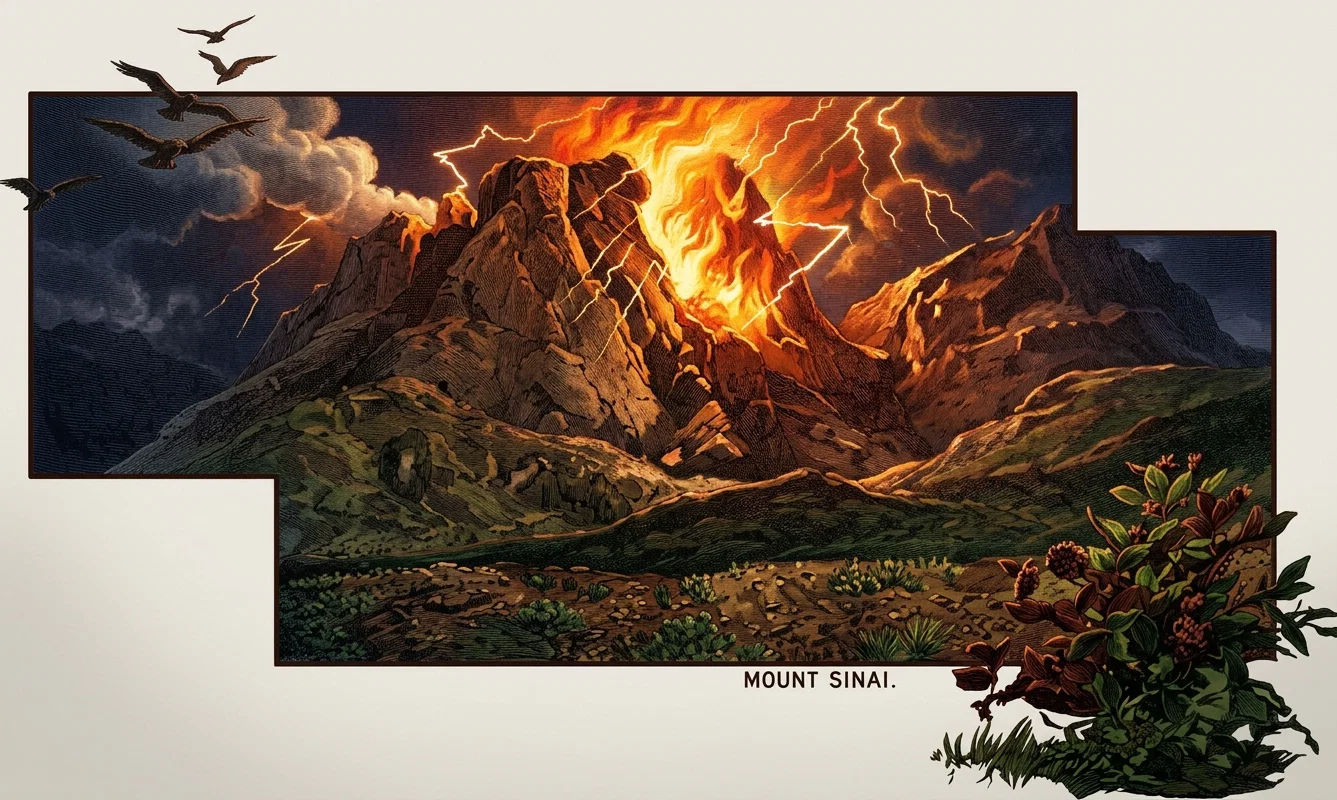
“From the blazing top of Sinai . . . spoke the law in tones that shook the world.”
“THINK not that I am come to destroy the law, or the prophets: I am not come to destroy, but to fulfill. For verily I say unto you, Till heaven and earth pass, one jot or one tittle shall in no wise pass from the law, till all be fulfilled.” Matt. 5: 17, 18. These words are taken from the sermon of Christ on the mount. In very plain language, He states His attitude toward the Decalogue.
The one who here speaks is the same who, from the blazing top of Sinai, in majesty and grandeur such as men have never since seen, spoke the law in tones that shook the world. It was Christ who spoke the law from Mount Sinai. “And Thou didst divide the sea before them, so that they went through the midst of the sea on the dry land; and their persecutors Thou threwest into the deeps, as a stone into the mighty waters. Moreover Thou leddest them in the day by a cloudy pillar; and in the night by a pillar of fire, to give them light in the way wherein they should go.” Neh. 9: 11, 12. Compare with 1 Cor. 10: 1-4. What folly to argue, as some do, that Christ abolished the law which He spoke with His own voice from the top of the trembling mount! Does Christ affirm only to disannul? It cannot be.
Plainly and clearly He informed the vast multitude assembled about Him that His Father’s law will remain unchanged until all things are “fulfilled.” There are many things not yet fulfilled. The Lord has promised that all who sleep in the grave will come forth. This is not yet fulfilled. He has promised that He will make a new heaven and a new earth, wherein righteousness shall dwell. This is not fulfilled. All the prophets of the Bible have looked forward to that grand and awful day when Christ will descend to earth the second time, to gather His people home. He has not yet made His second advent. He has promised that Satan will be bound on this earth for a thousand years. Satan is not yet bound, as we all can readily see. God has promised that the time will come when He will make this earth empty and turn it upside down, when desolation and chaos will cover the face of creation, when there will be no man, when the fruitful place shall be a wilderness, and all the cities of the earth will be broken down at the presence of the Lord. Jer. 4: 23-27. All this is yet unfulfilled. These tremendous events, and many more, are yet impending. Therefore the law of God stands secure, for not all things are fulfilled.
Does “Fulfill” Mean Abolish?
THE “no-law” advocates seek to parry the force of this declaration by arguing that Christ fulfilled the law in obeying it, and that hence it is no longer binding. But does obedience to a law abolish it? Is the constitutional law of the nation abolished because it is obeyed? Are the statutes of the state abrogated because the citizens obey them? What folly! Before such a conclusion can be reached in reference to the Decalogue, it will be necessary to show that fulfilling means abolishing. What confusion confronts those who put forth such a claim!
When Jesus came to John to be baptized, He said, “Suffer it to be so now: for thus it becometh us to fulfill all righteousness.” Matt. 3: 15. Hence if “fulfill” means abolish, all righteousness was abolished by the Saviour. Again, in Gal. 6: 2, Paul exhorts us to bear “one another’s burdens, and so fulfill the law of Christ.” In the law of Christ, we are enjoined to love one another; but on the ground of the claim put forth concerning the abolishing of the law, we are no longer required to love one another, for the law of Christ has been abolished.
Again, speaking of Christ, the prophet says: “The Lord is well pleased for His righteousness’ sake; He will magnify the law, and make it honorable.” Isa. 42: 21. The word “magnify” in this text has the same force as the word “fulfill” in Matt. 5: 17; and in order to harmonize with the “no-law” theory, it must mean abolish. None who put forth that argument will dare to deny this. If they do, their whole gossamer fabric is at once rent into shreds.
Unavoidable “No-Law” Conclusions
LEAVING them to grapple with the problem as to how the law could be magnified, or made more honorable, by being abolished, let us look at an incident in Peter’s experience. When he was preaching at the house of Cornelius, the Holy Spirit fell upon all present; and they were heard to “speak with tongues, and magnify God.” Acts 10: 46. Now since “magnify,” as applied to the law, means abolish, why would it not mean the same as applied to God? Then it would follow that even the Lord Himself is abolished.
Summing up the argument in harmony with the “no-law” idea, we have the law abolished, righteousness abolished, love abolished, and God abolished. Would not the apostles apply most vigorously to such a doctrine the cutting term “damnable heresy”? It is to such monstrous conclusions that “no-law” advocates, and other opponents of God’s law, are driven in seeking to escape the binding claims of that fiery law which came from the hand of Jehovah.
Is it necessary to ask why such a doctrine is taught? The answer is at hand. The purpose is none other than to evade the claims of the fourth commandment of the Decalogue, which reads as follows: “Remember the Sabbath day, to keep it holy. Six days shalt thou labor, and do all thy work: but the seventh day is the Sabbath of the Lord thy God: in it thou shalt not do any work, thou, nor thy son, nor thy daughter, thy manservant, nor thy maidservant, nor thy cattle, nor thy stranger that is within thy gates: for in six days the Lord made heaven and earth, the sea, and all that in them is, and rested the seventh day: wherefore the Lord blessed the Sabbath day, and hallowed it.” Ex. 20: 8-11.
Rather than turn from the precept of man to that of God, they resort to a line of argument which leads to the conclusion10that the Creator of the universe Himself has passed away. This is coming within speaking distance of atheism, to say the least. This same spirit would, if possible, burst into the sanctuary, enter the most holy place, drive God from His throne, rend the ark into fragments, and, seizing the tables of the Ten Commandments, hurl them from heaven.
Its Claims Will Be Met
CHRIST fulfilled His Father’s law, not by abolishing it, but by meeting its claims. “The wages of sin is death.” Rom. 6: 23. “Sin is the transgression of the law.” 1 John 3: 4. All have sinned, and are doomed to eternal death. God gave His only-begotten Son to die in the sinner’s stead, thus preparing a way by which we can, through obedience to the law, secure entrance into the city of God, and recover our lost right to the tree of life. Matt. 19: 17; Rev. 22: 14.
Instead of the Sabbath’s ending at the cross, it survived the world’s midnight, the Dark Ages, when all Christendom was suffering beneath the iron heel of Rome. And when sin and sinners shall be destroyed, and this earth is restored to its Edenic beauty, the Sabbath will be kept as in the beginning, and all flesh will come to worship before the throne on that blessed day. “For as the new heavens and the new earth, which I will make, shall remain before Me, saith the Lord, so shall your seed and your name remain. And it shall come to pass, that from one new moon to another, and from one Sabbath to another, shall all flesh come to worship before Me, saith the Lord.” Isa. 66: 22, 23.