PROPHECY has been aptly defined as “history in advance.” All Biblical expositors and all students of the Word agree that we have in the Bible not merely a single comprehensive prophecy giving in brief the history of the leading nations to the end of the world, but a number of such outlines. Would it not be strange indeed if our own nation, in many respects the greatest in the Western world, were not mentioned in some way in the inspired Scriptures?
In prophetic outlines, as in other brief historical sketches, only the most prominent events are noted. As the general secular historian condenses volumes into chapters, and chapters into paragraphs, so in the Scriptures the divine Spirit has given us in a few words, or sometimes even in a few lines, the history of mighty empires during centuries of time.
Symbolic Prophecy
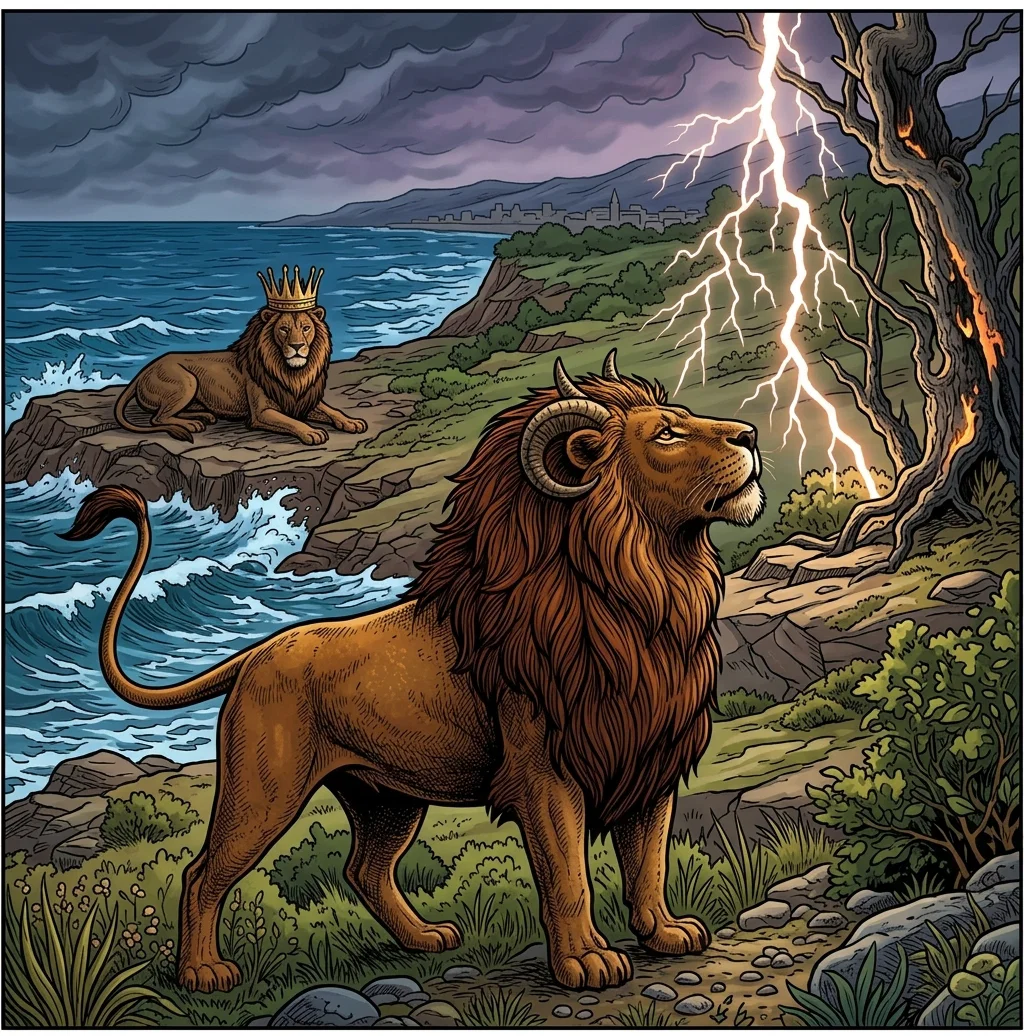
A striking feature of prophecy is its use of symbols. For instance, in the second chapter of the book of Daniel we find the history of the leading nations from the time of Nebuchadnezzar down to the end of this world, represented by a great image of a man. In the seventh and eighth chapters kingdoms are symbolized by beasts and horns, while in the same connection days stand for years. This is true also of some of the visions of John recorded in the Revelation. Every one recognizes at once the fitness of such symbols, for even today, we ourselves frequently use like symbolism; for instance, we speak of the lion, meaning thereby Great Britain, or of the bear when we refer to Russia, or of the crescent when we mean the Turkish Empire, and of the eagle, alluding to Germany.
The Kingdoms of This World in Prophecy
In the second chapter of Daniel the kingdom of Babylon is represented by the golden head of the great image. Medo-Persia is symbolized by the breast and arms of silver; Grecia by the belly and thighs of brass; Rome, united and strong, by the legs of iron, but when divided and comparatively weak, by the feet and toes, “part of potters’ clay, and part of iron.”
In the seventh chapter the figure changes from a great image to wild beasts. A lion with eagle’s wings symbolizes Babylon; a bear with three ribs in its mouth stands for Medo-Persia; a leopard with four wings of a fowl represents Grecia; while Rome is depicted as a nondescript beast having teeth of iron, nails of brass, and ten horns, representing the ten kingdoms that should arise and that did subsequently arise out of the Western Empire.
The Papacy in Prophecy
Reading the prophecy of the seventh of Daniel, we find that for a time this nondescript beast had ten horns, “there came up” presently “another little horn, before whom there were three of the first horns plucked up by the roots.” “In this horn were eyes like the eyes of man, and a mouth speaking great things.”
This little horn has been repeatedly identified by Protestant commentators in the Papacy, which in its essential features is seen to be the resultant of all the false religio-political systems that had preceded it, even from the days of Babylon. The remaining chapters of the book of Daniel simply draw out and enlarge upon what is given very briefly in the second and seventh chapters.
Turning to the New Testament, we find this same little-horn power variously described. In the second chapter of Second Thessalonians it is called “the man of sin,” “the son of perdition;” and to him are attributed acts and words of blasphemy similar to those attributed to the little horn of the seventh of Daniel. Protestants are agreed that prophet and apostle are both describing the papal apostasy.
Called Also “the Beast”
In the book of Revelation we find many references to this same power, which is variously characterized as “a beast” or “the beast” (Rev. 13: 1, 2, 4), a “whore” (17: 1), “a woman” or “the woman,” and “that great city, which reigneth over the kings of the earth” (verse 18). For many centuries, and especially since the Reformation, dissenters from the errors and abuses of Romanism have been agreed in applying these different names, descriptive titles, and designations to the Roman apostasy in its various phases, and especially to the Roman hierarchy, commonly known as the Papacy, which is not wholly identical with the Roman Catholic Church, but is that phase of the Roman Church which makes the Pope the visible head of the whole visible church, and its supreme ruler.
Not only does the Papacy assume and exercise supreme power over the Roman Catholic Church in things spiritual and ecclesiastical, but the Pope claims likewise as the vicar of Christ, to be the ruler of the whole earth, the governor of kings. This political phase of the Papacy is described in Rev. 17: 18 as “that great city, which reigneth over the kings of the earth.”
Inasmuch as Rome in her various phases embraces so much, no one symbol could properly describe that wonderful system of religious doctrine, of ecclesiastical rule, and of political domination; hence in Rev. 13: 1-10 where all these phases are summed up in a single system, the symbol used has some of the features of each of the beasts that preceded it, and instead of being named for some one known creature, it is called simply “the beast.”
The Beast Defined
It is difficult to define the beast in few words, but for the purposes of this article, let us understand that the beast is a spiritual and ecclesiastical system dominating political systems and using civil power for the furtherance of its ends. And for the purpose of this study we shall use the terms “the beast,” “the Papacy,” and “the papal church” more or less interchangeably, though, as already explained, these terms, so closely and necessarily related, are not in all respects truly synonymous.
As described in the thirteenth of Revelation, the beast is Rome as a whole, but with its papal phase especially emphasized. By the papal phase of Rome we mean Rome dominated by the papal hierarchy backed up and supported by the whole body of the Roman Church. From as early as the sixth century of the Christian era, this has been the situation in a large part of Europe; hence we may say that, roughly speaking, the beast operates in and dominates not only the Old World, or at least the major part of Europe, but also a large part of the New World; while the papal spirit, working through other false systems, such as the Greek Church in Russia and Siberia, and Mohammedanism in Turkey, holds practically the rest of the Old World in chains of spiritual and political servitude.
The Second Beast a New World Power
All this being plainly true, we necessarily look to the New World for the second beast; and it becomes a matter of paramount importance to us not only to know what is meant by the beast of Rev. 13: 1-10, but to comprehend also the meaning of the expression “another beast,” in verse 11; and to understand likewise the work that he does, and to know what is meant by “the image of the beast,” which he causes the people to make and then to worship.
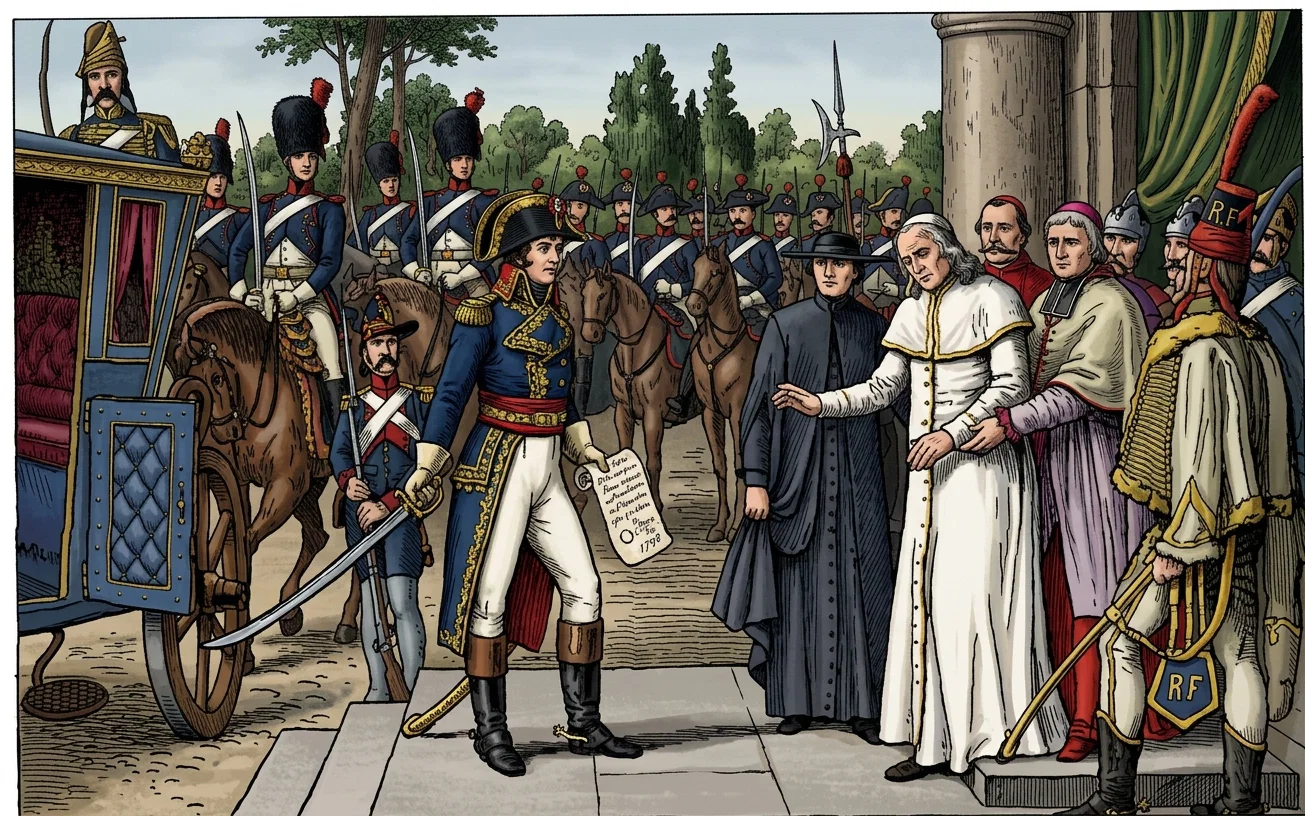
THE POPE TAKEN PRISONER BY BERTHIER IN 1798
An important clue to the identity of the other beast of this chapter is given in verse 11, for this second beast is seen coming upon the stage of action, or emerging from the veil of obscurity, evidently about the time the first beast receives his deadly wound and goes into captivity. In fact, it would seem that the misfortunes of the first beast are the opportunity of the second beast; and that it is by the good offices of the second that the first is again restored to something at least approximating his former prestige and power.
In his notes on the thirteenth of Revelation, prepared in 1754, Mr. Wesley said of the second beast of this chapter: “He is not yet come, though he cannot be far off; for he is to appear at the end of the forty-two months of the first beast.” Beyond question the “forty-two months” ended in 1798, signalized by the culmination of one phase of the French Revolution.
The Deadly Wound of the Beast
FRANCE had long been the chief supporter of the spiritual and political pretensions of the papal power. It was a French king, Pepin, son of Charles Martel, who, in A. D. 754, made the Pope a temporal ruler by the gift of territory wrested from the Lombards. This is known as “the donation of Pepin.” As one result of the Revolution fully launched in Paris July 14, 1789, not only was the support of the French nation entirely withdrawn from the papal government, but about the middle of February, 1798, acting under orders from the French Directory, General Berthier entered Rome at the head of a formidable army, took the Pope prisoner, declared the Papacy abolished and the papal government dissolved, and proclaimed a republic in the Eternal City. Thus in a very marked manner were fulfilled the words of the prophet: “He that leadeth into captivity shall go into captivity; he that killeth with the sword must be killed with the sword.”
Here was the culmination of a series of events and influences, extending, it is true, over more than two and a half centuries, but bringing finally the definite result described in the prophecy as “the wound by a sword.” Rev. 13: 14.
The United States Seen “Coming Up”
At this era, namely, about the time of the culmination of the events that resulted in this attempted destruction of the previously greatly weakened Papacy, the prophet is represented as seeing “another beast coming up out of the earth; and he had two horns like a lamb, and he spake as a dragon.” Verse 11.
This second power, styled in the prophecy “another beast,” is, we fully believe, the United States. In 1798 the new republic was not yet a quarter of a century old, reckoning from the signing of the Declaration of Independence; while the national Constitution was not framed until 1787, and did not become effective until two years later, only nine years before the wounding of the first beast. Thus as the events occur leading up to and culminating in the deadly wound given to the first beast, the United States as the second, or “another beast,” is seen coming up in previously unoccupied territory, and taking its place among the powers of earth.
The first beast of Revelation 13 is described as rising “up out of the sea.” Verse 1. As we learn from Rev. 17: 15, the sea is a symbol of many peoples. “The waters which thou sawest,” said the angel, “are peoples, and multitudes, and nations, and tongues.” Hence we understand that this first beast, or power, arose in a part of the world already thickly populated, or from nations already established in fully occupied territory.
But the second symbol, described as “another beast,” is seen by the prophet “coming up out of the earth.” The original word anabaino, translated “coming up,” is defined in Strong’s Concordance as meaning “arise, ascend (up), climb (go, grow, rise, spring) up, come (up).”2The second beast comes up out of the earth, not in the sense in which a burrowing animal emerges from the earth when he comes forth from his hole or den, but in the sense of growing or springing up, as a beast grows up or springs forth from the earth. A writer in the Dublin Nation nearly three quarters of a century ago, having no knowledge presumably of any such application of this prophecy, speaks of the United States as a wonderful empire which “amid the silence of the earth” was daily adding to its power and pride.
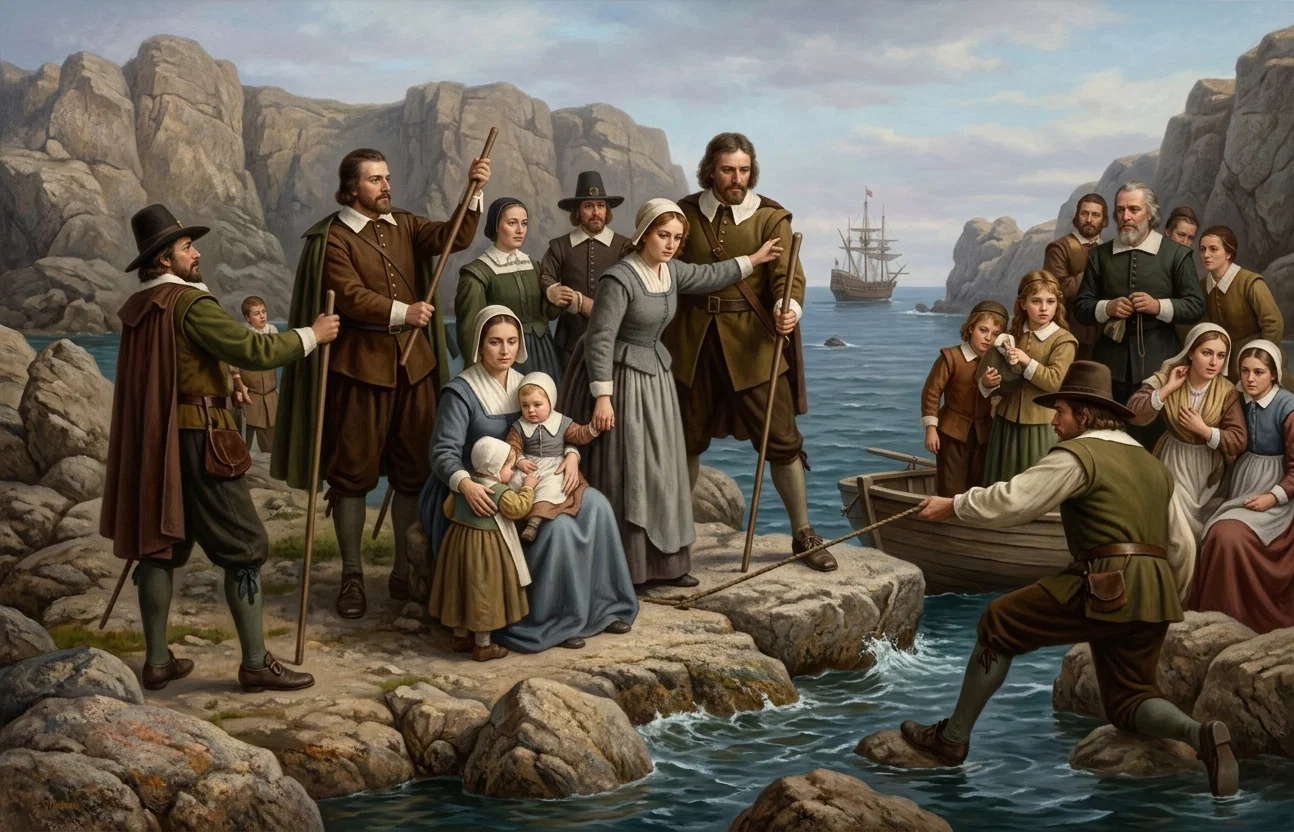
THE LANDING OF THE PILGRIMS
In his work, The New World Compared with the Old, page 635, Mr. G. A. Townsend says:—
“In this web of islands [the West Indies] began the life of both Americas. There Columbus saw land; there Spain began her baneful and brilliant Western Empire; thence Cortez departed for Mexico, De Soto for the Mississippi, Balboa for the Pacific, and Pizarro for Peru. The history of the United States was separated by a beneficent providence far from the wild and cruel history of the rest of the continent, and like a silent seed we grew into empire.” (Italics ours.)
Thus secular writers, describing the rise and development of this country, unconsciously use the very symbolism of the prophetic scriptures.
Civil and Religious Liberty
This second beast has “two horns like a lamb,” but speaks “as a dragon.” The Scriptures employ the dragon as a symbol of that which is evil and despotic. In appearance, then, and in early profession this power is lamb-like, but later it develops a different character and enacts oppressive laws, for it is by its legislative acts chiefly that a nation speaks. It also instigates and encourages the making of an image to the first beast.
“The first beast,” the papal phase of Rome, was a development. Step by step, little by little, papal Rome became papal Rome. The first important act of governmental recognition of Christianity was the edict of toleration by Galerius, A. D. 311. This was issued, not in recognition of a principle, but as a matter of policy. It was followed two years later by the Edict of Milan, issued by Constantine and Licinius. This edict was more ample in its provisions, but like that of A. D. 311, reiterated by implication the claim of the empire to the right to supervise the religion of its subjects; upon its face it was a matter not of right but of “our bounty,” and of “our gracious purpose in securing the public tranquillity.”
The Edict of Milan not only decreed religious liberty,—equal rights of worship for all as a grant,—but it was ordered the restoration to the Christians of the church property confiscated under the edicts of Diocletian. This soon raised the question as to the parties entitled to receive and hold this property.
This question was first raised in Africa, and Constantine sought to settle it by a letter to Anulinus, the royal governor of that province. In his first letter the emperor explained that the property was to be restored to “the Catholic Church of the Christians.” See Eusebius’s Ecclesiastical History, book 10, chap. 5.
As there were factions in the church then, as there have ever been, this instruction did not prove to be sufficiently definite; and in March, 313, we find Constantine writing another letter to his “most esteemed Anulinus,” in which he made it plain that the property was to be restored to “the Catholic Church over which Cæcilianus presides.” See Eusebius’s Ecclesiastical History, book 10, chap. 7.
The result, therefore, of the edict of toleration by Galerius and of the Edict of Milan, both of them proper enough and even commendable as far as they went, was a flood of appeals by Christian bishops to pagan emperors for the decision of questions affecting in various ways the Christian church and Christian doctrine. That which grew out of it ultimately was a complete union of church and state, the church finally dominating, controlling, and using the civil power for the accomplishment of her ends. Thus were supplied in the course of a few years the essential later features of the first beast of the thirteenth chapter of Revelation.
Rome and the United States
We have said that the second beast of this chapter is a symbol of our own government. Let us see if we can trace a parallel between Rome and the United States.
In the first place each began as a number of self-governing colonies, which later united, forming a strong central government. Each guaranteed universal religious liberty: Rome by the Edict of Milan, the United States by the First Amendment to the Federal Constitution. We have seen how the guaranty of freedom of conscience was gradually rendered void in Rome as a result of the action of the Christians themselves in appealing to the civil authorities to settle religious disputes, and we shall see that similar influences are at work in the United States.
In Rome, that which led up to a complete union of the state with the church was the seeming necessity of deciding authoritatively what was Christian and who were Christians. It will be readily seen that the same questions are arising in our own land.
The first step in the change from paganism to Christianity was toleration. This step had been taken in the edict of toleration by Galerius, before Constantine became emperor. The second step was by the Edict of Milan, which put Christianity as nearly as possible upon a legal par with paganism. The next step was due to appeals to the emperor to become the arbiter of disputes, not between pagans and Christians, but between the various Christian parties. The acceptance of this office by the emperor made Christianity a ward or child of the empire equally with paganism, with the result that it soon became equally with paganism a religion of the state.
The Origin of Sunday Laws
Sunday was a sacred day with both neo-paganism, that is, of Mithraism, or Eastern sun worship, and of Western or Latin Christianity. Seizing upon this fact, Constantine, A. D. 321, promulgated his first Sunday law, using the neopagan designation and descriptive title of the day, but making it a rest as well as a festival day, thus clothing it with one of the distinctive features of Christianity; namely, the observance of a weekly day of rest.
We find in the history of Roman political religion that this link between neopaganism and apostate Christianity was not only strengthened in after-years, but from that time to the present the Sunday institution has in various ways furnished an important point of contact between church and state. One of our most frequently quoted church historians says of the very era to which we have alluded:—
“There had in fact arisen in the church . . . a false theocratical theory. . . . This theocratical theory was already the prevailing one in the time of Constantine; and . . . the bishops voluntarily made themselves dependent on him by their disputes, and by their determination to make use of the power of the state for the furtherance of their aims.”—Neander’s History of the Christian Religion and Church, Torrey’s translation, Vol. II, p. 182.
One of the first appeals to this power in behalf of the church was to the end “that the public shows might be transferred from the Christian Sunday and from feast days to some other days of the week.”—Id., p. 300.
The reason for this request was not far to seek; it was for the reason, as stated by the bishops themselves, “Populi ad circum magis quam ad ecclesiam conveniunt” (The people collect more at the circus than at the church).—Id., note 5.
The historian himself amplifies the reason in these words:—
“Owing to the prevailing passion at that time, especially in the large cities, to run after the various public shows, it so happened that when these spectacles fell on the same days which had been consecrated by the church to some religious festival, they proved a great hindrance to the devotion of Christians, though chiefly, it must be allowed, to those whose Christianity was the least an affair of the life and of the heart.”—Id., p. 300.
Enlarging upon this same subject, Neander tells us that “church teachers . . . were, in truth, often forced to complain that in such competitions the theater was vastly more frequented than the church.” They appealed to the state therefore “in order that the devotions of the faithful might be free from all disturbance.” “Every faculty of the mind,” argued they, “should be occupied with the worship of God.” By such appeals, supported by such convincing reasons, “the church received help from the state for the furtherance of her aims.” See Id., p. 301.
Another writer thus states the argument by which the bishops justified their appeal to governmental force:—
“It is, indeed, better,” says he [Augustine], “that men should be brought to serve God by instruction than by fear of punishment, or by pain. But because the former means are better, the latter must not therefore be neglected. . . . Many must often be brought back to their Lord, like wicked servants, by the rod of temporal suffering, before they attain to the highest grade of religious development.”—Schaff’s Church History, Vol. II, sec. 27.
“It was by Augustine,” remarks Neander, “that a theory was proposed and founded, which . . . contained the germ of that whole system of spiritual despotism, of intolerance and persecution, which ended in the tribunals of the Inquisition.”—Neander’s Church History, Vol. II, p. 217.
In theory the Reformation of the sixteenth century challenged the right of the church to appeal to the state to enforce her dogmas and religious observances, but we presently find the Reformers and their successors doing this very thing; and in this, Sunday enforcement soon came to have a prominent place, especially in England.
The English colonies inherited Sunday laws from the mother country. It is perhaps not surprising that these statutes were retained when the colonies became States, and this notwithstanding the fact that all the State constitutions contain seemingly ample guarantees of freedom of conscience.
But while Sunday laws are avowedly religious in England, in this country they are styled “police regulations,” and are defended and maintained on so-called civil grounds.
Sunday Laws the Link Connecting Church and State
It is not, however, in the action of the several States that we may expect to find the fulfillment of the inspired predictions concerning the second beast of Revelation 13. It is the nation that in its profession resembles a lamb; it is therefore in the nation that we must look for the fulfillment of the specifications of the prophecy; and here, as in Rome, we shall find that Sunday is the point of contact, the link connecting church and state. It is by recognizing and enforcing Sunday keeping that this government chiefly denies its earlier professions of liberality, and allies itself with “the beast, which had the wound by a sword, and did live.”
During the last half century there have sprung up in this country a number of associations having for their chief object the promotion of governmental religion. Chief and first among these in point of time is the National Reform Association, organized in 1863 for the avowed purpose of securing “such an amendment to the Constitution of the United States as will declare the nation’s allegiance to Jesus Christ, and its acceptance of the moral laws of the Christian religion, and so indicate that this is a Christian nation, and place all the Christian laws, institutions, and usages of our government on an undeniable legal basis in the fundamental law of the land.”—National Reform Constitution, art. 2.
What this means is best told in the words of Rev. Jonathan Edwards, D. D., in a speech delivered before a National Reform convention held in New York City, Feb. 26, 27, 1873; Dr. Edwards said:—
“We want state and religion, and we are going to have it. It shall be that so far as the affairs of state require religion, it shall be religion—the religion of Jesus Christ. The Christian oath and Christian morality shall have, in this land ‘an undeniable legal basis.’ We use the word ‘religion’ in its proper sense, as meaning a man’s personal relation of faith and obedience to God.”—Proceedings of the (1873) National Convention to Secure the Religious Amendment to the Constitution, p. 60.
Another prominent National Reformer, Prof. C. A. Blanchard, in a speech in Pittsburgh in 1874, said:—
“Constitutional laws punish for false money, weights, and measures, and of course Congress establishes a standard for money, weights, and measures. So Congress must establish a standard of religion, or admit anything called religion.”—Proceedings of the Fifth National Reform Convention, p. 71.
These words are particularly significant in view of this from Rev. Mr. Edwards referred to above:
“Now, we are warned that to engraft this doctrine upon the Constitution will be oppressive; that it will infringe the rights of conscience; and we are told that there are atheists, deists, Jews, and Seventh-day Baptists who would be sufferers under it.”
“These all are, for the occasion, and so far as our amendment is concerned, one class. They use the same arguments and the same tactics against us. They must be counted together, which we very much regret, but which we cannot help. The first named is the leader in the discontent and in the outcry—the atheist, to whom nothing is higher or more sacred than man, and nothing survives the tomb. It is his class. Its labors are almost wholly in his interest; its success would be almost wholly his triumph. The rest are adjuncts to him in this contest. They must be named from him; they must be treated as, for this question, one party.”
“What are the rights of the atheist? I would tolerate him as I would tolerate a poor lunatic; for in my view his mind is scarcely sound. So long as he does not rave, so long as he is not dangerous, I would tolerate him. I would tolerate him as I would a conspirator. The atheist is a dangerous man.”
“Tolerate atheism, sir? There is nothing out of hell that I would not tolerate as soon! The atheist may live, as I have said; but, God helping us, the taint of his destructive creed shall not defile any of the civil institutions of all this fair land! Let us repeat, Atheism and Christianity are contradictory terms. They are incompatible systems. They cannot dwell together on the same continent.”—Proceedings of the National Reform Convention (1873), pp. 60, 62, 63.
May 21, 1888, in an article in the Christian Statesman, the official organ of the National Reform Association, Rev. E. B. Graham said:—
“If the opponents of the Bible do not like our government and its Christian features, let them go to some wild, desolate land, and in the name of the devil, and for the sake of the devil, subdue it, and set up a government of their own on infidel and atheistic ideas; and then if they can stand it, stay there till they die.”
Reinforced by Strong Organizations
Much more of a similar nature might be quoted, but these utterances must suffice; and coupled with the fact that the National Reform Association has during the last quarter of a century been heavily reinforced by other numerically stronger organizations, they are ample. Among these may be mentioned the Woman’s Christian Temperance Union, the Young People’s Society of Christian Endeavor, and, strongest of all, the Federal Council of the Churches of Christ in America, the latter embracing thirty denominations, with a combined membership of more than eighteen millions.
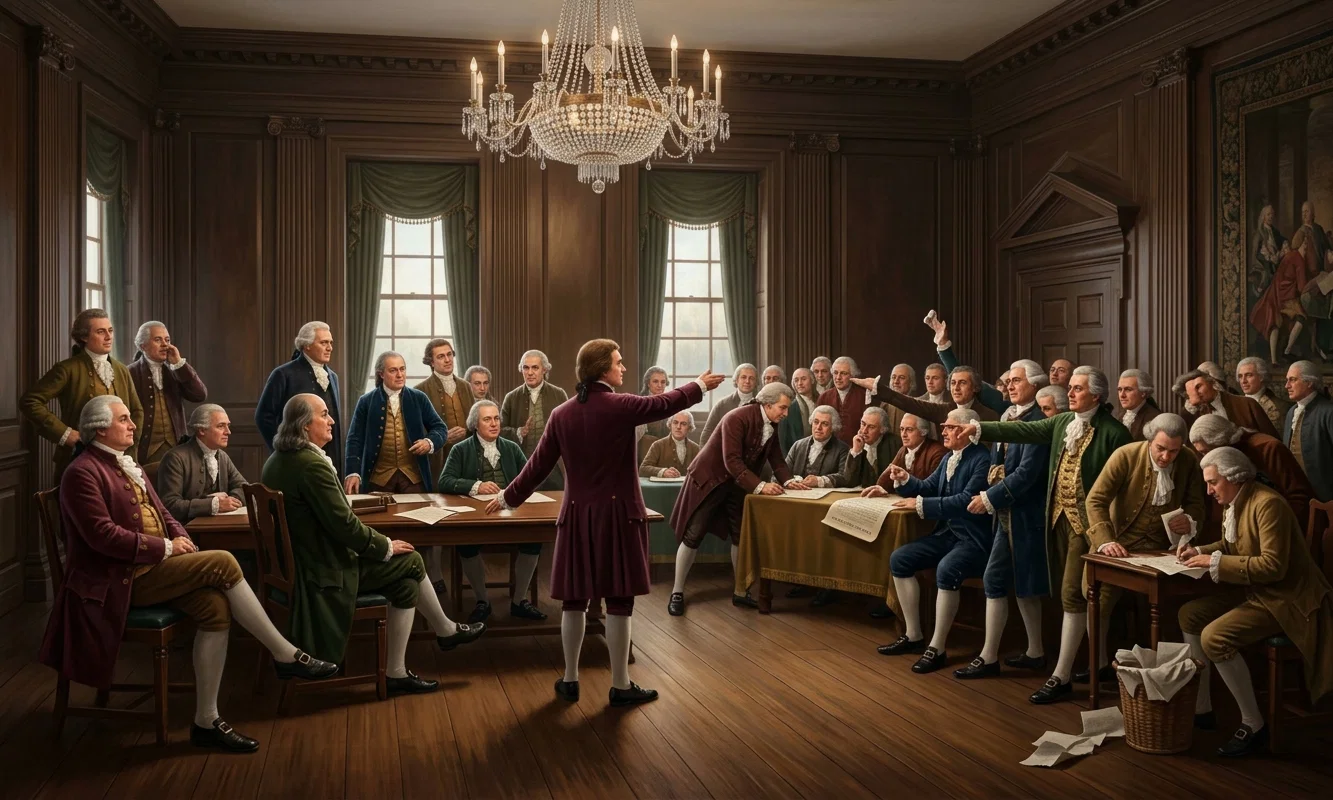
SIGNING THE DECLARATION OF INDEPENDENCE
A Lobby in Washington
To the weight of other immensely influential organizations must be added the various “Sabbath unions,” local, State, and national. The Federation of the Churches of Christ in America alone claims a constituency of fourteen million. The National3Bureau of Reform maintains a lobby at the national Capitol for the furtherance of religious legislation; and as might be expected, we find Roman Catholics allied with Protestants for the destruction of the constitutional safeguards of religious liberty.
Hastening on to the Fulfillment of Prophecy
And now today we stand as a nation, not indeed at the parting of the ways, so to speak, but well started upon the highway that leads straight to all that is foretold of this nation in the thirteenth chapter of Revelation.
The government has begun to bend under the combined weight of immense religious combinations and influences called into being for the express purpose of effecting a political object; namely, the subversion of that part of the Constitution which says that “Congress shall make no law respecting an establishment of religion, or prohibiting the free exercise thereof,” and encouraged by their success thus far these same combinations and influences are working most persistently for the total subversion of every principle of religious liberty.
The beast is a political system dominated in whole or in part by an apostate church. In its inception the beast was one united nation dominated by an apostate church. Later, in its ten-horn stage, it became, and still remains a number of nations or states, all more or less closely united with a corrupt, dominating religious power.
Clearly the image to the beast is a government, or system of states, more or less closely united with and dominated by apostate religion. Who cannot see that the details of the prophetic picture are being rapidly filled out in our own land?
With the Papacy bending all its vast energies to the task of making America Catholic, and with almost every Protestant body, for a little temporary advantage, proving untrue to the very foundation principles of Protestantism, what may we not expect? The inspired Word says that here shall be formed an image to the papal beast, and that by the example of this country the world and they that dwell therein shall be caused to worship the beast that had the wound by the sword and did live, and today we find ourselves well along on the road leading directly to this once seemingly impossible but now rapidly approaching consummation. Under the influence of apostate Protestantism the once lamblike beast is even now beginning to exhibit the characteristics of the dragon, the enemy of all good, the oppressor of all who would follow and obey that which is good.
But in that day, when the last earthly safeguard is swept away, when every human refuge fails, God will be the hope of his people.