The Bengal Mission

4%

Review and Herald Publishing Association · Tacoma Park Station, Washington, D. C. · May 27, 1915

FromReview and Herald, Vol. 92, No. 26.

Read the full edition

The Bengal Mission

The headquarters of the Bengal Mission is in Calcutta. It was here our work in India began. Sister Georgia Burrus, now Sister Burgess, came to India in the spring of 1894. She settled in Calcutta, and began the study of the Bengali. In the latter part of the same year Elder D. A. Robinson and wife and Sister May Taylor, now Sister Quantock, reached India and settled in Calcutta, and in 1898 Brother and Sister W. A. Spicer joined them.
For years our principal work in India was confined to the province of Bengal. Our printing and medical work were started in Calcutta. From the first, until the establishment of the headquarters of the India Union Mission in Lucknow, Bengal was the training ground for the missionaries as they came to India.
In the early days of our work in Bengal a large church was built up in Calcutta.
From this church, workers have been selected and trained for efficient service. These workers are to be found in all parts of India, still doing good, faithful work.
The Bengal Mission is a very large and important center in India. Including Assam and a number of minor states, it has a population close to 70,000,000. Calcutta, with a population of a million and a quarter, is perhaps the most influential city in India. It is a great commercial and educational center. English education occupies a large place in school work in Calcutta. The opportunities for doing English work and coming in contact with progressive people from all parts of India are greater here than in any other city of the Indian Empire.
But while Bengal has benefited by the advantages that attend the headquarters of an enterprise, it has also suffered from the drawbacks that usually go with the headquarters. It is a fact that the local interests of the work usually suffer greater neglect at headquarters than in any other part of the field. The general officers are often obliged to carry local responsibilities; and as they are pressed with the burdens of the whole field, the local interests where the headquarters are stationed suffer. Again, continual drafts are being made on the working force close to headquarters to supply more distant fields. This keeps a continual change going on, which is a great disadvantage.
From my observations in the Bengal Mission, I judge that this field has not escaped the losses that attend these disadvantages. But in sending forth her workers to other fields, Bengal has been a blessing to the cause in all parts of India.
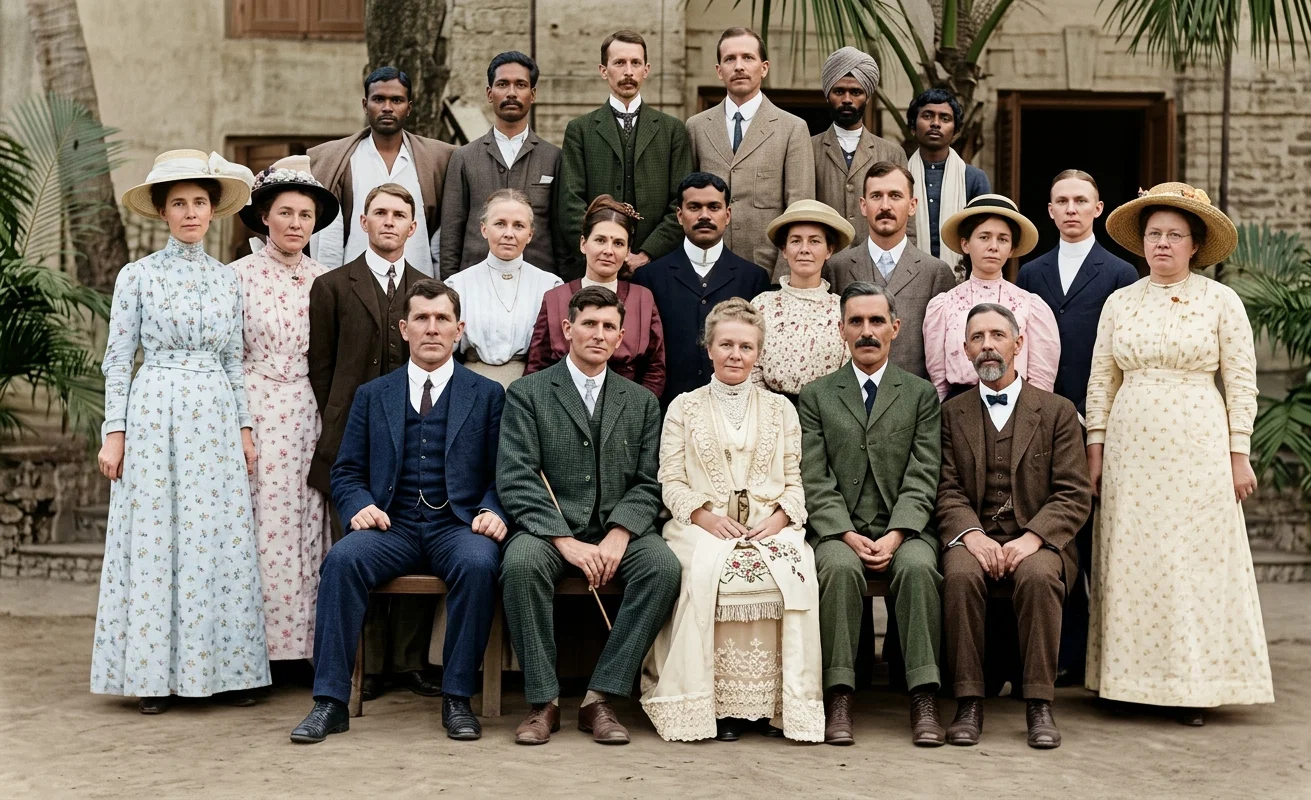
GROUP OF WORKERS IN BENGAL
I found an active, progressive evangelistic work being carried on in Calcutta. Elder J. M. Comer, assisted by Brother Walter Mead, has charge of the work for the Europeans. Brother Comer has been working in Calcutta three years, and has been encouraged by the addition of many members to the church.
Through changes and misfortunes of various kinds, the membership of this church was greatly reduced. Only a dozen or fifteen were left, but now there are between forty and fifty members, and new members are being added from month to month. Soon after the war broke out, Brethren Comer and Mead began a series of Sunday evening meetings in the Theater Royal. The attendance was very good. I had the privilege of speaking three times in this hall to large, appreciative audiences.
Another effort is being conducted in the city by Brethren A. G. Watson and P. C. Poley. They are working for the educated Indians. Many who attend their public meetings are young men attending the Calcutta University. I gave two addresses to the Indians. In my first I dealt with the relation of the present war to the old, never-ending Eastern Question. I spoke as plainly and as emphatically as I knew how regarding the prophecies of Daniel and the Revelation, and also regarding the destiny of Turkey. The vice chancellor of the university was present. At the close of the meeting he came forward and talked with me at some length about our position. I felt sure that our treatment of this great conflict from the standpoint of the Scriptures made a deep impression on these men. Another evening I spoke for theirtemperance society, on the progress of prohibition in the United States, and of our position as a people on the temperance question. It seemed to me that judicious, patient effort, watered with tears, might reach these people, and establish some of them in the truth. The brethren are holding meetings, distributing literature, and visiting among Indian families the best they can, with the prayer and the hope that the Holy Spirit will turn some of them to the Saviour.
While in Calcutta I had the privilege of twice visiting the Bengali church. The meetings were held on the large veranda of Grandfather Mookerjee's home. Brother L. G. Mookerjee, who for a time attended the Foreign Mission Seminary, interpreted.
It was a pleasure to meet Grandfather Mookerjee and the members of his large family. He embraced the message and united with us in the early days of our work in Calcutta. One of his ancestors was among the very first baptized by William Carey. So the entire family has been under Christian influence for a hundred years. Quite a number of them are members of our church. At our first service, they handed me seventy rupees as an offering to missions in the European Division. They also presented me with a map of the province of Bengal, to keep me in remembrance, I take it, of the needs of this great mission.
In company with Brother and Sister Burgess, who now have charge of the Bengal Mission, I visited the Karmatar and Jagdispur stations. At Karmatar we have a good bungalow for our workers, a dispensary, and a school. These buildings are well located about a mile out of the town. Unfortunately, the work at Karmatar has been rather broken up for some time, so that but little was being done there at the time of my visit. Karmatar has been the center of much to encourage and of some things to sadden our workers. This is where our beloved Brother D. A. Robinson was cut off by smallpox in the closing days of 1899.
Brother Brown, who was working with him, died at the same time. I went to the burial place to look at their graves, and to spend a little time in reflection.
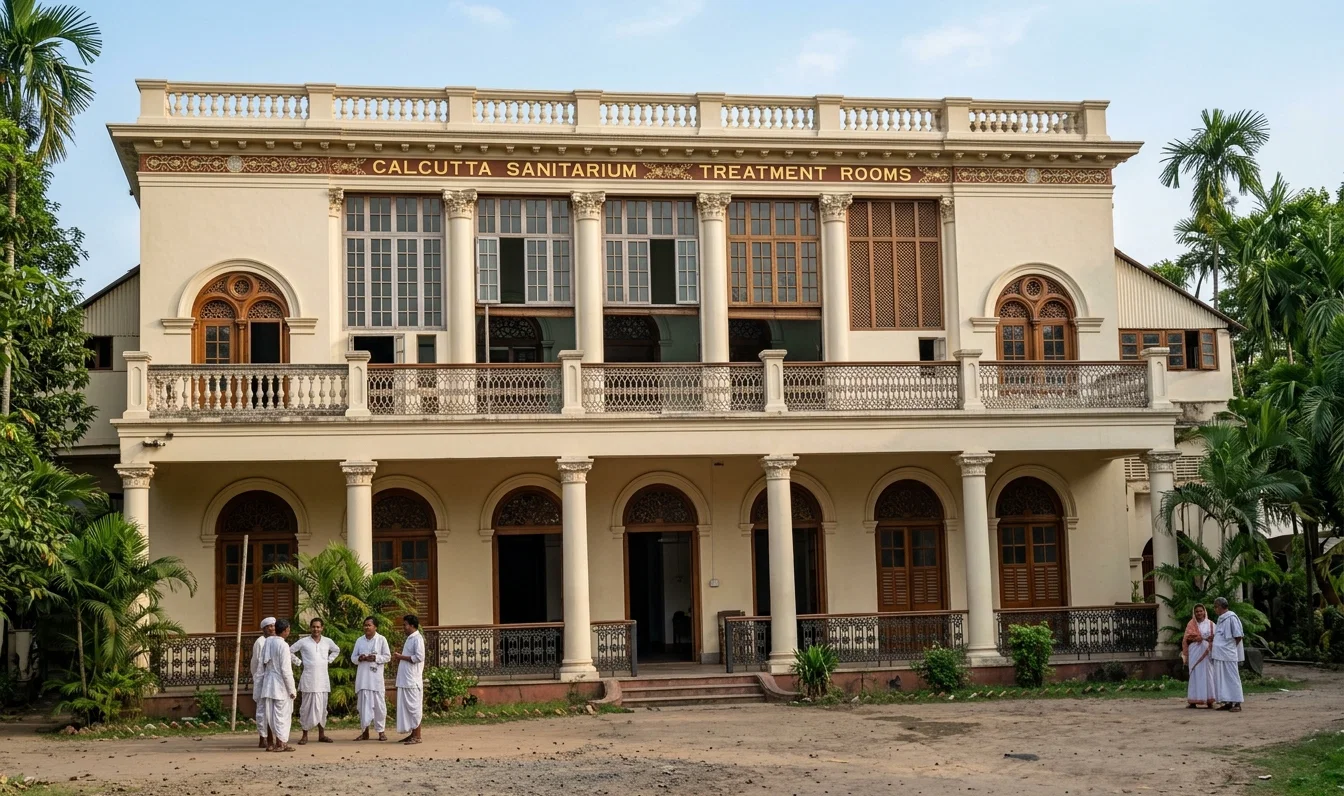
CALCUTTA SANITARIUM TREATMENT ROOMS
As I stood looking at the stone marking Brother Robinson's resting place and reflected on what I had seen in India, I could understand as never before our dear, devoted Sister Robinson's love and solicitude for India, which never left her until her thoughts and feelings were hushed in death. How I wished that the deep experiences of mixed joy and sorrow of missionaries could be transmuted to the hearts of all our people in the homeland. What a new vision would come to them! How much greater would be their zeal and solicitude for these fields! Then I asked myself, What can be done? What can I do to convey these experiences more clearly and fully to the hearts of our people? And I promised my Master to do my best.
Since the Calcutta conference it has been arranged for Brother and Sister L. G. Mookerjee to take charge of the Karmatar station and build up the work. This has been the training ground of many who have come to India, and now a good company should be established there.
At Jagdispur I found Brother and Sister Leech hard at work. They have both learned the Santali language so that they can work with the greatest freedom among the people of their station. They are conducting a small girls' school and operating a dispensary. As they are nurses, they find a great deal to do for the sick and suffering. The rented buildings they are occupying are altogether too small, and are quite unsuitable for their work. As this mission is in a good center and should be permanent, it will be necessary to erect suitable buildings. Arrangements have been made for the land, and appropriations should be made for the buildings as soon as the difficulties growing out of this war are removed. Brother and Sister Leech love their work, and are inclined to work beyond their endurance, especially during the hot months. While we all recognize the danger in this, yet it is hard to keep within bounds where there is so much to be done and so few to do it. And so everywhere we turn, it is the same story of great fields white for the harvest, but not enough laborers.
It was with great regret that I failed to visit the East Bengal Mission, but it seemed impossible to do this and finish the other work that was pressing. Brother and Sister Kellar have been located at Gopalgunje during the past year or more. They have met with difficulties and disappointments in the work. These often beset the missionary, and it requires courage and determination to surmount them. Often great difficulties are a prelude to great victories. From the reports given of that field, it presents great needs and equally as great opportunities for effective missionary work.
The Calcutta treatment rooms, under the management of Brother J. H. Reagan, are doing good work. The location is good. The building is a credit to the cause, and the plant is well equipped. As I spent some time in the institution, I had a good opportunity to see the actual work being done. It was gratifying to see such men as the chief justice, the leading lawyers, and prominent clergymen and business men of Calcutta regular patrons of the institution. Brother Reagan takes advantage of every opening to tell his patrons about our message and work. In this way many are given a very favorable impression of our work in India, and some are led to obey the truth. The treatment rooms are entirely self-supporting. The records show the following for the last year's work:—
Number of patients, 423; number of treatments, 1,831; cash received, $4,000; total expenses, $3,753; gain, $247.
Our treatment rooms in Mussoorie showed 189 patients, 1,721 treatments; cash received, $2,388; expenses, $2,000; gain, $388.
An excellent work is being done by these treatment rooms; and as they are self-supporting, we ought to establish as many of them as possible throughout India.
A. G. DANIELLS.