A Plea for the Hottentots of South Africa
5%

Review and Herald Publishing Association · Takoma Park Station, Washington, D. C. · Feb 1, 1912

FromReview and Herald, Vol. 89, No. 5.

Read the full edition

A Plea for the Hottentots of South Africa

ISAAC B. BURTON
“And I saw another angel flying in mid heaven, having eternal good tidings to proclaim unto them that dwell on the earth, and unto every nation and tribe and tongue and people.” Rev. 14:6, A. R. V.
It is well for us to consider just a moment the vastness, the extensiveness of the above text. The angel carrying the good tidings is to proclaim them to those dwelling on the earth. We would conclude from the words, “unto them that dwell on the earth,” that every person living in the time of this proclamation would have the privilege of hearing it; but the Lord is very definite in his commission, and in order that there be no possible chance of any one’s being overlooked, he says the good message is to go to “every nation and tribe and tongue and people.”
I am grateful for this promise, and knowing that what the Lord promises he is also able to perform, I can with a light heart pen a little information of a tribe which, had justice been done to it, would to-day stand as a leading nation in Cape Colony.
I have reference to the people now commonly called the Hottentots, but formerly known as the Quaiguais. Quaiquai was the tribal name, but the clicks being difficult for the Europeans to learn, they called them Hottentots, a name which now embraces both the original tribe and the remains of a few other tribes. By the onward march of civilization, these people have been driven together, and they have now become so mixed that it would be difficult to distinguish the separate tribes. Taken as a whole, they hold no aversion to being termed Hottentots.
Several years ago I wrote an article for the Medical Missionary on the Bushmen of the Karihara, not knowing at the time that they were a branch of the once powerful Hottentot tribe. Dr. Bleek states that “the Hottentots and Bushmen resemble each other in their mythology and in many of their customs, although their language is somewhat different.” These two races evidently branched from one parent stock at a distant period.
I hoped that something would be done for them before now, as they are much nearer than some tribes among whom we have established missions. Having faith in the promise that this gospel of the kingdom shall be preached to all, Iagain make the plea, not for the Bushmen only, but for the originals as well. They are at our very door, yet have been passed by; and sometimes it is even said, “O, he is only a Hottentot!” Yet these people have souls for whom Christ died.
These people once occupied practically the whole of Cape Colony, and are still to be found in large numbers in German West Africa and in the Colony, mostly in settlements extending to the Natal border.
They are described in history as “more akin to the Mongolians, having broad foreheads, high cheek-bones, oblique eyes, and a dirty olive-colored complexion. The orbits of the eyes are wide and distant from each other,” and their faces can not be considered attractive. The hair of the Hottentot is very peculiar in the way it grows on the head. Like that of the Negro, it is short, crisp, and woolly, but it possesses the peculiarity of not covering the head, growing in little patches, each about as large as a pea. These patches are quite distinct, and in many instances are scattered so sparingly over the head that the skin can be plainly seen between them.
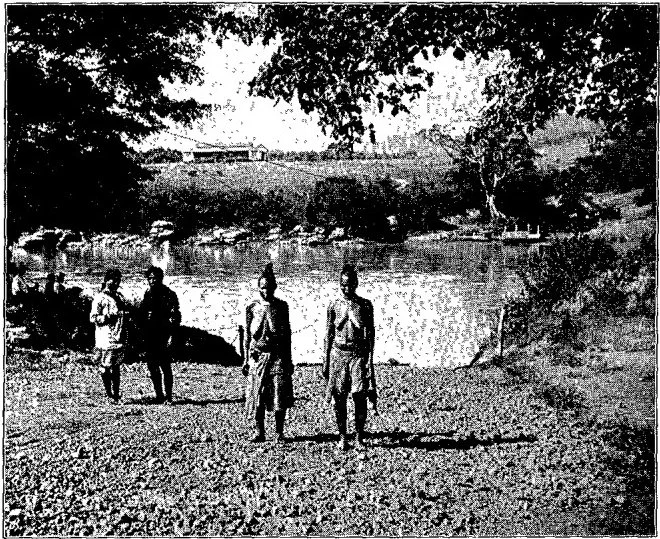
NATAL RIVER, WITH FARMHOUSE AND ORCHARD
IN DISTANCE
NATAL RIVER, WITH FARMHOUSE AND ORCHARD IN DISTANCE
These Hottentots are not like any of the other native races of Africa, either in language, customs, or physique. As to their origin, we have no clue, although many theories are advanced. One thing is certain, that they have migrated from the northern parts of the continent. According to their own traditions, they were once a powerful nation, divided into tribes, each tribe with its chief, ruled over by a king or head chief.
When the Cape was discovered in the fifteenth century, the records state that this people were living in peace and harmony, having large herds of stock, which fact alone would prove them to have been a pastoral people. They believed in a Supreme Being, and in the immortality of the soul, but had no idea of future reward or punishment. Like the Kafirs, they worshiped the spirits of their ancestors, and very much dreaded their influence. There is an insect called the Hottentots’ god, which is held in veneration. They also used to pray to the sun, moon, and stars.
Their weapons differed from the weapons of the Kafir tribes, who use spears, axes, and sticks. The Hottentots had bows and arrows, and often poisoned the arrows.
This people who at one time were so rich in flocks, have been driven by the gradual encroachment of the European colonists and by wars with other tribes, to seek a refuge in the deserts of the interior, among the inaccessible rocks; and are now found in settlements scattered over the Colony, and are practically destitute of flocks. In the Cape Colony records, 1809-11, I find these words: “A people not inferior in natural endowments to any upon the face of the globe were represented to the colonial government as unfit to live.” Had the government been enabled at that period to acquire the information necessary to decide upon the best measures to be adopted, the horrors which have since disgraced the name Christian in these parts might have been prevented.
The Dutch in the seventeenth and eighteenth centuries were determined to make the native a serf (and that spirit has not yet died out), and they denied him the rights of a man. If the native revolted against this treatment, he was put out of the way in a businesslike fashion; but if he submitted, as did most of the Hottentots, he was treated with patriarchal kindness and leniency. The Dutch settlers appear from the first to have disassociated their dealings with the Hottentots from their ordinary code of morals. It was not thought dishonest to cheat them, nor illegal to rob them.
The Hottentot is not so addicted to idleness as the other native races, and is really the most useful laborer the farmer has. He is the most intelligent worker, and is noted for his fidelity to his employer. It is not uncommon to find Hottentots who have been with their employers all their lives, and on no condition would they leave, as they consider themselves a part of the estate.
Unfortunately, many vices have crept in among them, of which drunkenness is the greatest, and this has played such havoc with them that it is bringing about the extinction of the race within the Colony.
The first mission in Cape Colony was established among the Hottentots in the year 1737, by the celebrated George Schmidt. He started the work by opening up what is to-day known as the Genadendal Mission, in the district of Caledon, under the direction of the Moravian Missionary Society. Mr. Schmidt’s health failed, and he left the Colony in 1744. When he wanted to return, the company refused him permission. Although nothing more was done for fifty-two years, the seed sown by the servant of God took root, and fruit was seen when the station was re-opened. There has always been a great deal of opposition to any instruction being given to the Hottentots, and that spirit is very much alive to-day.
This mission station has about five thousand inhabitants. Each family has a house and lot, the latter being large enough for a garden. Besides this, there is a tract of country which is used in common by all for pasturage. The mission has fine dwellings, large church-school buildings, a printing-press, and stores.
This is but one of the missions among this people. There are many more; but there are thousands without these privileges. Many of these people can read and write, and some are well educated. But when are we going to take to them the last message.
I plead for this people. We have not their hard language to learn; for they can be reached with the Dutch. There are many among us who are conversant with that tongue. Who will be the first to say, “Here am I; send me”? A great work can be done for them by working among them with a gospel wagon. It is one of the cheapest, simplest, and yet most efficacious methods of which we know. May the Lord open hearts so that this message may go to these waiting people, and the work be finished without delay.