The Hebrew and Greek Originals the Primary Sources of the Protestant Version
By George L. Robinson
The Origin and History of the Text of the American Standard Edition of the Protestant Bible
The Hebrew and Greek Originals the Primary Sources of the Protestant Version
In these days of MSS. discovery and of the science of textual criticism, Protestants rejoice that they are not bound hand and foot by the church to Jerome's Latin, or to any other version merely, of the Scriptures. During the last century, ancient MSS. of the New Testament have come into the possession of scholars which antedate the translation of Jerome by fifty years or more, and which are older than the extant MSS. of Jerome's translation by over two hundred years. And while the oldest known MSS. of the Old Testament in Hebrew are not older than the ninth century A. D., they are approximately as old as the oldest Latin MSS., and there is every reason to believe that they suffered less corruption in the hands of the Jews during the first ten centuries of our era than did the Latin text of Jerome in the possession of the Western Church. The MSS. of the Vulgate differ widely from one another, and there is as yet no complete critical text of them prepared. On the other hand, all the known Hebrew or Massoretic MSS. resemble one another so closely that the best authorities agree that they represent in the main one and the same text. The greatest probability of mistake in the process of transmission was not subsequent to the time of Jerome, but before; namely, when the scribes exchanged the old round character for the square, shortly before the Christian era. As students of the law, the scribes were not simply copyists, but revisers. Yet their text, from which the Vulgate was translated, was regarded by Jerome as the “Hebrew verity.” The Massoretes aimed only to preserve for future generations the Bible text exactly as it has come down to them. Accordingly, they counted every verse (as they conceived of verses) and the words, even the letters, also, and recorded in the Talmud how often certain words and phrases and forms occurred. Jerome's Latin text, on the contrary, was, as we have seen, continually being revised and corrected by the Greek.
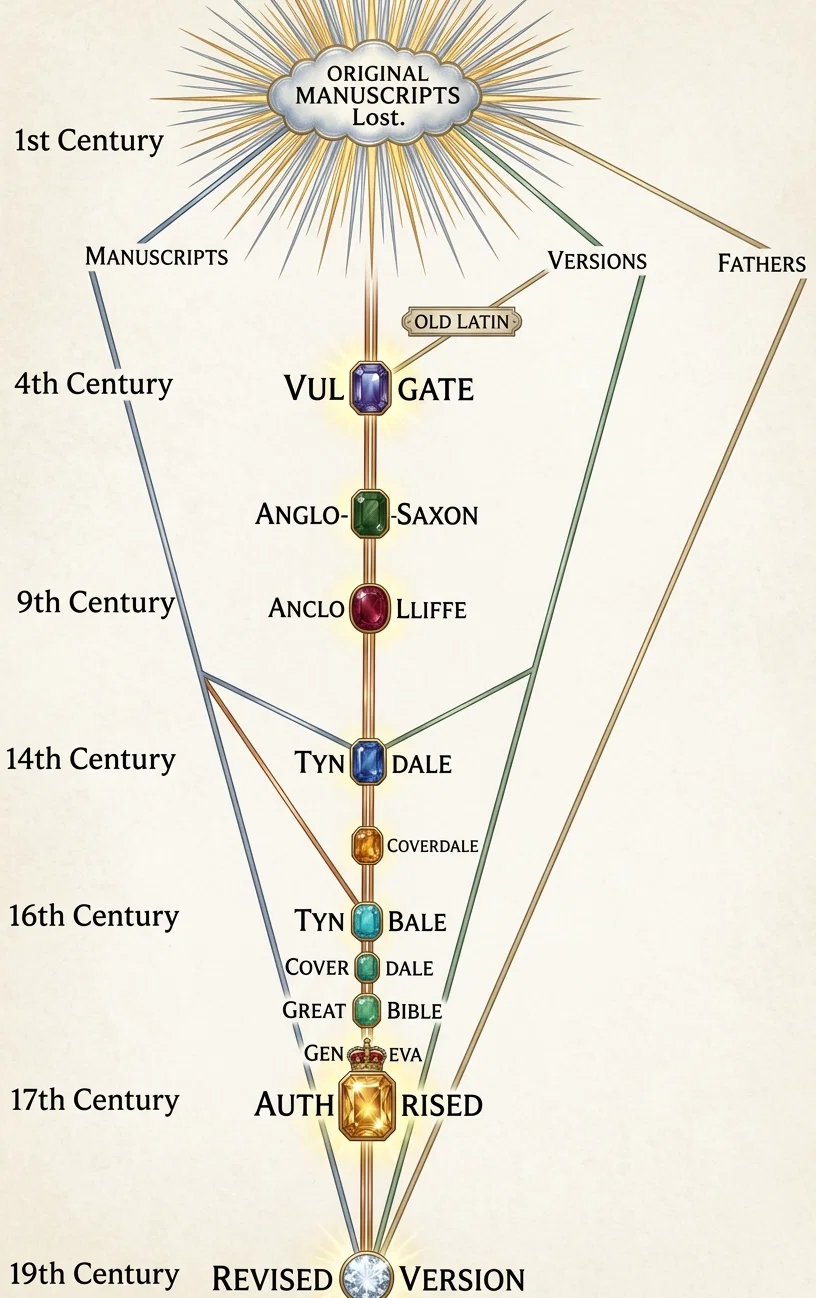
DIAGRAM SHOWING HOW WE GOT OUR BIBLE
In view, therefore, of such facts, writers should be careful not to exaggerate the changes which must have taken place in the Hebrew text and minimize those which actually took place in the Vulgate. The probabilities are that the Hebrew suffered far less than the Vulgate; and that the originals, and not the Vulgate, are the truer source of the Bible text.
Tyndale's Pioneer Attempt at Translating the Original Hebrew and Greek (1525 ff.)
“The history of our English Bible,” says Westcott, “begins with the work of Tyndale, and not with that of Wycliffe.” The latter, though the first, indeed, to translate the Bible into English (1382), used as his basis the Latin Vulgate. Tyndale went straight to the originals, and was perfectly capable of doing so. He had sat at the feet of Erasmus, the celebrated professor of the Greek at Cambridge; and his translation of the Bible gives evidence on every page of his superior linguistic ability, particularly in Greek. He also consulted the Vulgate, the Latin translation of the New Testament by Erasmus, and the German translation of Luther.
He lived in an age of persecution—the reign of King Henry VIII, “the most disgraceful monarch that ever sat on the British throne.” Determined to give the Bible to the common people, and knowing that he could not accomplish his purpose at home, he fled to the Continent and pursued his work in exile. He lived to see a part only of his task completed. But before he was strangled and burned at the stake, he had succeeded in translating and publishing the whole of the New Testament (1525), the Pentateuch (1530), and the book of Jonah (1531). He also translated, in prison, the books of the Old Testament from Joshua to 2 Chronicles, which were left in MS., and afterward used by Coverdale in completing his version. He also corrected and published his New Testament in two revised editions (1534-35).
The character of Tyndale's work is unimpeachable. Writing to his friend in Fryth in 1532, he says, “I call God to record against the day we shall appear before our Lord Jesus, to give a reckoning of our doings, that I never altered one syllable of God's Word against my conscience, nor would this day, if all that is in the earth, whether it be pleasure, honor, or riches, might be given me.”
Many excellences of Tyndale's translation are very wonderful. Even Geddes, a Catholic scholar, writes: “In point of perspicacity and noble simplicity, propriety of idiom and purity of style, no English version has as yet surpassed it.” To be sure, his bitter persecutor, Bishop Tunstal of London, claimed that there were some two thousand errors in his translation, but among those cited the most serious are his having employed “seniors” for “priests” or “elders,” “congregation” for “church,” and “love” for “charity.” On the whole, it is a noble translation, and as such has become the basis of every subsequent revision.
Coverdale's Completion of Tyndale's Task (1535ff.)
Coverdale finished what Tyndale, by his untimely death, left incomplete, and published the first complete printed edition of the Bible, in English. But he11did so on the basis chiefly of the German and Latin versions; and, accordingly, it is impossible to class his Bible among primary translations. He appropriated Tyndale's labors along with his own, and dedicated the whole to Henry VIII. In his dedication, he avows that he has honestly handled the Word of God. He says, “I make this protestation, having God to record in my conscience that I have neither wrested nor altered so much as one word for the maintenance of any manner of sect, but have with a clear conscience purely and faithfully translated this out of five sundry interpreters, having only the manifest truth of the Scripture before mine eyes.”
His translation, however, did not succeed in satisfying either the king or Cranmer, the Archbishop of Canterbury; for it did not obtain the king's sanction, and the work of revision went steadily on.
Matthew's Version; or the First Revision of the Protestant Bible in English (1537)
Matthew's Bible possesses very little independent value, as it consisted, with certain alterations, of Tyndale's Pentateuch, his unpublished translation of Joshua to 2 Chronicles, his version of the New Testament and the book of Jonah, and of Coverdale's Prophetic and Poetic books, with the Apocrypha. And yet, though only a composite work of the character described, it was the first version to become “authorized,” and the labors of the next twenty-five years were devoted to improving it in detail. Its merit was to present the earlier texts in a combined form. It has never exerted any independent influence upon any succeeding version; it could not, as it was wanting in originality. Two thirds of it was Tyndale's; the other third Coverdale's. Perhaps this accounts for the editor, John Rogers, adopting an assumed name for his composite production. It was essentially a transitional work.
The “Great Bible;” or the Second Revision of the Protestant Bible (1539)
The publication of the “Great Bible” marked a new epoch in Bible reading. A copy was required to be set up, with the king's authority, in some convenient place in every church in the kingdom. This version owed its origin to the zeal of Thos. Crumwell, Earl of Essex, at that time chief minister of Henry VIII, who, it seems, invited Coverdale to undertake a revised translation on the basis of Matthew's Bible, but with a more systematic collation of the Hebrew and Greek originals than had previously been attempted. Coverdale responded, and describes his mode of procedure thus: “We follow,” he writes, “not only a standing text of the Hebrews, with the interpretation of the Chaldee and the Greek; but we set also in a private table the diversity of readings of all texts.” It became the authorized version for the next twenty-eight years, and strictly speaking still remains the only “authorized” version which the Protestants have, as there is no historical proof that the King James's Version was ever formally authorized.
Seven editions were issued in rapid succession; all except the first having a preface by the Archbishop of Canterbury, and, therefore, sometimes spoken of as “Cranmer's Bibles.” It is, perhaps, not generally known that the psalter of this version is still in use, having been incorporated, on account of its charming rhythm, in the prayer-book of the Church of England (1662) in preference to the version of King James. The text, however, is far from being accurate. Insertions from the Vulgate which are no part of the original, are frequently retained, only printed in smaller type.
The Genevan Version; or the Third Revision of the Protestant Bible (1560)
Tyndale's, Coverdale's, Matthew's, and the Great Bible all belong to the reign of Henry VIII; the result practically of the labors of but two men,—Tyndale and Coverdale. The next step in the process of producing the Protestant Bible was that taken by a group of exiles, who, during the persecutions of “Bloody Mary,” fled to Geneva, and there under the influence of John Calvin translated the Bible into English from the originals throughout. Whittingham's New Testament appeared first (1557). But the exiles of Geneva were not content until they had translated the Bible entire. This occupied them for more than two years. Meanwhile Elizabeth had succeeded to the English throne, and they accordingly dedicated their translation to her (1560). They left on record an account of how faithfully they endeavored to perform their task. For the Old Testament, their basis in English was the Great Bible; for the New Testament, Tyndale's, with Beza's revised Greek text, which with all its faults was the best that was at hand. They printed their version in Roman letters, which was a vast improvement upon the heavy Gothic or black letters of former versions; divided their text for the first time into chapters and verses, introduced italics to show that certain words had no literal equivalents in the original, and produced a Bible, which, though never sanctioned formally by church or state, for seventy-five years was the household Bible of the Protestants of England. Of their version Bishop Westcott says, “It is the most important revision which our English Bible underwent before the settlement of the received text.” It passed, in all, through more than one hundred and thirty editions, and was issued as late as 1644. It was the Bible of the Puritans. Its outstanding feature is that it was the product not of a single individual with two or three assistants, but of a group of earnest revisers.
The Bishops' Version; or the Fourth Revision of the Protestant Bible (1568)
For many Anglicans the Genevan Version was too Calvinistic; at the same time, it became more and more evident that the Great Bible was not able to hold its place alongside of the new version, which was considerably more accurate. Accordingly, Archbishop Parker of Canterbury took measures to have the old translation revised. He designated certain bishops, not less than eight, and apportioned the work among them. After four years of faithful and uninterrupted labor, they completed their assignments, their work was reviewed by the archbishop, and printed, without dedication (1568). As a revision, it was based upon the Hebrew and Greek, but no changes were made in the text of the Great Bible which were not demanded by the originals. The Apocrypha was taken from the Great Bible, but left practically unrevised. Parker's design was to secure a uniform text for public use, to remove all errors, and to produce a popular, not a literary version. But the work of the bishops was of very unequal merit. Not infrequently, the changes which they made were arbitrary. Consequently, the version can not be regarded as a success. Yet it gives evidence of close study and great fairness. It succeeded, indeed, in supplanting the Great Bible, but it was not able to compete with the Genevan.
In all, about thirty editions of it were published, the last appearing in 1606. During the same period more than one hundred editions of the Genevan were issued. The second edition of the Bishops' (1572) was the immediate basis of the King James's Version.—Prof. George L. Robinson, Ph. D., in The Bible Record for November, 1905. (To be concluded)