Mission Work in Samoa

5%

Review and Herald Publishing Association · Washington, D.C. · Feb 25, 1904

FromReview and Herald, Vol. 81, No. 8.

Read the full edition

Mission Work in Samoa

W. E. FLODING
Our work in Samoa was first established in the fall of 1895, as the Samoa Medical Mission. But since the Lord blessed us with grounds and building, it has been called the Samoa Sanitarium.
Hundreds and thousands of patients have visited our sanitarium,—many from mere curiosity, and many to receive help for their physical ailments.
When Dr. Braucht, with his helpers, began the pioneer work in Samoa, the natives came in such large numbers that it was impossible to attend to all who would come every day, so numbered tickets were given, that he might do justice to all. The work had not been going on very long till the doctor was looked upon by the Samoans as a wonderful man, and of great wisdom. He was known all over the islands as the Fomai Jutaia (the Jew doctor). This name was given to him by the missionaries, because the doctor was an observer of God's Sabbath. And ever since, he is known to all Samoans by that title.
A few who have asked if it was his people who killed Christ have learned different. Many, when asked why they call him a Jew doctor, have no special reason, only that that is the name by which they first learned to know him, and which designated his peculiarity as a Sabbath observer.
All work in treating the sick not absolutely necessary was discontinued on the Sabbath, that the workers might have a day of rest unto the Lord. This always required more or less explanation,—that Saturday is the seventh-day Sabbath, and that they as observers of God's law were keeping the wrong day. To this they would reply that that was the day they used to keep, but the missionaries changed it, on account of the steamers coming in on Saturday, then called Sunday. The arrival of these steamers always meant a great deal of excitement on their sabbath. It afforded opportunities to the Samoans to earn some money by taking passengers to and from the steamer (as they have no wharves in our harbor), selling curios, and giving heathen dances, and diving for money thrown overboard by the passengers. The Christianized Samoans were not supposed to take part in any of these things, but among them, as well as among civilized nations, the majority take the name of Christ that they may have a good name and be trusted more.
That they might not have so many temptations on Sunday when the steamers would come, it was changed from the seventh to the first day of the week—not for Sunday's sake, but because the steamer came on that day. The first people coming to the island, in crossing the day-line had not skipped a day to be in harmony with the rest of the world, so Sunday came on the seventh day of the week, instead of the first, until it was changed by the missionaries.
Our mission has been a standing testimony to all the people, of the seventh-day Sabbath. Every Sabbath intruder, unless an emergency case, has been sent away, and has been told to wait. And those coming for consultation, to buy medicine, pay bills, or for any other business for which the first six days of the week were created, were never received on the Sabbath.
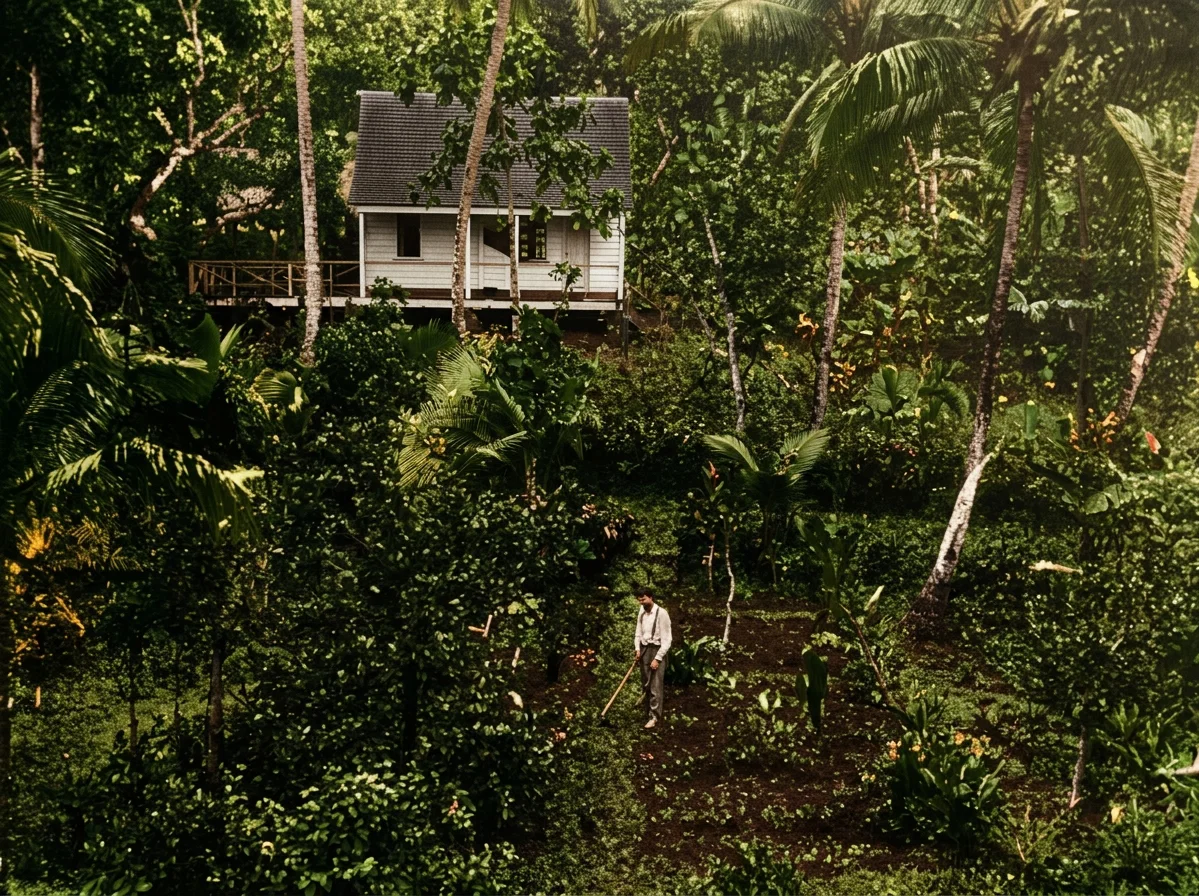
COTTAGE, SAMOAN SANITARIUM
All Samoans know that tobacco, tea, coffee, kava, salt meat, fish, canned meats, shell-fish, etc., are forbidden when they come to the sanitarium for treatment, and they never forget to ask what is forbidden, but often appear to forget when they are eating, and thereby some have passed through dangerous experiences.
There are enough schools and opportunities to give every Samoan an ample education. There is every chance for them to be taught the Word of God and to know him. But where Satan has succeeded so well in blindfolding, there is need of much hard work and persuasion, to dispel the darkness. They quickly acknowledge the truth, but it is very difficult to get them to apply it to themselves. There are few who have any stability of character. Where life comes so easy, there are not those experiences that develop thought and an appreciation of God's goodness and mercy and a desire to grow in grace and a knowledge of the truth. Days come and go, time is no question; so they can follow the customs and traditions of their forefathers. The gospel is accepted as a matter of convenience.
The Samoan will acknowledge the truth, and that he ought to do differently, but he has not the power to do so, because of the customs which he permits to stand in the way of God's commands. God's law and the Lord's prayer are memorized, and repeated every Sunday with a breath foul with tobacco. Those who do not smoke are very few.
They live together in villages varying in size. Each village has its chief, and everything is held in common. As a rule, they all work, worship, and play together, making it very hard for any one who wishes to do differently. They think a great deal of their customs; this is anything but a help to them spiritually. Often the most trifling disregard of custom will cause enmity. The Bible has to be secondary when Samoan customs stand in question. But when the natives are sick, their cry is, “God overrules.” Most of the time they do what in their judgment ought to be done, thereby often killing a person who would live if left alone. Whatever happens, “God overrules.” Satan gets the blame if the patient dies. Of every death that I remember, the spirits of departed friends carried off the souls of the deceased. The spirits are called devils, and it seems they are always associated with sickness, and the native doctors give treatments with leaves, poultices, and massage, by which these devils are charmed or expelled, I do not know which. They catch them at the tip of the ear, the big toe, or some point. The doctor picks them off, and the patient gets well. The Samoan pastors do a great deal of praying for the sick, but their actions make it impossible for God to answer prayer.
Nearly every village has a nice large stone church, where all go to worship, unbelievers as well as believers bow reverently upon entering the house of God, and offer a silent prayer. All take a hearty part in singing, praying, and saying the ten commandments. They all look alike, and act alike, so it is pretty hard to tell the pious from the wicked. And it is a common thing for church-members, if they have a grudge against their pastor, to hurt him by joining the Catholic church, or one of some other faith.
At the same time, there are some nice people among them, taking into considerationtheir environments and race. There are many who know they are doing wrong, and have expressed themselves as wishing to do better, but a lion is in the way.
With the Samoans, the missionaries who have the greatest following have power something like a chief. Whatever they say is done in a way. If you prove to the natives from the Bible that they err in something, they can not change, unless the missionaries say, “All right,” and then the whole church changes. Nevertheless, I know the Lord has honest souls among the Samoans, and that some will be ready to meet him when he comes.
As soon as we get some literature to work with, I believe we shall see good results. Being so far from civilization, a great deal of time is consumed by having our literature published several thousand miles away. We hope in a short time to have the book “Christ Our Saviour,” printed in Samoan, and we expect some tracts as soon as there is opportunity for them to come, which we believe will be a help in finding those who shall be ready to stand before God and rejoice to see him face to face.
Thus far all I have been able to do has been to reason with the people out of the Scriptures, and help the sick, of whom there are so many that a person's whole time could easily be occupied doing nothing else, especially by giving free treatments. As it is, the doctor has his hands full.
When I think of the millions who have not heard of the Word of God, and where missionaries have not yet been, I feel that the young people who have a burden for souls ought to make an earnest effort to reach such fields. There are great opportunities and advantages in being the first, or among the first, to enter. I believe the heathen who have not heard the Word of God will be more ready to accept the truth as it is in Christ than so-called Christianized heathen, who have been preached to death, and to whom the Word of God apparently means so much talk. Furthermore, the missionaries of other denominations can not then tell our missionary to enter some new field, and not come following after them. It is a splendid thing to know how to take care of the sick people, and not to be afraid of losing respect by doing work that requires a pair of overalls or an apron, when circumstances so demand. Above all, do not forget the object of your labor. Pray for Samoa.