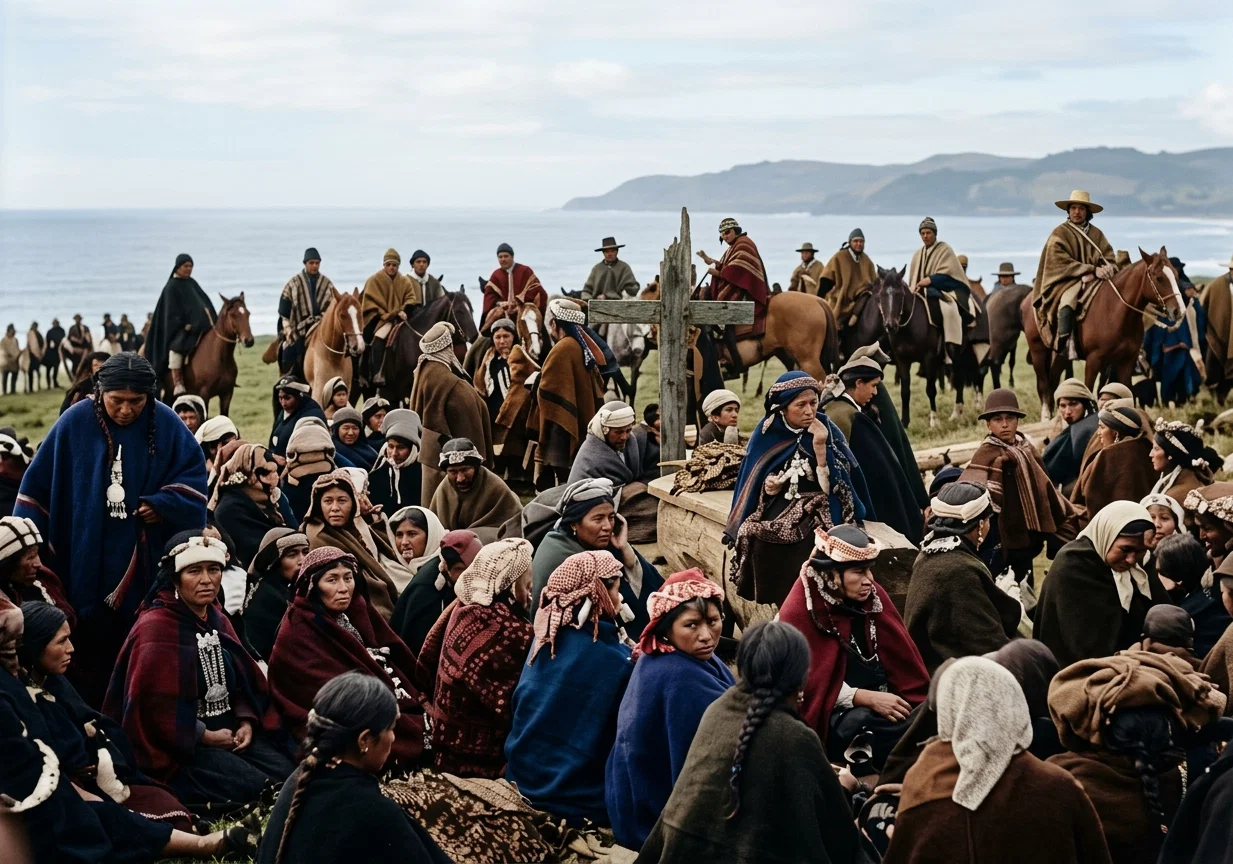
After an hour’s ride along the seashore south from Bajo Imperial, on Sunday morning, November 1, we arrived at Pillaf, an Indian village, where, according to the announcement, an Indian chief named Ignacio Puelpau was to be buried. Already there had assembled four or five hundred Indians from various directions, to pay their last tribute of respect to the remains of the well-known chief.
AT THE FUNERAL
At sundown the evening before, the coffin containing the body was dragged by two yoke of oxen to the top of a little knoll overlooking the expanse of the broad Pacific. This was to be the site of the ceremony. The coffin, as may be seen in the accompanying picture, was made by hollowing out a log in the form of a canoe. A three-inch plank hewn from a log formed the covering. A rude cross was planted at the head. Around this the wives of the chief, the relatives, and the most intimate friends gathered to pass the night weeping and mourning by the body of the deceased.
They were provided with a large quantity of all kinds of flesh meats, the rarest of which was horse flesh, a delicacy indulged in only on great occasions. They were also well supplied with wine, and the native mudai, which is a drink made from corn.
The process of making this last-named drink is very novel. I will tell it just as it was told to me, and confirmed by one of the chiefs. When a person of rank dies, they at once begin preparations for the funeral, which is to take place ten days later. A number of women surround an iron kettle on the floor. A quantity of corn is given them, which they are to chew, but not to swallow. When it is thoroughly masticated, they spit it into the kettle, and with a fresh supply repeat the process until all the corn is thus ground. Water is then added to the mass, and it is placed over the fire to boil, after which it is poured into a keg, and set aside to ferment until the day of the funeral, or elon. This is considered the most delicious of all drinks.
Supplied with meat and mudai, the friends of the dead chief passed the night around the coffin. Sunday morning other Indians began to arrive from all directions, and by noon their numbers had increased to more than a thousand. Soon after our arrival the trilla began. About thirty or forty horsemen galloped around in a circle, inside of which was the coffin and the mourners, as seen in the illustration. All shouted and yelled and made the most hideous noises, for the purpose of frightening away the “evil spirit.” This continued for about fifteen minutes, when all retired to one side. The ceremonies then ceased, while the multitude was generously served to meat and mudai. Fortunately for my companion and myself, we had our lunch with us. About two o’clock in the afternoon they had the great trilla in which more than two hundred horsemen participated. The hundreds of hoofs soon filled the air with such a cloud of dust that we could see only those nearest to us. After this the most intimate friends of the deceased gathered around on either side of the coffin to bid the chief good-by. They believed that he was just starting on a long journey to the “happy hunting grounds,” and amid their sobs they bade him farewell. They related to him everything of interest that had occurred during the last ten days since he had died, bidding him to tell it to their friends who had gone on before.
One’s heart would needs be of stone not to be touched by a scene so pathetic, the saddest part of it all being that they die with no hope in the Saviour in whom we believe. Here in the south of Chile are hundreds of thousands of these poor, ignorant, superstitious creatures who live and die without any hope in Christ.
After two more trillas, they attached two yoke of oxen to the coffin, and dragged it to the panteon, or cemetery, where the burial took place, not without preparations being first made for his long journey. His favorite horse was killed, and the skin, with the hoofs and head attached, was placed in the coffin with him. This was given to him to ride to the “happy hunting grounds.” A knife, some meat, some flour, a spoon, and a kettle for cooking were placed in the coffin beside him, also a mantle and a good supply of wine and mudai. They also provided him with a bundle of sticks to kindle the fire to do his cooking on the way. Gallons of mudai were poured over the coffin after it had been put into the grave, after which the grave was filled up. Thus in this twentieth century are these people still groping in midnight darkness with not a ray of light.
While at the funeral I met again the old Indian chief of whom I wrote some time ago, who wanted a school on his land. He was anxious to know how soon we could have a school for his children and for the children of his people. He said: “We Mapoches are very ignorant, and don’t know anything. The Chileans take advantage of our ignorance, and rob us of all that we have. We need some one to teach us.” I told him: “Yes, I know that the Mapoches are ignorant. When I came here to-day and saw all these poor, ignorant people, it made me want to weep for them, and want to teach them about our God.” It touched him when I told him that I felt sorry for them, and he said that he wanted a school so much, and that he had more confidence in us than in anybody else.
He is the most honorable of all the Indians in all that part, and has more Indians under his control than any other chief. It seems to me, dear brethren, that it is our time to make a beginning among this people. Here we can start work among them with very little cost, and he will give the land and the lumber for a house. These hundreds of thousands must hear the message in their own tongue.
One of our best workers has a strong desire to spend his life in labor for these people, but he can not be spared until we have some one to take his place. He and the writer are the only workers in the field among all these ten millions of people. We are still straining our eyes toward the homeland, hoping to see some one coming to our help. And shall we look in vain? We are praying that God will send us some one, and we believe that he will answer our prayers.