The Balkan Meeting

7%

Review and Herald Publishing Association · Washington, D.C. · Feb 18, 1904

FromReview and Herald, Vol. 81, No. 7.

Read the full edition

The Balkan Meeting

GUY DAIL
TUESDAY afternoon, October 20, Elders Conradi and Huenergardt and I left our pleasant surroundings in the Caucasus, for the Balkans. A journey of sixty-four hours via Rostov and Taganrog, past thriving towns and villages and developing mines of iron and coal, through the renowned “black earth” region of South Russia, brought us to Odessa, the second port of Russia, which is a very nice city, with four hundred and five thousand inhabitants. We hastily registered at a hotel. On making inquiry concerning the best route to Rumania, we learned that in the evening a ship would leave for Galatz, so we secured the necessary vise to our passports, and left the harbor about sunset. Fourteen hours on the Black Sea enabled us to reach Sulina, Sabbath morning. The greater part of our route from Sulina to Tulcea lay through the international canal, which was formed at great expense by confining and deepening the middle outlet of the Danube; thereafter, until nine o’clock in the evening, we were on the bosom of the broad, meandering stream. We stayed all night in Galatz, and had a good sleep. Sunday morning we took the train for Faurei, Feteschi, and Constanta, on the Black Sea. We crossed the Danube, on the famous Cernavoda bridge, one of the great bridges of Europe, and certainly a credit to the Rumanian government.
We arrived at Constanta, the place of our Balkan meeting, about nine o’clock Sunday night. This is Rumania’s only seaport, and is provided with a fine harbor. It is the national bathing resort, and is one of the reputed birthplaces of Ovid, the Latin poet, in whose memory there stands a nice monument in one of the public squares. It is the eastern terminus of Trajan’s celebrated wall, erected near the Roman frontier to protect the empire against the inroads of the barbarians. The city contains about eleven thousand inhabitants,—Rumanians, Turks, Greeks, Jews, Bulgarians, Armenians, Servians, Russians, Hungarians Germans, and Gipsies, so that the streets of the town present a veritable, living kaleidoscope, revealing the quaint dress and the typical costumes of many nations. Here, as in other parts of the broad and fertile valley of the Danube, we saw a number of artificial hillocks, erected as watch-towers and ramparts for the Moslems during their supremacy. It must be remembered that for centuries the Balkan Peninsula has been one of the great storm-centers of the world, and that it is to-day the home of political unrest, discontent, and eagerness for revolution, the dwelling-place of insecurity and perpetual uneasiness, the battle-field where must be fought out the great Eastern question.
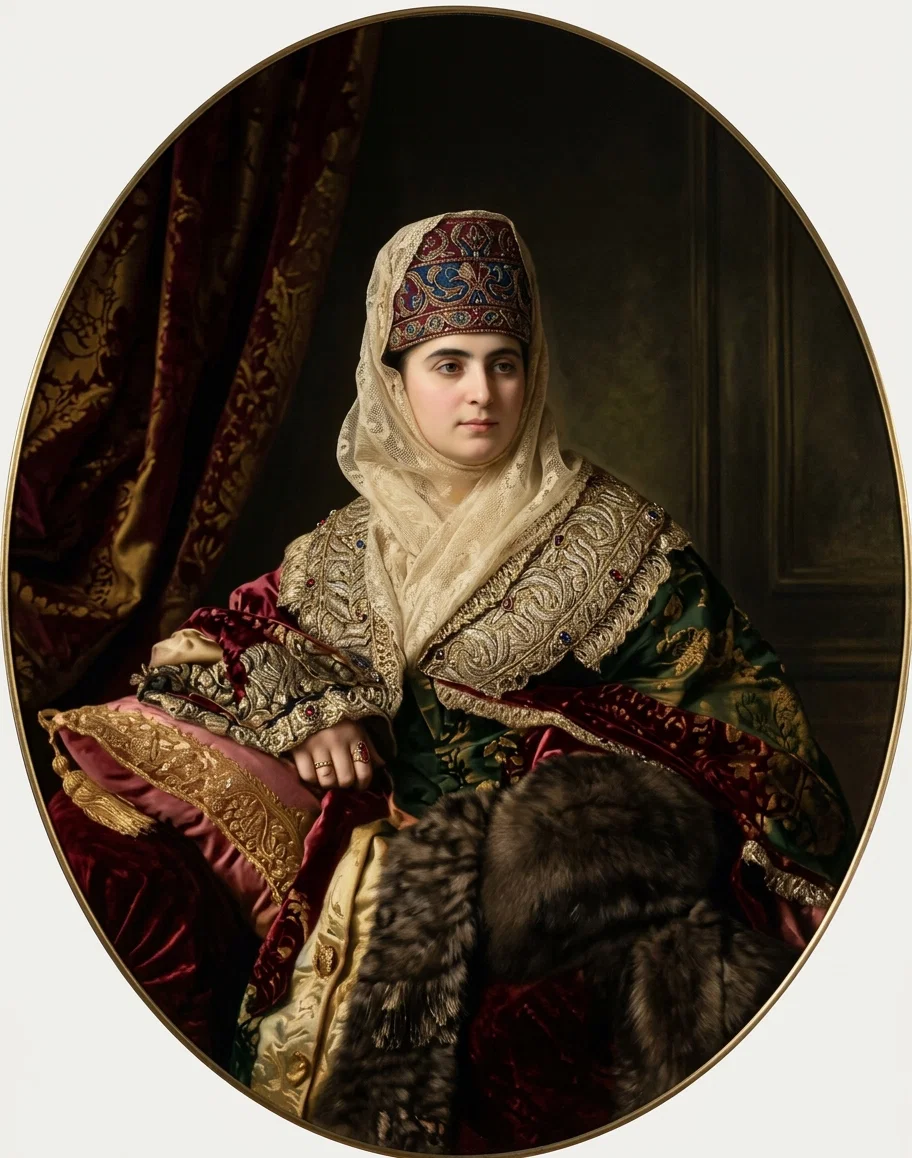
AN ARMENIAN LADY
AN ARMENIAN LADY
In the territory of the Balkan Mission are Rumania, Bulgaria, Servia, and Montenegro. These states have been formed from the dwindling European dominions of Turkey, since 1861, by the aid of Russia or Austria, and with the consent of the powers.
The country of Rumania was separated from Turkey in 1861, and formed into a kingdom in 1881. It is about the size of New York and Rhode Island, and has 6,100,000 inhabitants. At nearly every station we saw immense piles of wheat, sacked and ready for shipping. Annually, forty million dollars’ worth of cereals is exported. Of the constitutional principality of Bulgaria, one could form the States of Connecticut and South Carolina, so far as area is concerned, while its people, whose chief occupations are agriculture and the raising of flocks and herds, number 3,800,-000. Servia, a constitutional kingdom, is as large as the three States of New Hampshire, Massachusetts, and Rhode Island; and the majority of its 2,550,000 inhabitants are engaged in herding swine, which feed in almost countless numbers on the acorns that grow in the immense oak forests. Montenegro is an absolute principality. It fought against the Turks for two hundred years before it secured its independence, in 1878. It is really an impregnable mountain fortress. It is not thickly populated; there are only 227,840 people there. It is as large as Rhode Island and Delaware together; its area is 3,630 square miles.
Thus far most of our work has been done among the Germans that live in Rumania; some effort has been put forth in Bulgaria. As to literature in the leading languages found in the Balkan Mission, we have “Steps to Christ,” “Matthew Twenty-four,” a selection of “Bible Readings,” “Full Assurance of Faith,” “Seven Reasons for Sunday-keeping Examined,” “Blessed Hope,” “Which Day Do You Keep, and Why?” and “Sabbath and Sunday,” in Rumanian; “Steps to Christ,” “Bible Readings,” “Blessed Hope,” “Is the End Near?” and “Which Day Do You Keep, and Why?” in Bulgarian; and “Full Assurance of Faith,” “Blessed Hope,” “Seven Reasons for Sunday-keeping Examined,” and “Sabbath and Sunday,” in Servian.
The meeting had been announced for a later date, so things were not quite so well prepared as they might otherwise have been; but there was yet time to call together a goodly number of the eighty-seven believers in this field, which was represented by between forty and fifty brethren, October 28-31. We were glad to see such an earnest spirit manifested by the believers who were present. There was deep humiliation and confession of sin. Educational, evangelical, publishing, and health-reform branches of the cause were all given due consideration. Quite a number of our people are planning to leave Rumania, as our German brethren find it so difficult to purchase land; they will, in the main, move to the eastern part of Germany, where large estates formerly owned by Bohemian noblemen are sold to returning German emigrants, on very easy terms. This weakening of our Balkan membership makes it very imperative that we begin a more earnest campaign among the native peoples of the peninsula.
There was in Constanta one Armenian family, the father and mother of which could not understand German, and they knew very little Rumanian (the evening discourse was translated into Rumanian from the German), and yet they were generally present. I could but think how true we ought to be in attending the services of the Lord’s house, when they are conducted in our native tongue.
During the first three quarters of 1903.twelve were added to the Balkan membership; the tithe amounted to $412.22; offerings, $22.45. Two ordained ministers and one Bible worker received permission to continue their labors in this field, but the missionary licentiate had to flee from the country soon after the meeting in Constanta.
The circumstances leading up to this brother’s exile may be interesting and instructive. All have doubtless heard of the Macedonian troubles. Naturally enough, political feeling runs high. The Bulgarians sympathize with the Macedonians; the Rumanian government favors the Turks. There are many Macedonians in Rumania. Our Bible worker is a Macedonian, and therefore a Turkish subject. He was working with one of our ordained ministers, a Russian. They were laboring in Bucharest, the capital city, which contains two hundred and eighty thousand inhabitants. They decided to speak of the final fate of the Turkish government, as revealed in Daniel 11. When these lectures were given, detectives were present, and heard everything that was said. They misinterpreted the nature of our meetings, declared them to be political in their nature, and, consequently, forbidden. One can readily see that it is a very unwise thing for a Turkish subject to say anything that can be twisted and distorted into opposition to that government, in a land that especially sympathizes with the Ottomans. As might be expected, the brother had to flee, to save himself from being handed over to the Moslem authorities as a seditionist and revolutionist.
En route to Arad, Elder Conradi expected to speak to our little company of believers in Bucharest. Unknown to him, it had been advertised in the city papers that he would lecture on the Eastern question. When we went to the hall, we found that the police had been there and blown out the lights. Our brethren entered the place, and it was soon relighted. From one hundred to one hundred and twenty intelligent, well-dressed, wide-awake people came in; but just before time for the service to begin, the detectives came and inquired for Mr. Conradi. They took him before the mayor. The mayor said that he had but one question to ask: “Mr. Conradi, do you intend to speak to-night, or not? If not, you are free to go.” Owing to the manner in which the meeting had been advertised, we could not deny the political coloring it seemed to bear, and Elder Conradi saw that it would be folly to raise the cry for religious liberty, when the authorities had such good grounds for suspecting that the meeting was of a political nature. He quietly agreed not to speak, and had to leave the city without addressing our brethren. We believe this instance teaches, and that the general experience of our people will show, that we have no need whatever of resorting to sensational, politico-religious methods in our attempts to spread the everlasting gospel. What we need is the power of God, and not the power of sensationalism. Our business is to preach Christ and him crucified, and not to be continually finding fault with the government and with everything that it or its representatives may do. There is no call for our berating those who rule over us: we are commanded to pray for them, and as far as in us lies, to live peaceably with all. In many of these European fields the unwise actions of one man may do almost infinite harm to the cause which he professes to represent. We should be as wise as serpents, as harmless as doves.
In behalf of our work and workers in the great Balkan Peninsula, we would ask the prayers and sympathy of God’s children everywhere. Difficulties there are, and enough of them, but God will give those who trust him the final victory. And there are no more hardships to be borne here by his children than we may soon expect to encounter in the most favored lands of earth.
Hamburg, Germany.