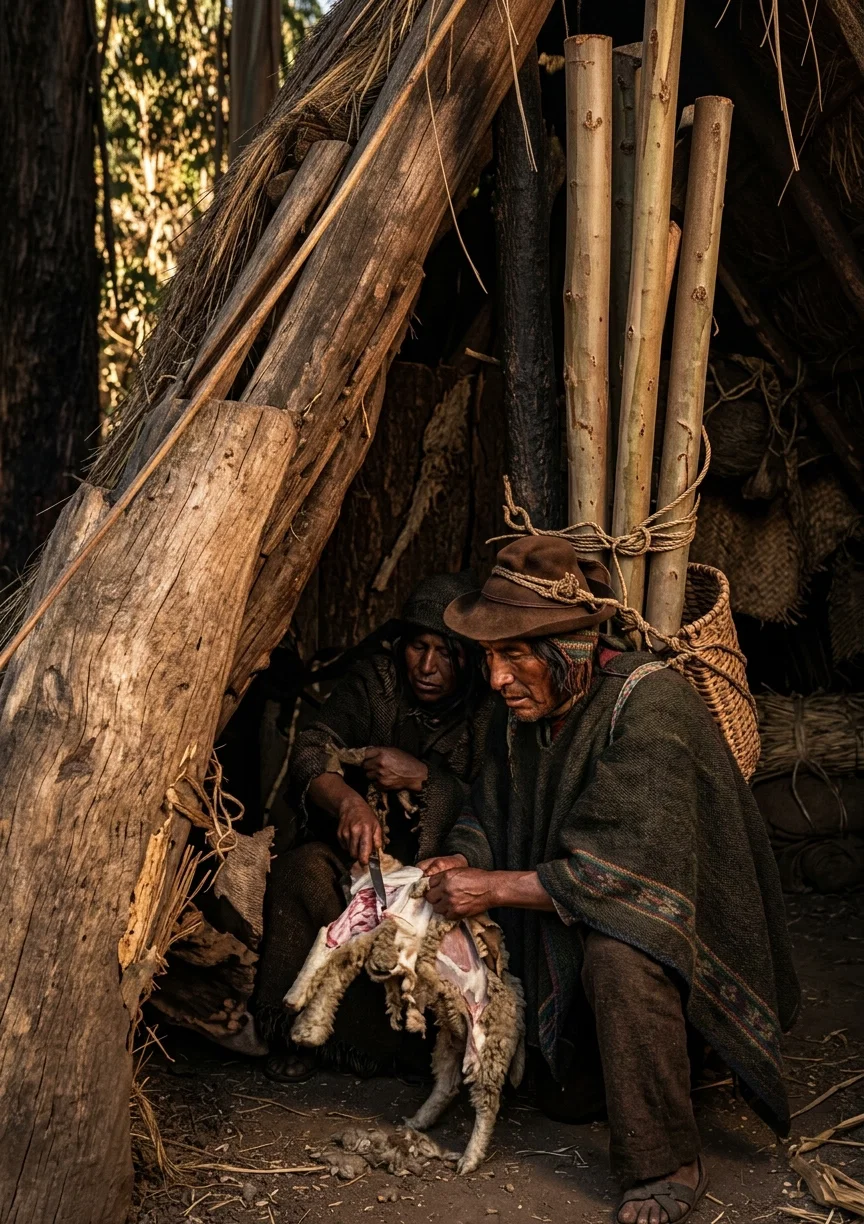
The accompanying illustration shows some of the South American Indians, our near neighbors. They objected to its being taken, and wanted to be paid. They are very superstitious, so the picture was taken unawares. They are here skinning a lamb.
The young girl came to the door the other day with a basket strapped on her back, in which she had a special kind of bean that grows here. On being asked if she wanted to sell the beans, she said, “No, no; a reglo” (gift). Thanking her, we took them and gave her some other things in return, as they always expect it.
SOUTH AMERICAN INDIANS
They can be heard at night making strange noises, hallooing, pounding, etc., when any of them are sick. This is to drive away the evil spirit. As a class they are harmless,—much less so than the Chileans,—although they will steal anything that is left in their way. They know nothing of God, and must be told the story of the cross in their own language, since their knowledge of the Spanish is limited. There are about five millions of these poor souls in South America. As yet we have not a single worker among them.
We are now located on the land that has been selected for a school. We have built a four-room square cottage, which will be used for a part of the school building later. In another year the main building will be erected, if the Lord permits.
‘It is indeed a restful change to be in the country, surrounded with green grass and lofty trees, after having lived in the crowded cities of the northern part of Chile, where the sandy hills are absolutely barren.’ Valparaiso has its attractions, being16built in the rugged hills, overlooking the blue bay of the Pacific. But the southern part of Chile is very fertile. It is said that in the past there were twelve different kinds of beans raised here by the Indians. Even yet there are many varieties. Fruits grow in abundance, and in their season can be procured very cheaply. It is a good country for vegetarians. The natives use a great deal of meat, and liquors in abundance.
We are located about fifty miles from an active volcano. One can stand in our door and watch the smoke rolling out during the day, and often see the fire at night. It is a pretty sight, as the mountains are covered with snow the year round. There are a few other volcanoes in sight, but only this one is active at present. Slight earthquakes are quite common, being more frequent in the north, but stronger in the south.
One can have almost any climate desired in Chile—hot, cold, wet, or dry. In the north it is hot, and never rains. In the central part it rains in the mountains only. In the south it is cold, and rains unceasingly in the winter.
All kinds of business are open to one coming here. Even among the better classes the natives respect a foreigner. The people live mostly in the cities, as they do not like the country. We need consecrated, thrifty, industrious farmers from the States, to move here, and show by example what can be produced. They can be self-supporting missionaries, and a great power for good. The Lord has a work for such brethren.
As for the moral condition of the country, it is well described by D. E. Dansin in the Christian Worker:—
“Although it is a land of great outward show and pretension, a land of churches, of convents, of priests, of nuns, of crosses, of holy water, of images, of rosaries, and all the rest of the paraphernalia of priestcraft and idolatrous worship; at the same time it is a land of ignorance and sin. Gross idolatry and blind fanaticism there go hand in hand with stupid iniquity, lying, theft, and deceit, even in the very pretended temples of God and by the very priesthood who serve at the altars.”
But there are honest hearts even among these, who are seeking for light. Shall we point them to it?
“What though the spicy breezes
Blow soft o’er Ceylon’s isle;
Though every prospect pleases,
And only man is vile?
In vain with lavish kindness
The gifts of God are strown;
The heathen, in his blindness,
Bows down to wood and stone.”