The Head Physician of the Late Pope a Friend to Our Principles
By Chas. T. Everson
CHAS. T. EVERSON
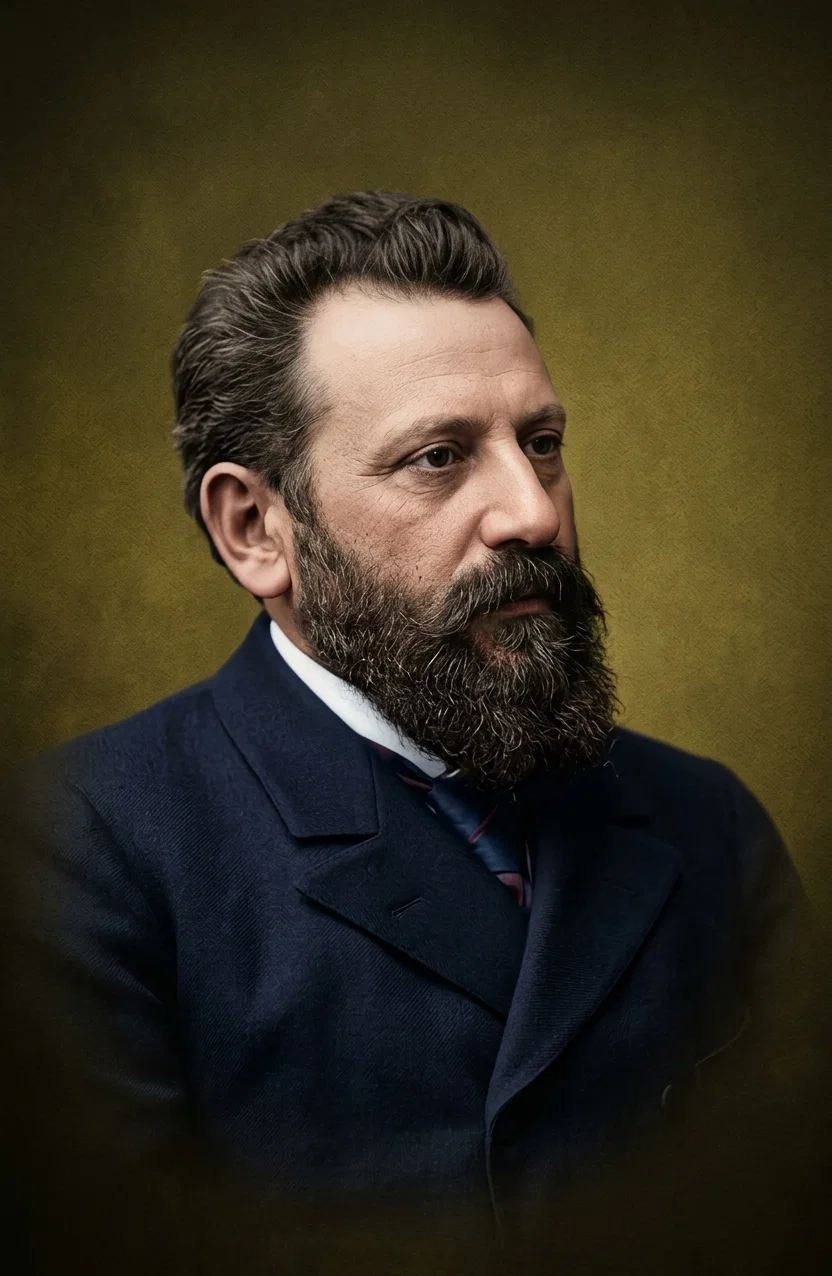
A SHORT time ago the eyes of the world were directed toward the Vatican because of the serious illness of Leo XIII, which sickness finally culminated in his death. Catholics in all parts of the world prayed for the recovery of the head of their church. Even kings and princes mingled their petitions with those of priests and prelates on behalf of the Roman pontiff. With so much solicitude felt for the condition of the pope's health, special interest would naturally center in the man who was the chief agent in answering the prayers of princes and prelates and the petitions of the great body of the Roman Catholic Church. This man upon whom the late pontiff15relied as a child does upon its mother, was Prof. Gaetano Mazzoni.
Professor Mazzoni was born in one of the small towns of Italy, but came to Rome to finish his education. He was graduated with honors from the medical department of the University of Rome; and by successive severe examinations he passed from one hospital to another until he became the assistant surgeon to all the hospitals of Rome. And in 1891, because of his extraordinary ability he was chosen by the faculty of the great University of Rome to be the surgeon-in-chief to all the hospitals in Rome. The person who is elected to this most important office holds it for a term of ten years. But at the end of his tenure in office, if he is still the most eminent surgeon in Italy, he may be re-elected by the faculty of the university. And just last year, because of the great fame that Professor Mazzoni had attained, he was re-elected to the office of surgeon-in-chief to all the hospitals of Rome for another ten years.
Because of his eminence as a surgeon, he was called to operate upon one of the leading cardinals of the Vatican; and the operation was so successful, and was performed in such a masterly way, that the professor won the implicit confidence and friendship of the cardinal. This cardinal was a very close friend of Leo XIII, and consequently when the pope became sick, he asked this cardinal's advice as to whom he should call as his physician.
This was in the year 1899. This prelate, having all confidence in Professor Mazzoni, immediately advised the pontiff to employ him. But the pope had learned that Dr. Mazzoni was not a good churchman, and on this ground objected to employing him. But the cardinal told the pope that what he needed at that time was a good doctor rather than a good churchman, and the pope called the doctor.
The professor at that time performed an operation on the pope that was very remarkable. Although the pope was then nearly ninety years old, the professor performed a highly successful operation whereby he removed, from his aged patient, a tumor of about six inches in diameter. The pope quickly recovered his health, and ever afterward had the utmost confidence in the ability of Dr. Mazzoni. On this occasion the pope presented the professor with his photograph with his autograph underneath.
The pope also conferred upon the professor the Order of St. Gregorio Magno, and made him honorary consulting physician to the Vatican. He refused the offer to become the regular doctor of the Vatican, but said that he would come whenever the pope needed him. The pope gave him the extraordinary privilege of coming to the Vatican whenever he chose, without procuring a special permit. Consequently during the last few years of the pope's life he went to see him every two or three days, and they frequently talked together for hours.
DR. MAZZONI
That the pope had the utmost confidence in the ability of Professor Mazzoni was seen again and again during his last illness. On one occasion when the pope knew that he must undergo an operation, he appeared quite uneasy. But when he saw that the professor was smiling, he was reassured. “Will it be anything very much?” the pope asked. “We shall have finished in a few minutes,” replied Dr. Mazzoni. “Will that be really so?” again asked the pope. “In any case,” he added, “do what you want. We have confidence in you.” And owing to the exceptional dexterity of Dr. Mazzoni, this operation was very successful, and in a short time eight hundred grams of sanguineous fluid was extracted. On the conclusion of the operation, Dr. Mazzoni said to the pope, “Your holiness, it is over.” “What,” replied the pope, “have you already finished? Why have I felt nothing this time? At other times when injections were made, I experienced pain.” “That is due,” replied the professor, “to a new instrument that I have used, which I will show your holiness when you have recovered.” The pope then exclaimed, “Very well, you shall; but it is certain that the greatest credit is due to the marvelous hand of Mazzoni.”
After this operation the pope experienced greater freedom of respiration, and looked brighter. He thanked Professor Mazzoni several times, and presented him with the neck-chain that he usually wears. But while the professor's operations were remarkably successful, yet, because of the extreme age of the patient, a restoration to health was an impossibility. Professor Mazzoni told me that the pope had such a severe form of pleurisy that had an ordinary man been attacked by it, he would not have lasted so long as did the pope.
Now this man who has been given so much prominence in connection with his attendance on the pope, is a friend of our principles of treatment. It means something to have a man like this favor our principles, and not be afraid to say so,—a man whose standing entitles him to the first place in Italy as a surgeon, and whose reputation has gone around the world.
I have been to see him several times, and have been cordially received. The professor first became interested in our method of treatment by seeing that it really was able to do great things. A few years ago, having a patient whom he could not help, he sent her to our sanitarium at Basel. She remained there under the skilful care of Dr. DeForest for some months, and then returned to Rome cured. She met the doctor a few days after her return, and told him that she was well. But he, not being yet converted to our methods, said that a little water and nuts would not last long. But the nuts lasted, and the water did not fail, and the young lady remained well for years and worked hard, and is still well. When the professor saw this, he began to perceive that there was something in the treatment that could do that which even he with all his ability could not do. Then he began to call the young lady his marvel, and sent for some of our books, that he might know about these things. When I first went to see him, he told me that he wanted some good scientific book on our principles, that when we should begin our work here, he might help us more intelligently.
About two weeks ago I went to see the professor again; and although he was extremely tired from the long strain that he had labored under in the recent illness of the late pope, and several patients were waiting for him, he gave me nearly an hour of his time. He told me that although there was a hydropathic establishment in Rome, yet he believed that when we got started, we would offer something far superior. In fact, he said that he believed our method of treatment is the best there is. The difficulty, he thought, was to convince the Italian people of its merits. He does not believe in medicines, and that is saying a great deal for a doctor in this country where medicines are so freely used. But in a country where the people depend so much upon what the leaders say, it will be a great help in interesting the people to be able to quote the words of such an eminent man in support of our principles.16
I told him we intended to get out some literature and inform the people. He thought that would be a good idea, and he also said that when we once get started and cure a few patients whom the other hospitals can not help, our principles will soon spread, first to tens, and then to hundreds. This plainly shows that the professor has confidence in what these principles will do when they are put to the test.
As he had been wanting a good book on our methods of treatment, I secured for him a book from Dr. Kellogg, on “Rational Hydrotherapy.” He was glad to receive this book, and was especially pleased because it was presented to him by the author.
In a country like this, where our principles are so little known, God has evidently gone before and prepared the way in providing a friend for these principles in such an eminent man, who is himself an Italian, and therefore one in whom the people have confidence; for while they might not listen to us, they all believe in what he says. He is not much of a Catholic, as we have noticed already in connection with his service to the pope. And, in fact, the devout Catholics said at that time that the pope would surely die because he had called a “heretic” to operate upon him.
He is already wealthy, and has a world-wide reputation, and therefore, looking at it from a worldly point of view, he has nothing to gain from us, and is evidently interested in these things because he has faith in them, and believes that they can accomplish great things.
It is not necessary for me to say that we ought to begin medical work in Rome as soon as possible. We expect to begin sanitarium and medical missionary work here just as soon as we are able to do so.