The Chinese World

5%

Review and Herald Publishing Association · Washington, D.C. · Oct 15, 1903

FromReview and Herald, Vol. 80, No. 41.

Read the full edition

The Chinese World

J. N. ANDERSON
Numerically as well as geographically China is one of the great empires of earth. The Chinese as a race constitute not less than one fourth of the world's population. Like the English-speaking people, who, by their numerical strength, enterprise, and force of character, occupy a large and unique place in the affairs of earth, the Chinese race, which, though radically different in almost every respect, constitutes a leading factor in the make-up of the world. In a very important sense each of these two races must be looked upon as a world all by itself. In point of population and national antiquity,—dating from the time of Abraham,—the Chinese vastly outstrip all other races, while the geographical magnitude of the Middle Kingdom, extending from latitude eighteen degrees and ten minutes north to forty-eight degrees and ten minutes north and from longitude seventy-four degrees east to longitude one hundred and forty-four degrees and fifty minutes east, places it in the first rank of world empires. Some territory has been lost to China since the year 1840, when it was estimated that the Chinese emperor ruled over five million three hundred thousand square miles. In view of these facts, what wonder that China calls herself the “Middle Kingdom,” the “Celestial Empire,” in comparison to which, according to popular belief, all other nations are islands, petty border States, tributary indeed, but often in a so-called state of rebellion or insurrection against the rightful sovereignty of the great sovereign state, the Middle Kingdom.
In shape, the Chinese empire approaches a great rectangle whose circuit is fourteen thousand miles, or more than one half the circuit of the globe, embracing a third of the largest continent of the four world portions. The coastline is roughly stated at forty-four hundred miles, while her three great river systems are perhaps the most extensive and complete in the world.
This vast empire naturally divides itself into the three divisions of China Proper, Manchuria, and the colonial possessions (Tibet, Kokonor, Ili, and Mongolia). The last division, although one half the territorial extent of the empire, is of little importance, politically or otherwise, being barren and sparsely inhabited. Manchuria is the home of the present Chinese, or, rather, Manchu dynasty, which has held power for two and one-half centuries. This province, with its language and people, is in fact foreign to China, and has been and still continues to be the cause of no little friction; and as I write these lines, it is a bone of contention which may at almost any time plunge the leading world powers into an international war. China proper embraces the eighteen provinces, and almost universally answers to the term China.
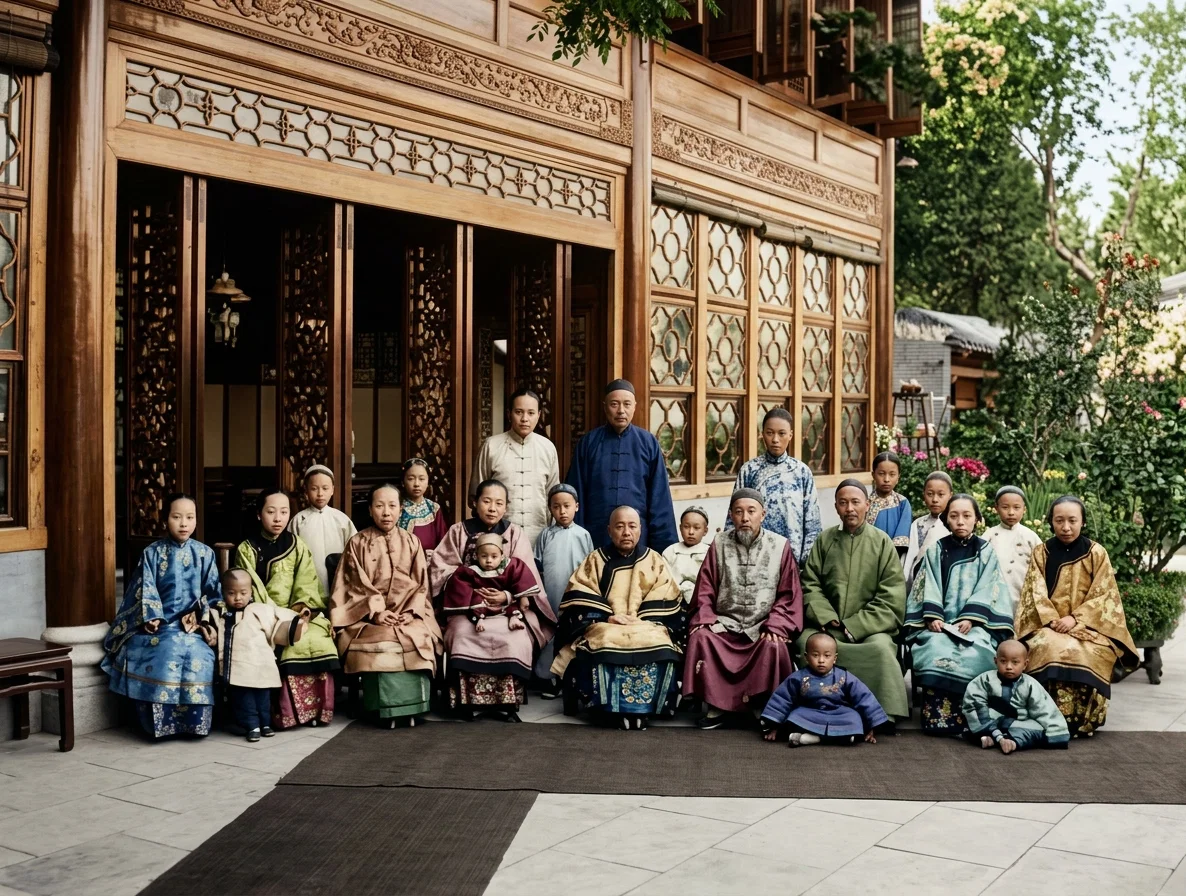
THE FAMILY OF A WEALTHY CHINAMAN
Unlike England, which in order to extend her dominions was forced to go beyond the seas, the Chinese race is in an important sense one, planted together in one continent, a mighty empire developed through not less than four millennia to its present magnitude from a roving, nomadic people who once inhabited what is now the province of Shen-si.
Yet it is a mistake, though general and deep-seated, to conceive of China as a well-organized and united empire. Her written word is indeed one, but her tongue is so diversified as to present as many and as great differences and divisions as the continent of Europe, though less perceptible and less definite. Again, the word China may mean, on the one hand, the great inert population for the most part gathered in villages, which, with the rural masses, constitute perhaps ninety-five per cent of the entire people; while, on the other hand, it may mean that relatively small but very important literary class constantly recruited from the general mass, from which any one may rise on the ladder of literary tests. This class, together with the political and military Manchu, not only rules China politically and civilly, but furnishes whatever public opinion it has, writes its books, its pamphlets, and conducts its ceremonies, its business, and most of its worship. This is at once China’s strength—and China’s weakness—a puzzle and a vexation to Western diplomacy.
But it must not be forgotten that China and the Chinese are by no means co-extensive. The allusion is not to the influence China may have exerted upon the world outside of herself, but rather to the many Chinese who, in spite of their superstitions, attachment to native land, and contempt for things foreign, have for centuries emigrated to other lands both near and remote. Considered from this point of view, the Chinese race, by its skill, enterprise, and industry, occupies the chief place in the Oriental world. Nor have the Chinese hesitated to enter the great labor markets of the Western world, where, by their intelligence, thrift, and industry, they have successfully competed. “They are equal to any climate, be it hot or frigid; all that is needed is teaching and guiding combined with capital and enterprise, to convert them into the most efficient workmen to be found on the face of the earth.”
In the United States, where the Chinese have received anything but fair treatment, and where there has been the most vigorous and unreasonable opposition to their presence, there are to be found at the present time over one hundred thousand. Canada has perhaps about one fifth of that number, most of whom, as in the United States, are to be found on the Pacific coast. Trinidad has from two thousand to three thousand Chinese, while Cuba, Porto Rico, and other West India Islands had in 1877 not less than forty-five thousand. Mexico has about three thousand of these Orientals. The South American States, especially those on the west coast, have a considerable sprinkling of Chinese, amounting in the aggregate to probably not less than seventy-five thousand or one hundred thousand. In 1893 the Sandwich Islands had a Chinese population of forty thousand, many of whom held good positions, including several lawyers.
Europe seems to have very little attraction for the Chinese, and very few are to be found there. Africa, however, where European capital has entered to develop the country and its resources, has a considerable number of this strange but misunderstood people. Ceylon and India also have some, and evidence is abundant to show that their presence in those parts dates from ancient times. In Burma they are numerous, and the opinion prevails that the future of that country belongs to the Chinese. Thetrade of Rangoon is in a large measure in their hands, and the commercial towns up country, such as Mandalay, etc., have large numbers of these desirable immigrants who possess the very qualities which the Burmese and other indigenous races lack. Since the annexation of Burma by Great Britain, the tide of Chinese immigration has steadily increased, until they now number probably forty thousand. The same statement holds true, only in a more absolute sense, of Siam, Anam, and Cochin China. In the last place mentioned, the Chinese fairly swarm, not indeed as idle cumberers, but as patient, persevering, and intelligent traders and workmen. In and around the Straits Settlement there are said to be at least six hundred thousand Chinese, not counting those in Borneo, the Dutch colonies, or the Philippines. If all territory under direct British control be included, they slightly outnumber the children of the soil. There has been, and continues to be, a large influx of Chinese immigrants into Malaysia and all surrounding islands.
The Philippine Islands, it is estimated, have about one hundred thousand Chinese, and now that American capital and enterprise have entered to develop the country, the demand for Chinese laborers is increasing, despite American aversion to cheap labor. Since the war with Japan, very few Chinese are to be found in that land.
Australia, with a total population of four million, has about forty thousand Chinese, but owing to restrictive legislation this number is constantly decreasing. New Zealand has a small number of Chinese, but there, too, discriminating laws drive them from the country, and prevent further immigration.
To the far north in bleak Siberia, Russia's imperial penitentiary, the Chinese swarm along the banks of the Upper Yenisei River. In Vladivostok no less than thirty thousand reside, carrying on various businesses in a small but effective way.
It is thus seen that the Chinese are a most potential factor, especially in these Oriental parts, where they stand head and shoulders above other native races, whose business affairs they are laying hold upon in proportion to their superior skill, intelligence, and industry. In a political and military way, they count for almost nothing; but as laborers and tradesmen in any capacity, this people possess superior qualities, and the countries to which they come receive incalculable benefits from these unoffending, peace-loving, and industrious people.
This is the Chinese world—a great ancient empire—with abundant resources yet undeveloped, a population exceeding one fourth that of the entire race, thousands of whom are scattered to all parts of the Orient, and many to Western lands. With these facts before us, it is manifest that China, or the Chinese race, is one of the great, if not the greatest, missionary problem confronting us as a people. While God has marvelously opened to the message this great field, we do well to count seriously the cost, and lay our plans accordingly, remembering, on the one hand, that the work is God's, who is both able and willing to carry it forward, and, on the other hand, that he employs human agencies, and that to us has been committed this work.
Not that the work of giving the message to China's millions must be done by laborers from the home field. Were this method possible, it would require years and years, to say the least. The only way is to raise up and train native workers, who will be able to do the work quite as effectively, and with but a fraction of the outlay, both in time and money. But while it is true that a good proportion of the Chinese converts make earnest, intelligent evangelists, teachers, and Bible workers, it is equally true that the work of directing and superintending must ever devolve upon workers from the home fields. The situation requires scores of consecrated, intelligent workers, whose coming can not safely be long delayed.
China proper has eighteen large, populous provinces, each of which ranks in size with any State of the Union, and largely exceeds in population. Each one of these eighteen provinces is a mission field all by itself, which really needs a full corps of workers, both medical and evangelistic, who, with the aid of native helpers, can in a systematic and thorough way herald the message of Jesus and his coming.
Canton, China.