This gathering was held at Lausanne, on the beautiful Lake Geneva, French Switzerland, June 29 to July 6. At first we had only planned a meeting of the Romance-Swiss, or Central European Conference, near the end of the month of July, expecting to have a union council the previous May; but matters so shaped that we were able to hold these two gatherings together. This gave comparatively little time in which to prepare for the meeting, yet we were glad to see so many present.
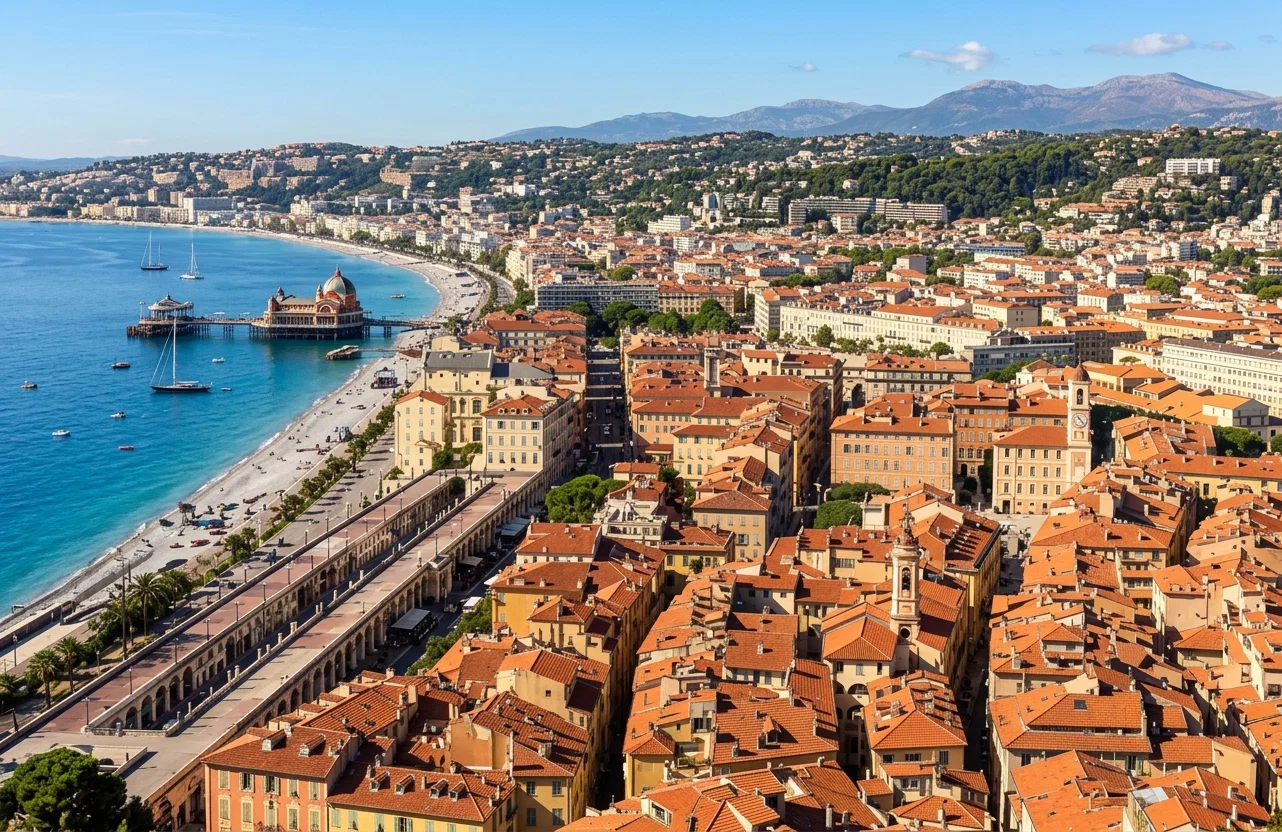
THE CITY OF NICE
One year ago the Latin Union was partially organized, but the work of perfecting the organization was more fully completed this season. There were about one hundred and seventy-five camped on the ground. Twenty-two of these were from France, two from Belgium, and two from Italy. Considerable attention was given to the work in this great field, with its one hundred million people. While some new workers have joined the ranks, yet the force of laborers is very inadequate for the accomplishment of the work that needs to be done.
In Romance-Switzerland, which contains the French-speaking and the Italian-speaking cantons, there was quite an encouraging growth last year. There are over four hundred members in this conference which contains only a million people. Elder Tieche was chosen conference president, and with him there are to be associated six other workers.
There are in the French Mission seven workers. Elder Wilkinson was again appointed local director of this field. Our work is centered largely in Paris and in Southern France. There are about one hundred and twenty believers here.
Elder Everson, of Rome, was present, and brought encouraging reports from that place. He is learning the Italian, and several other laborers are to be associated with him. There are now about forty Sabbath-keepers in Italy.
Brother J. Curdy was chosen director of French Belgium, which was organized into a separate mission, with a population of three million. We have about a score of Sabbath-keepers in this field.
We are glad to say that we now have made a beginning in Spain, as the Bond brothers have taken up work in Barcelona, where they will perfect their knowledge of the Spanish language while doing general missionary and Bible work.
The deliberations of the union conference were harmonious, and Elder Wilkinson remains president of the Latin field. A general meeting was planned for France the coming year. During 1902 there were ninety-two additions in the Latin Union. That conference paid a tithe of $5,186, and gave $1,830 in gifts and offerings. This speaks well for the liberality of the 577 members we have in the union. Considerable time was given to the removal of the French publishing work from Basel. It was decided to make Paris the headquarters for our periodicals, and to have a depository in Geneva (very close to the border of France and Switzerland), from which books may be sent into both countries at single postal rates. This will give Romance-Switzerland and France the same postal advantages that Basel has furnished to German Switzerland and Germany. Brother J. Roberts has been put in charge of the Latin Union publishing work, and it is expected that he will look after it in the entire field. We surely need publications, not simply in the French, but in Italian, Spanish, and Portuguese as well. This is a very important part of our work. Last year, with six canvassers in the field, the house sold $4,079 worth of books.
The establishment of a sanitarium and school in French Switzerland, which shall be a general training center for the Latin-speaking part of Europe, received favorable consideration. We hope to be able to exchange the lot and building in Basel for fifteen or twenty acres of nicely located land in a picturesque part of French Switzerland, and then fit up a sanitarium and food factory, and connect with them a training-school for workers. Our food factory in Switzerland has done well. It has a growing business; and as it is earning one thousand six hundred dollars per annum, it is a source of financial help to the medical missionary work carried on by the sanitarium. Elder Irwin10and Dr. Paulson rendered excellent help in the meetings, the latter giving his special attention to the youth. The outside attendance was not so large, as there was in progress a centennial feast in commemoration of the century's existence of the canton. Twelve were baptized at the meeting. At the close of the meeting, we spent two days looking for a suitable location for the headquarters of the French health and educational work.
The work in the Latin Union is but opening up, and we do not doubt that, through the blessing of God, we shall see considerable growth in this part of the Lord's vineyard. While we may not look forward to so rapid an increase in these Catholic countries as we would expect in the Scandinavian, the British, and the German Unions, where there are more Protestants, still we do believe that as workers and facilities are multiplied, a rich harvest will be reaped. This field has actually suffered from not having its own center in its own territory; we hope that as this is now to be attained, there will be a more rapid development.
As to finances, it is true that through careful management and the liberality of the people sufficient money has been accumulated to make up for the present deficit in carrying forward the work in this field. However, as the force of laborers is being increased, and there are heavy traveling expenses from America to their fields of labor, it is evident that this surplus will soon be exhausted. The money that has accumulated in the Basel house is really to be used in supplying suitable and most necessary institutions in the field. Last year our brethren were able to hold a successful institute in the city of Paris, and there is a growing interest in the educational work throughout the union. One can scarcely realize the great advantage of training workers who speak the language as their mother tongue. It is no easy thing thoroughly to master a foreign tongue, and even where this is said to have been accomplished, there is almost invariably a foreign accent. The sooner we develop our native talent, the quicker will the field grow.
When we come to consider the fact that our sanitarium in Basel is now to be removed into French-speaking territory, and the health-food business, which has really been its support, must have adequate quarters and machinery, and when we further consider that there must be sufficient room for carrying on the educational work for the training of nurses and evangelical laborers, and that the publishing department must provide literature in the French, the Spanish, the Italian, and the Portuguese, and must be enlarged to meet this demand,—when we come to take all these things into account, we can at once see that in providing these facilities, the field will require whatever surplus it now has on hand. But if we think of the amount of money invested even in some of the State conferences in schools and sanitariums, or of the institutions that are ours in the German, the British, and the Scandinavian Unions, we shall admit that the Latin Union, with one hundred million people, ought to be just as well supplied. These considerations hold all the truer, as we remember that the money now on hand is to enable us to pay cash for the needed changes; and if it is exhausted in gospel work, the field will have to be kept waiting for the necessary facilities until the means can be collected on the other side of the Atlantic. As we look over the Basel property, we find that some of its present value is made up of rather unsalable stock, as, for example, nine thousand dollars is invested in books, some of which are not now first-class. Of this stock, the German Union took the German book stock on its percentage, and the Latin Union receives two thousand six hundred dollars' worth of the book stock in the German, and in the English language (mostly sheets of books which are not very salable), and six thousand eight hundred dollars' worth of French books, many of which belong to the same class. This really gives them but little material assets. In fact, the Latin field must have additional capital with which to carry on its publishing work.
Again: four or five thousand dollars is invested in sanitarium furniture, for which the sanitarium actually owes the publishing house; but as the new building has to be fitted up, this furniture will come into play, although it can not be called cash assets, and will not assist any in enlarging the work.
I am convinced that provision will have to be made through appropriations for the evangelical work in the Latin Union the coming year, and that our people in the States should begin to consider this great field in their prayers and gifts.