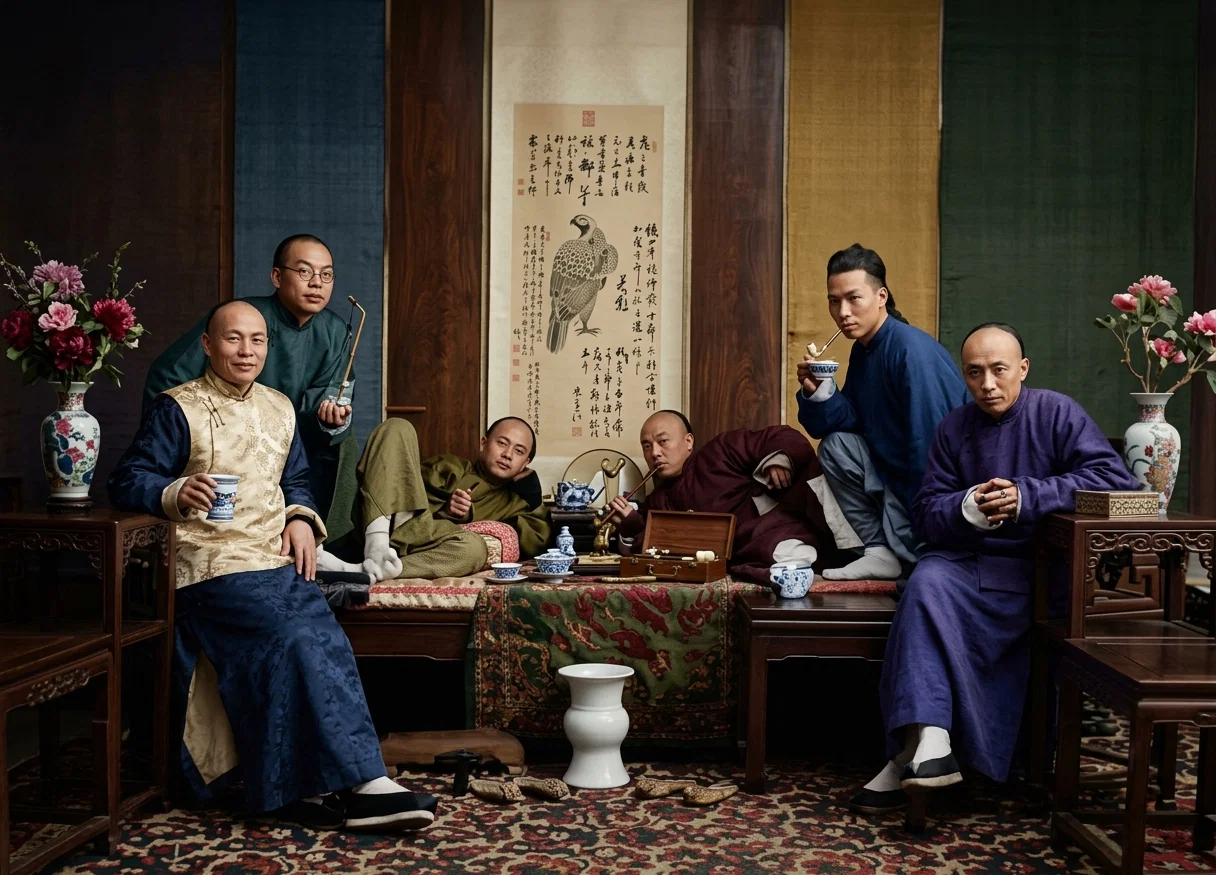
Chinese Opium Smokers

6%

Review and Herald Publishing Association · Washington, D. C. · Sep 3, 1903

FromReview and Herald, Vol. 80, No. 35.

Read the full edition

Chinese Opium Smokers

C. W. DAVIS
The poppy seems to have been cultivated in China as an ornamental flower in the Sung dynasty (976-1264), and even earlier the healing virtues of its seed were known, while the medical use of the opium capsules dates back a great many years. Opium was used for medical purposes; it was a highly esteemed drug, being imported overland from Burma through Central Asia into China.
Dr. Dugeon, of Peking, says that opium smoking was introduced from Java by the Chinese from Chicu-chicu and Changchow in the early years of the eighteenth century, toward the end of the reign of Shanghai (1662-1722). The first edict issued against it was in 1729, being directed against the practice in Formosa, which was the result of a report of an official sent by Shanghai to inquire into the unseemly proceedings in that island.
CHINESE OPIUM SMOKERS
Taou Kwang was the first emperor to attempt to suppress the vice of opium smoking. When loss of revenue was urged as an argument to deter him from his purpose he exclaimed with righteous indignation, “Heaven forbid that I should derive profit from the vices of my subjects.”
This good prince was unfortunate in the agent whom he selected to carry out his humane decree. The Viceroy Lin, haughty and overbearing, employed unjustifiable means to obtain possession of the forbidden drug, giving just ground for reprisals on the part of Great Britain. To save himself the trouble of capturing the opium ships which lay beyond the harbor, he surrounded the whole foreign quarter at Canton with soldiery, and threatened the lives of all foreigners, without distinction of nationality, in case of refusal to surrender the drug. Summoned by the Superintendent of Trade to deliver up, as the only means of escape, the merchants handed it over to the queen’s representatives to be used as a ransom for the lives of the community. Her majesty was accordingly pledged to make good their loss. To punish this high-handed proceeding, and to exact the promised indemnity were the objects of Britain’s first war with China, not at all to force the Chinese either to receive opium or to consume it.
It is impossible to say what proportion of the Chinese smoke opium, but it is well known that large numbers of all classes throughout the empire are given to this habit. In some parts of the country the proportion is larger than in others. From the imperial palace down to the lowest hovel it has in its clutches all sorts and conditions of men; even women and children in some places, are victims of this insidious vice.
The large decks of steamers are covered with smokers lying in every direction, some enjoying their fantastic dreams, others still smoking. Prepared opium has the appearance of coal-tar. They take a little on the end of an opium tool, and hold it over the peculiar opium lamps; when it is sufficiently baked, they insert it into the pipe which is now ready to smoke.
The writer has in mind the case of a woman who appeared to be about sixty years old, and who was addicted to this vile habit. She was a most pitiable object as she lay upon the deck of a Hongkong and Canton steamer, her head supported by a rude Chinese pillow (generally made of earthenware or wood). She being too weak to hold the opium pipe in the usual manner and to use the common pipe, her servant prepared the opium in the bowl, and by means of a long india-rubber tube connected at one end with the bowl, the other end being placed in the victim’s mouth, the poisonous drug was inhaled into her lungs.
Although opium is taxed heavily, various means are resorted to by which it is smuggled into the country. One method is the following: As soon as the customs officials are seen approaching a vessel which is about to enter the port, the smugglers who are on the vessel procure a long piece of strong twine and connect small sealed tins of opium on the one end and small floats on the other; then they are dumped overboard, to be picked up on some future occasion. Various are the means that are employed, cleverly and sometimes successfully, to evade the customs authorities; and for this reason it is impossible to determine the amount of opium consumed in this country.
A new vice, that of subcutaneous injection of morphia, appears now to be spreading rapidly in some parts of the country. It has been said on good authority that there are shops in Canton where persons may go and put their money on the counter, and without saying a word as to what they want, morphia will be handed to them.
Though partly consumed as a liquid decoction by the use of a hypodermic syringe, it is chiefly used to make pills and tabloids, which are taken as a substitute for opium by those who find it inconvenient to smoke during business or when traveling.
A large quantity of opium pills are made, and sold under the name of anti-opium pills. Some, in their endeavor to give up smoking, try these; but they seldom cure any one of the habit; they simply, by the opium contained, satisfy the longing of the smoker, and enable him to stave off the desire to smoke for a while.
The habit once formed is very difficult to break. Some try over and over again, but very few ever give it up entirely. It does not require a specialist to tell at a glance those who are addicted to this vile habit, or as the nation terms them, “opium devils.” Every attitude, every feature of the face, every sentence, is a living witness that they are in agony till the craving is satisfied. They are pitiable objects, emaciated almost to a skeleton, until they finally succumb to their vice.
Canton, China.