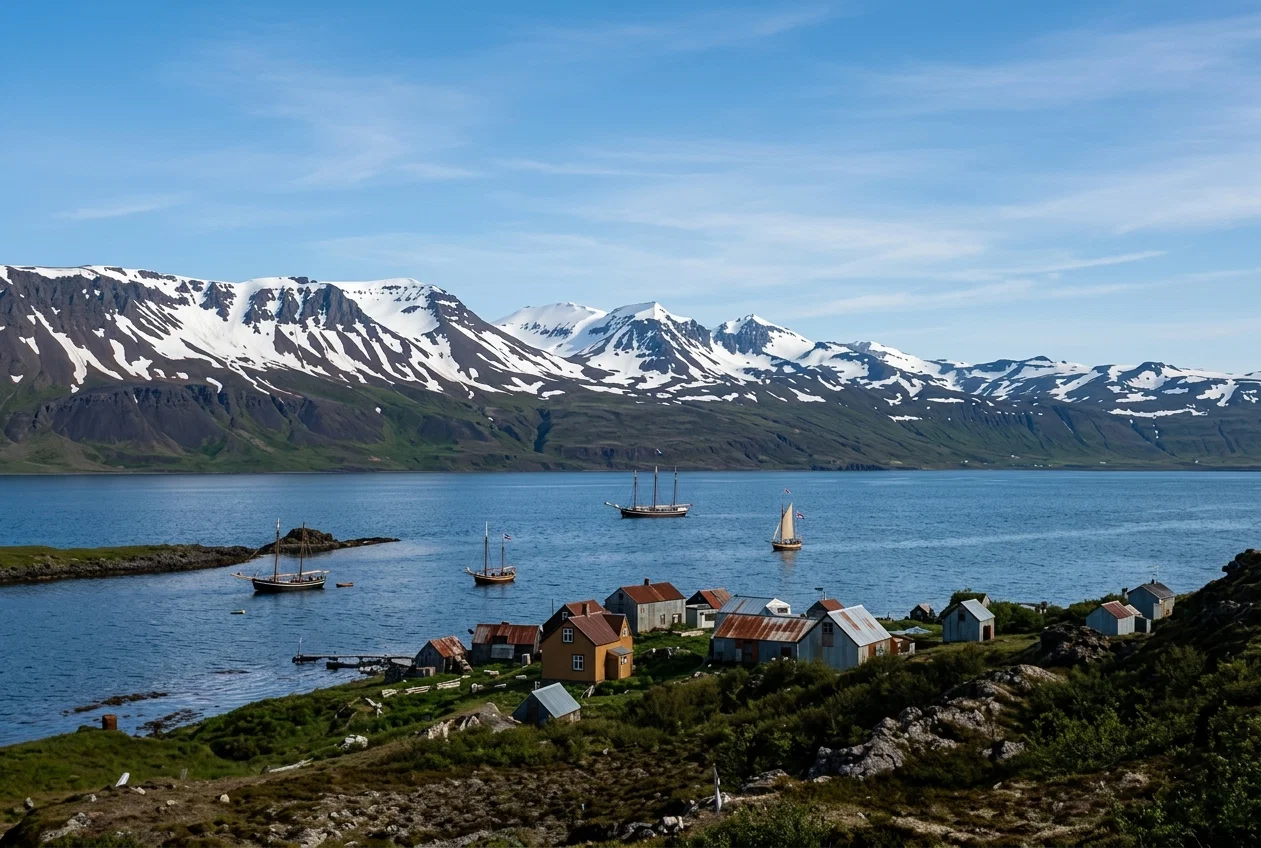
ICELAND has an area of over thirty-nine thousand square miles. It is nearly as large as Ireland, or twice the size of Denmark. But it is very sparsely settled. The population is between seventy thousand and seventy-five thousand. The settlements are mostly on the coast. Large regions in the interior are unsettled, and for the most part they may also be called uninhabitable; for great portions of the land are covered with snow, which does not allow of the growth of vegetation. From the first, the only settlements have been along the coast and in the valleys.
AN ICELAND VILLAGE
The island has very few cities, and they are small. The capital, Reykjavik, the oldest city, was named by Ingolfur, the first settler. In the northwest there is Ísafjordr, with a population of about a thousand. In the north is Akureyri, with about the same number of inhabitants. And in the east is Sedisfjordr, with a smaller population. Besides these there are a few smaller towns, with a few hundred people in each.
Reykjavik has about five thousand inhabitants. The city covers quite a large area. Nearly every house has its little garden. But the cold climate makes the work hard, and their labor is not very amply rewarded.
The seat of congress is in Reykjavik. Here is also the supreme court, school for the ministry, medical college, and high school. It is also the residence of the governor and the bishop. There is a valuable public library, besides others. There are several printing offices in this city.
The houses in the city are one or two stories in height, and most of them are covered with galvanized iron plates. The reason for this is the high price of timber, which has to be imported, there being no forests on the island. The people take very good care of the little timber that grows.
Bricks are not made in Iceland. The houses are built of granite. Among the most prominent houses in Reykjavik are the capitol, the bank, the high school, the public school, and the hospital for lepers. The last two are the largest buildings on the island, and cost from eighty to one hundred and thirty kroner each.
The hospital for the lepers has been erected only a short time. It is a gift to the island from the Odd Fellows in Denmark. Leprosy is a disease very much to be deplored, and it has a great hold in Iceland. There are about one hundred and fifty lepers in this institution, who before were scattered in almost every place in the country, and were a constant menace to others. They are now gathered in the hospital, and the danger of spreading the disease is greatly reduced. The very best care is given these people in the hospital, and they have a pleasant home there for the remainder of their lives.
The new schoolhouse has a history. It is a testimony to the great progress of education in Iceland. Until a short time ago there were no public schools on the island. Parents looked after the education of their own children, many teaching them themselves. But now it can be said proudly that education has made great progress. It is very difficult to find an Icelander who can not read or write. Many, even among the farmers, can speak and write several languages.