The chief native foods of the Tongan Islands are bananas, sweet potatoes, yams, breadfruit, pineapples, cocoanuts, and flesh and fish.
There are many different kinds of bananas, which are prepared in a variety of ways, but the natives prefer them boiled in sea water, in the green state. When done, they are very hard and indigestible. Sometimes they are buried in a bed of leaves, with a sort of palm nut, which imparts a very pleasant flavor as they ripen. Some kinds are tied in banana leaves, and hung in a tree to ripen. Still another method is to tie them up in the tough leaves of a native plant, with cocoanut milk, and cook them in what is called an underground oven, which is simply a hole about eighteen inches deep. This they fill with wood; then they pile on stones, and light the wood. When the wood is burned out, the food is put on the hot stones, and covered with leaves and earth. In from one to six hours the food is nicely cooked. Sweet potatoes and yams are very palatable prepared in this way.
Yams are a coarser tuber, somewhat the nature of potatoes: they are the potatoes of the natives. One kind grows very long; I have seen them six feet in length; but they are not usually so long, for the reason that yams grow straight down, and the soil must be loosened by digging the hole six feet deep. I hardly need add that there are fewer six-foot yams than two-foot ones. There is one variety which was introduced by the famous Captain Cook, who, handing it to a chief, said, “I give you this.” The native at once said, “He is telling its name;” so it is still called kivi (pronounced kēvē), which means, “I give you this.”
Probably the breadfruit is the most nutritious of the island products. It grows on a large, beautiful tree with heavy foliage of large lobed leaves. It resembles the osage orange (hedge apple), but is not so rough, and is much larger. It is in season for about three months in the year, when the crop is good. Though called fruit, it is more the nature of grain than of fruit. When roasted, it looks and tastes much like the white breast meat of a turkey. We regard it as excellent food, and use it freely when obtainable, though, like most island foods, we find it a little hard for American stomachs to digest. The natives have a habit of burying breadfruit in deep pits digged for that purpose. After a number of years (seven is the stated number) it is dug up, and, like ripe poultry, eaten with a relish. Your sense of smell warns you15of its presence, even while you are a great way off. I once came upon a party of natives eating their dinner in the woods. They very kindly offered me a portion of this ripe breadfruit with some nicely baked yam. I had wished to see it, so now was my chance. I attempted to taste it, but without very good success. The odor seemed to cling to my hand for days.
To me the most graceful, as well as the most useful tree in the islands is the cocoanut palm. The effect produced by its great leafy plumes, fifteen feet in length, as they curve and bow in the soft and gentle sea-breeze on a hot afternoon, is delightfully restful. The long leaves are used for roofing and flooring the houses, and for making brooms, baskets, and mats; the coarse, fibrous membrane which encloses the young leaves is used for straining milk and kava; the husk of the nut for making rope, and for fuel; the nut shells for cups, and for making charcoal to burn in the box irons for ironing clothes; and the nut for oil and food and drink for man, and for feeding cows, horses, dogs, pigs, and fowls. Taken at the right stage, the water in the nut affords a most pleasant and refreshing drink, and the meat, which looks much like cooked starch, eaten out of the shell with a spoon, is a dish to tempt any one.
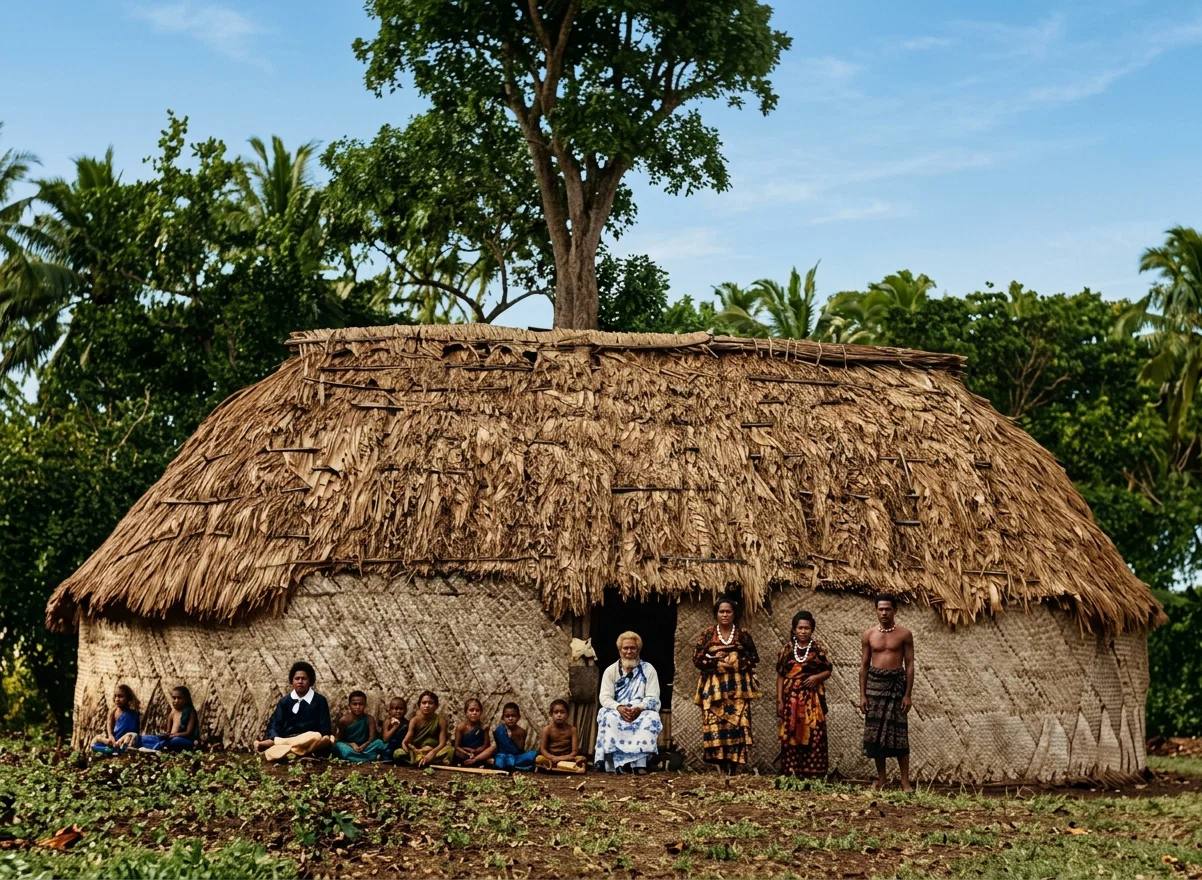
NATIVE HOUSE, TONGA
Oil and milk are made from the kernel by grating it to a pulp, and squeezing out the fatty substance. By adding water, one nut yields about one pint of nice rich milk, which is used in cooking or on porridge, just as cow’s milk and cream are used.
The cocoanut is prized chiefly for its commercial value. The nuts are split open, the meat removed from the shell, and dried in the sun. Thus dried it is called “copra.” As you might suppose, it becomes very rancid while drying, and emits a nauseating odor. The copra is shipped to Australia and Europe, where the oil is expressed, and the residue is pressed into cakes like linseed cakes, and used for feeding animals, cows principally.
We once had the misfortune of traveling in the tropics for five days on a steamer which had as part of her cargo two hundred and fifty tons of copra. The ventilating shaft, extending from the lower part of the steamer, where the copra was stored, through the second cabin, had a split near our stateroom. The heat from the engines caused the foul air, laden with stifling, nauseating stench from the copra, to rise. Finding the crack in the ventilator, it filled the cabin and staterooms with the stench. This, added to the distress caused by the roll of the vessel, was simply beyond description.
The natives are very fond of meat and fish. They keep a great many pigs, for which they have a particular liking. Fish, being easily obtained, is used very freely, especially jellyfish and shell-fish. The people can be seen almost any time on the beach, with baskets made from cocoanut leaf, digging in the sand for shell-fish, or wading in the shallow water after jellyfish. Sometimes a village unites in making a rude net from vines and leaves, hundreds of feet in length. With this a semicircle is formed on the reef, with the end at the beach when the tide is in, and thus the fish are kept from going out with the tide. The fish are then speared, and caught by men, and women, and children by basketfuls, who eat raw fish as they fill their baskets.
The lagoon abounds with a beautiful kind of jellyfish, which looks like a toad-stool or little umbrella of amber floating on its side near the surface of the water. The first time I saw these fish, I was crossing the lagoon with a native in his canoe (a log hollowed out). At first I could hardly believe my eyes; it was such an enchanting sight to see them by scores gracefully floating in the placid water, gently contracting the amber hemisphere with marked regularity, as if breathing in sleep, with no thought of fear. They varied in size from tiny little ones to those in which the hemisphere was four or five inches in diameter, with a stem six inches long. This scene reminded me of a Christian peacefully reposing on the great ocean of God’s never-failing love. I lifted one from the water in my hand, to get a better view of its beautiful form. After returning it to its liquid home, I asked the native its name, and if the people ate them. He answered the last question by taking a good-sized one from the water, and, giant-like, swallowing it down with a smack of his lips. A feeling of pity filled my breast at seeing this little kingdom of peace invaded, and one of its subjects so ruthlessly taken by the enemy and swallowed down while so happily basking in the sunshine, all unconscious of its danger. I thought of the great enemy who “walketh about, seeking whom he may devour.” How little we know when or where or how he will next assault the kingdom of peace. “Wherefore let him that thinketh he standeth take heed lest he fall.”