“Speak to the earth, and it shall teach thee.” Job 12:8.
Voices from the Dust of Assyria’s Mounds
By A. Earl Hall
Who Were Pul and Tiglath-Pileser?—Shalmaneser, Sargon, and the Siege of Samaria—Sennacherib, Esar Haddon, and Asnapper—Jewish Kings Mentioned on the Monuments
By A. EARL HALL, B. A.
This is the seventh of Professor Hall’s articles on the reply of archaeology to present-day Biblical criticism. In the six preceding articles, published during the latter part of 1915, he has stated the position of the higher critics—has told of their claims that certain portions of the Bible were pure myth and fable, and therefore could not be relied upon; he has told of how these critics have questioned the historical accuracy of some things that the Bible has affirmed; and then he has presented the evidence which scholars from every land have found in the inscriptions on the monuments and tablets of the ancient world, showing that the Bible record is miraculously correct, and that the child of God may safely and securely anchor his faith to the grand old Book.
The story he has presented of how the discovery of the Rosetta Stone and the Behistun Rock placed keys in the hands of scholars which enabled them to unlock the literary treasures of the ancient world, is a very fascinating one; and we trust that all our subscribers have had the privilege of studying and enjoying this important series of articles.
His concluding article next week will deal with the claim formerly made by the critics, that the prophet Daniel could not have written the book that bears his name, and that there was no such person as the Belshazzar mentioned by Daniel, etc. EDITOR.
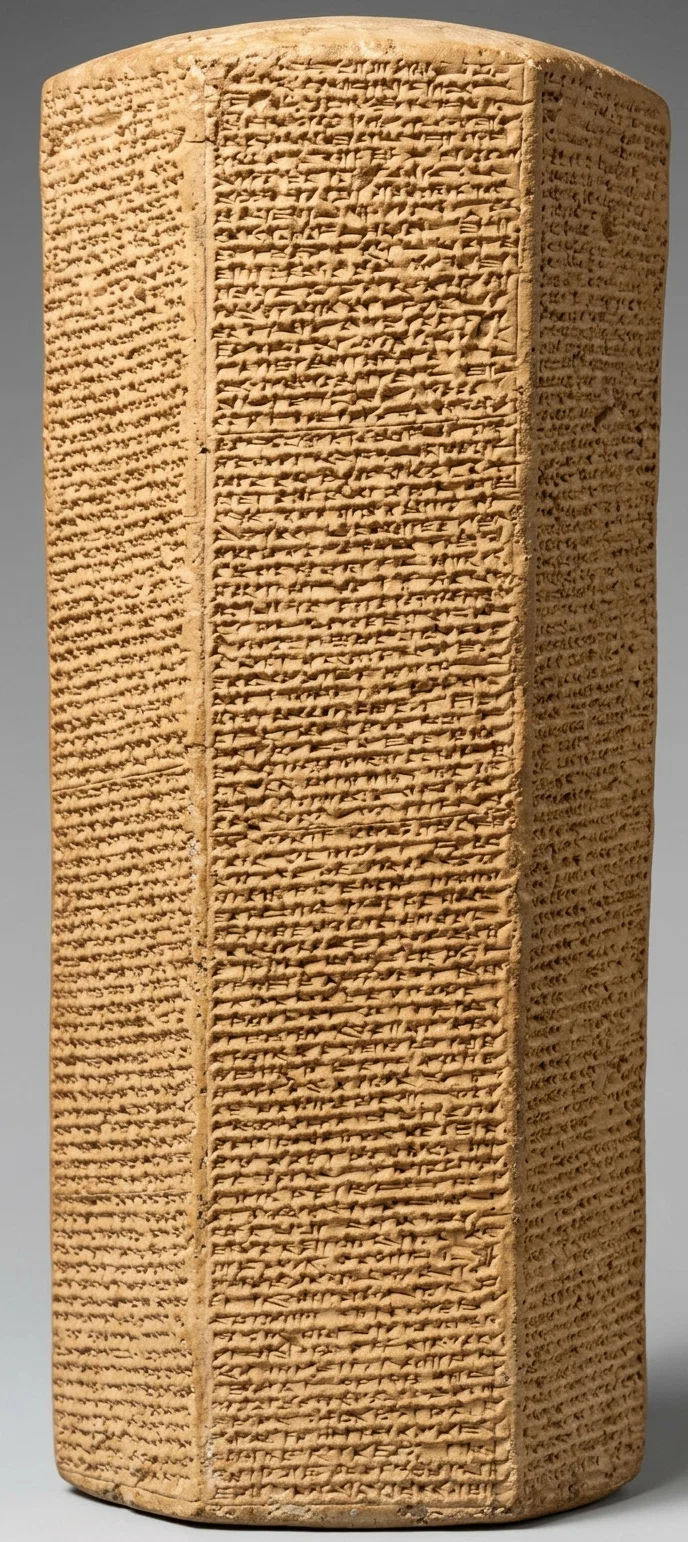
Six-sided clay prism of Sennacherib, king of Assyria. The cylinder is now in the British Museum.
“IF these should hold their peace, the stones would immediately cry out.” Again we quote extensively from the Assyrian records, to confirm whole sections of the history in Kings and Chronicles. It is now generally agreed that Pul and Tiglath-pileser are one and the same person, though there is at least one good reason to the contrary,—the name Pul alone in 2 Kings 15:19, and Pul and Tiglath in 1 Chron. 5:26. However, so far as is now known, the name Pul has not been found in the Assyrian lists of kings, and the name of Tiglath-pileser is found where Pul belongs. In the Babylonian lists, Tiglath-pileser does not occur, but in its place Pulu is found. It may be noticed in passing that a “break” in chronology is remedied by assuming that there were two kings, as will be seen by noting the kings of Israel and Judah they mention. For convenience, this article is written on the basis of the “one king” theory, Tiglath-pileser III, and not II, as was formerly thought.
THE STONES MENTION NINE MONARCHS AND FIVE NATIONS
He is the first Assyrian king mentioned in the Bible. In his own records, he tells of three kings of Israel,—Menahem, Pekah, and Hoshea; two of Judah,—Azariah (Uzziah) and Ahaz; Rezon of Damascus; Hiram of Tyre; and two queens of Arabia, previously unknown.
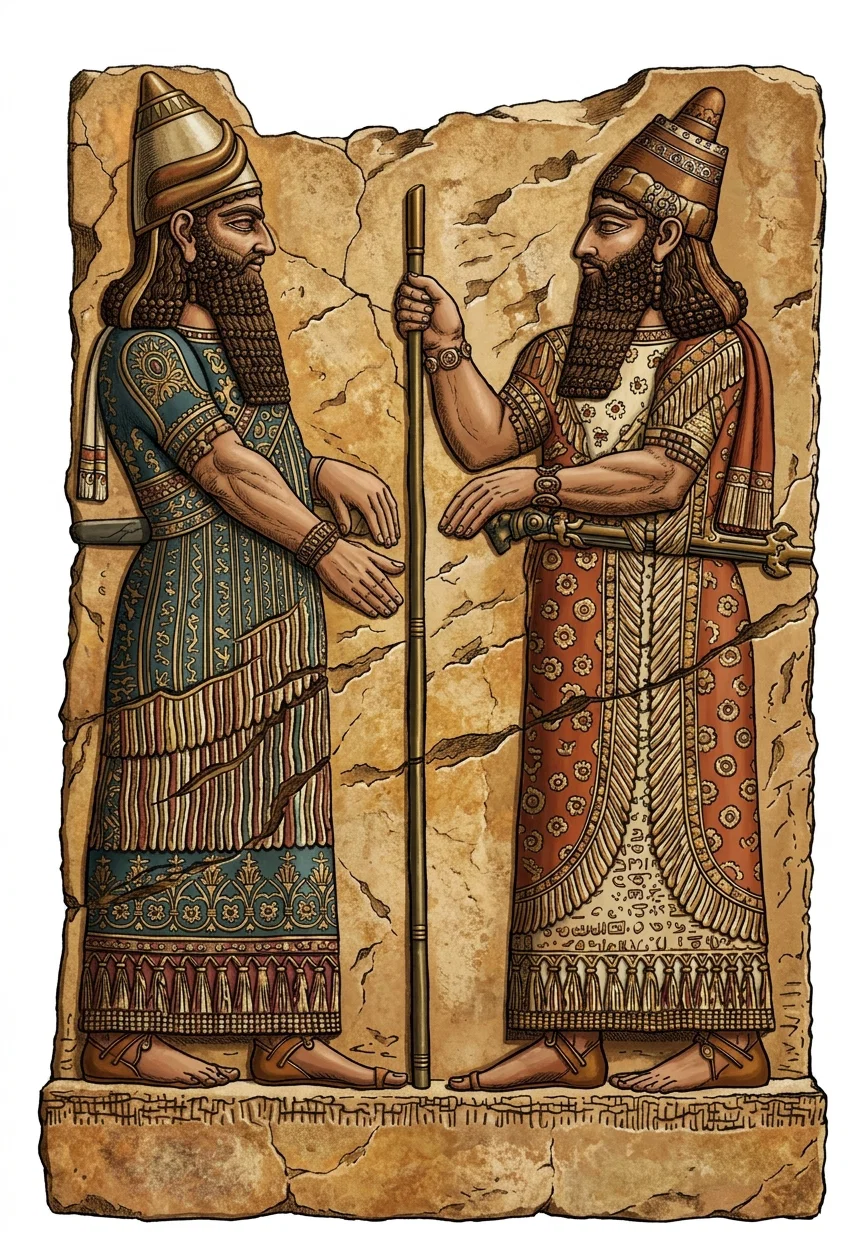
BAS-RELIEF OF SARGON II
Think of it! Here we have information from the “stones” of nine monarchs of five nations,—Israel, Judah, Syria, Phoenicia, and Arabia. The records are “graven in the rock,” and cannot tell what is not true. Now the chapters in the Bible dealing with this period can be read with much greater interest. The closing days of Israel—sad as they were—are now flooded with light from outside sources. The Bible student understands his Bible better, and so does the archeologist understand the monuments better, one record supplementing the other.
Believing that the reader will be desirous to read for himself from this material, we here give some selections that are of special interest. The figures refer to the lines of the inscriptions; the dots, to breaks in the tablets.
“The tribute of . . . Razinu, of the land of Damascus; of Minihimmi, of the city of Samirinai; of Hirummu, of the city of Zurai.” A list of the tribute is then given. (“Records of the East,” old series, volume 5, pages 48, 49.)
2 . . . “In the course of my expedition, the tribute which 3 . . . (Azari)ah, of the land of Judah, like . . .
4 . . . Azariah, of the land of Judah, in . . .
5 . . . without number to heaven were raised . . .
6 . . . in their eyes like that which from heaven . . .
7 . . . battle and to my yoke they
8 . . . of Assyria the great they heard and their heart feared . . .
9 . . . I pulled down. I razed.
10 . . . (to Azari)ah went over and strengthened him and . . .”—Id., page 45.
The next one speaks of affairs in Samaria:
15 . . . “The land of Beth-Omri (Samaria)
16 . . . the population . . . the goods of its people
17 (and the furniture to) the land of Assyria, I sent Pakaha (Pekah) their king they had slain . . . Husih (Hoshea)
18 to the kingdom over them I appointed . . . ten talents of gold, one thousand of silver . . . I received from them as their (tri)bute and419 to the land of Assyria I sent.”—Id., page 52.
An alliance of Judah with Hamath is mentioned by this king, which is of interest. From Sayce we take this statement: “At any rate, the alliance between Judah and Hamath explains a passage in 2 Kings 14:28, which has long presented a difficulty. It is now clear that Jeroboam is here stated to have won over Hamath to Israel, though previously it had been allied with Judah.”—“Fresh Lights,” page 103.
SHALMANESER IV
We possess thus far little information from this king, who ruled from 727 to 722. One record states that he remained “at home” during his first year. In the last three years, campaigns were undertaken, but the names of the places are missing. One of the campaigns, however, was against Samaria, as we learn from the next topic, and of course from the record in 2 Kings 17:3–5. He began the siege, but died before the city capitulated.
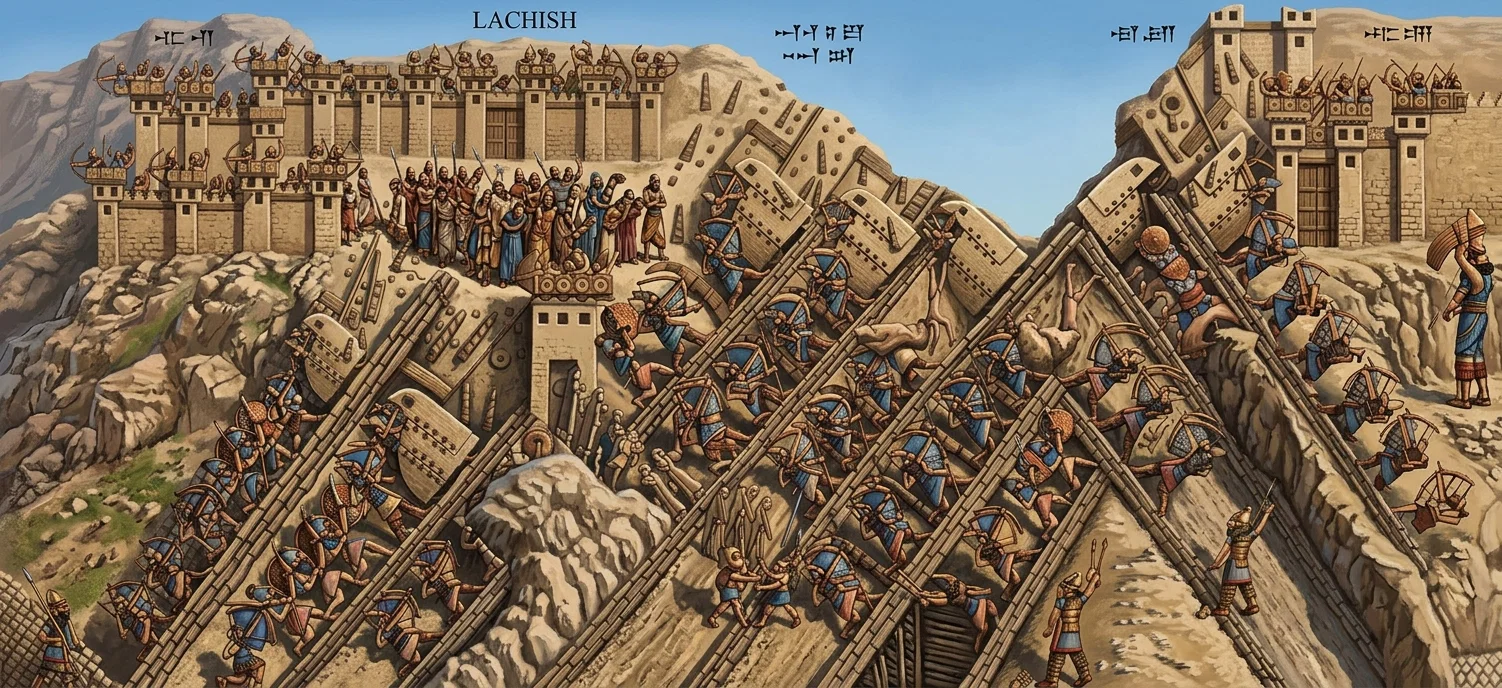
THE STORMING OF LACHISH BY SENNACHERIB’S ARMY
SARGON II
From Professor Price we get the following position of the critics concerning this man, who is mentioned once only in the Bible:
“There is one name in Isaiah (chapter 20:1) which well illustrates my point. Sargon is mentioned as king of Assyria; other kings of Assyria are given in other passages, but the writers have been extremely consistent and very shrewd in their introduction of these mythical monarchs. This case in Isaiah is unique. The name is not mentioned again in the Old Testament, neither is it found in any other literature. Now it is manifestly absurd to say that such a name is anything but a myth, or a scribal error.”—“Monuments and the Old Testament,” pages 33, 34.
RATHER ACTIVE MYTHS
Now if any confidence can be placed in the monumental records at all, Sargon was somewhat of a “personified” myth; for he says that he took 27,280 people from Samaria, and scattered them all over the Tigro-Euphrates valley. It was into this very country that the last two great kings of Assyria transported other peoples, whose descendants became the Samaritans of a later time. It was neither an error of the royal scribe, as Sargon was doubtless seeing that due notice was given him in the writing of the royal annals.
Another point is of much interest in dealing with this monarch. In Isa. 10:5–14, 28–34, is a bit of history that is rather vague. There seems to be no clue as to the person who did the deeds recorded there. This fact led the critics to call this “an ideal invasion” of the land of Judah by an “ideal” Assyrian king. See Sayce, “Fresh Lights,” pages 111, 112; and Brookes, “Testimony of History to the Bible,” page 11.
By a careful comparison of the record of Sennacherib’s campaign in Isaiah 37, it can be seen that the campaign of the tenth chapter must have been made by Sargon. Notice verse eleven: “Shall I not, as I have done unto Samaria and her idols, so do to Jerusalem and her idols?” He also tells of a campaign that he made in Judah which would settle the matter anyway. We also learn, from the Bible and the monuments, that the campaigns of Sennacherib were from the southwest, and this is from the northeast. Thus another victory for the Old Testament, especially as the mention in Isaiah is a very casual one.
SENNACHERIB AND HEZEKIAH
Sennacherib is probably the best known of all the kings of Assyria, from his frequent mention in the Bible. The special item of interest here has been mentioned in the above topic on Sargon. The record of his campaign against the cities in the west land has been found written on the wainscoting of the palace. Here also is a scene representing the siege of Lachish, and the king on a throne, receiving the spoils of the city.
Hezekiah had shut Padi, the king of Ekron (a vassal of Assyria), in prison in Jerusalem, and joined others in an alliance against Sennacherib, expecting aid from Egypt. How many expressions of the prophet Isaiah come to our minds here, warning Israel not to rely on Egypt for help, and similar ones!
HEZEKIAH OF JUDAH ON THE CYLINDER
A few excerpts from the famous cylinder which refer to this will be given:
Column 2: “The lords, nobles, and the people of Ekron, who had cast into fetters Padi their king against the covenants and oath of Assyria, and had turned him over with hostile intent to Hezekiah of Judah (and he shut him up in a dungeon), feared in their hearts.”
Column 3: “Padi their king, I brought out from the midst of Jerusalem, and set him upon the throne of dominion over them, and the tribute of my sovereignty I imposed upon them.”
“But Hezekiah of Judah, who had not submitted to my yoke—forty-six of his fenced cities and fortresses and small towns . . . I besieged and took [a record of the captives and spoil is then given] I brought forth from the midst of them, and counted as spoil. As for Hezekiah himself, like a bird in a cage in Jerusalem, his royal city, I shut him up. To the former tribute, the gifts payable every year, the presents due to my sovereignty, I made an addition and imposed it upon him (them).”
The record then tells of the desertion of his allies and the tribute imposed by Sennacherib.
The destruction of his army is not told by him. Indeed, we do not suppose that he would record a crushing defeat of this kind for his successors to read. The former successful one—see 2 Kings 18:13, 16—is that of which he tells in the record, a part of which has been given. An Egyptian legend tells of an event occurring, as some think, near the Egyptian border, though Sayce inclines to placing it near Jerusalem, that speaks of the destruction of an invading army.
Here is an array of facts written on slabs in the palace, and now in the British Museum, confirming Kings, Chronicles, and Isaiah.
The will of this king is of interest, and is here given: “I, Sennacherib, king of multitudes, king of Assyria, have given chain of gold, stores of ivory, a cup of gold, crowns and chains, besides all the riches, of which there are heaps, crystal and other precious stone, and bird’s stone, one and a half maneh, two and a half cibi, according to their weight, to Esar Haddon, my son, who was afterwards named Assur-Ebil-Mucir-Pal according to my wish, the treasures of the Temple of Amuk and (Nebo)-Irik-Erba, the harpist of Nebo.”—“Records of the Past,” old series, volume 1, page 138.
As Esar was not the eldest son, the jealousy of his brothers, ending in the murder of the father, is better understood.
ESAR HADDON AND ASHUR-BANI-PAL
These are the last two kings of Assyria of whom there are any definite records. In fact, those from the death of the latter to the fall of the nation are hardly known by name. From the prophetic standpoint, these two are of interest on account of the part they acted in bringing about the partial fulfillment of the prophecies of Isaiah concerning Egypt, especially chapter 20, verses 3–6. From our present one, the capture of Manasseh, the place to which he was taken, his release and return, demand our attention.
The monuments tell us that Manasseh paid tribute to both monarchs, but it is not plain as to which king took him captive. It seems plain that his capture occurred under Ashur-bani-pal. This question is outside our realm, as the Bible does not give the name, but says the captains of the host of the king took him captive; but it seems necessary to mention it at least.
THE RECORDS SOLVED THE MANASSEH PUZZLE
The fact recorded in 2 Chron. 33:11, that he was taken to Babylon, was one that puzzled the critics. Why should an Assyrian king take captives to Babylon, the capital of a rebellious province, and not to Nineveh, the headquarters of the Assyrian empire? From the reign of Sargon II, the Assyrian kings were called kings of Babylon. On account of trouble there, Sennacherib partially destroyed the city, but Esar Haddon repaired it in his early reign, and made it his capital for six months of the year. We also know, from the monuments, that Ashur-bani-pal spent part of his time there.
The treatment of Manasseh was in full accord with the customs of the times. Worse criminals than he were treated royally, and sent to their former positions, loaded with honors. The case of Necho is a good example of this fact. The cruelty of the Assyrians is well known to-day from their own records. Bear in mind that this record is found only in Chronicles.
This article has given a brief sketch of six of the greatest kings of Assyria; and counting from the reign of Shalmaneser II of the previous article, the time from the early ninth century to 626 is covered by an abundance of monumental evidence to the accuracy of the Old Testament. In Israel, the history from Ahab to the fall of Samaria has been given; and in Judah, from5
(Continued from page 4)
Uzziah to and including Manasseh’s reign. This is a test against which no charge of partiality or unfairness of any kind can be successfully brought. This portion of the Bible is accurate, and worthy of our study and firm belief. “All Scripture is given by inspiration of God.”
The next article will deal wholly with the book written by a Hebrew captive who became prime minister of the Babylonian and Medo-Persian kingdoms.