A PROTESTANT THEOCRACY

2%

Pacific Press Publishing Association · Mountain View, California · Nov 2, 1915

FromSigns of the Times, Vol. 42, No. 43.

Read the full edition

A PROTESTANT THEOCRACY

Ancient Israel Had the Only True Theocracy—The Prophet Declares No Other Will Exist Till Christ Comes in Person—Augustine’s Theory and the Papal Theocracy—The Geneva Protestant Theocracy Modeled After Augustine—Persecution and Death Followed
By ARTHUR G. DANIELS
THEOCRACY is a form of government in which all the affairs of men, whether temporal or spiritual, civil or religious, are united under the control of God. The government of Israel was a true theocracy. It was really a government of God.
The theocracy of Israel was established by the Lord when He led the people of Israel out of Egypt. The people received their instruction, their laws, their authority, all from God. The visible rulers of the government, such as Moses and Joshua and the judges, were all appointed by the Lord, the true head of the theocracy.

SELFISHNESS PRODUCED DISSATISFACTION

Because of their selfishness, the people were dissatisfied with this sort of government. They clamored for a king, in order to be like the nations around them, which were not theocracies, or governments of God. In this they virtually rejected God, and chose man in His place. “They have rejected Me, that I should not reign over them,” said the Lord to Samuel. 1 Sam. 8:7. But the Lord did not wholly reject
them. He gave them a king, but instructed and directed the king.
The relation which the king sustained to God and to the people when Solomon succeeded his father David as king of Israel is thus expressed: “Then Solomon sat on the throne of the Lord as king instead of David his father.” 1 Chron. 29:23.

OVERTURNED TILL END OF WORLD

When doing their duty faithfully, the kings of Israel ruled the people according to the directions of God. But the kings were not always faithful. Many of them rejected the counsel of the Lord. This was carried to such an extent by Zedekiah that God said to him: “Thou, profane wicked prince of Israel, whose day is come, when iniquity shall have an end, thus saith the Lord God; Remove the diadem, and take off the crown: this shall not be the same: exalt him that is low, and abase him that is high. I will overturn, overturn, overturn, it: and it shall be no more, until He come whose right it is; and I will give it Him.” Ezek. 21:25–27.
In fulfillment of this sentence, the kingdom of Israel was subsequently overturned three times—once by Medo-Persia, once by Grecia, and once by Rome. Soon after the third overturning, the theocracy of Israel was removed from the earth; and according to the sentence of God, “it shall be no more, until He come whose right it is.”

THE KINGDOM GOES TO THE RIGHTFUL ONE

He “whose right it is,” and to whom that kingdom will be restored, is the Lord Jesus Christ. Of Him we read: “He shall be great, and shall be called the Son of the Highest: and the Lord God shall give unto Him the throne of His father David: and He shall reign over the house of Jacob forever; and of His kingdom there shall be no end.” Luke 1:32, 33.
When Christ was on earth, He declared to Pilate that His kingdom was not of this world. John 18:36. He further
declared that the time when He should sit upon the throne of His kingdom would be at His coming. Matt. 25:31, 32.

THEOCRACY NO MORE FOR THIS WORLD

From the foregoing facts and quotations, it is plain that the kingdom, the theocracy, of Israel has been removed from this world, and that it will be no more until the close of this world’s history, when Christ will come and entirely change the order of
earthly affairs. “Therefore while this world stands, a theocracy can never be in it again. From the death of Christ until now, every theory of an earthly theocracy has been a false theory. And from now until the end of the world, every such theory will be a false theory. Yet such was the theory of the bishops of the fourth century.” And it was this theory that led to the establishment of the papacy.
Augustine, one of the fathers of the Catholic Church,reasoned thus: “It is indeed better that men should be brought to serve God by instruction than by fear of punishment, or by pain. But because the former means are better, the latter must not therefore be neglected. . . . Many must often be brought back to the Lord, like wicked servants, by the rod of temporal suffering, before they attain to the highest grade of religious development.”—Schaff’s Church History, volume 2, section 27.
Of the principle in Augustine’s theory Neander says: “It was by Augustine, then, that a theory was proposed and founded, which . . . contained the germ of that whole system of spiritual despotism, of intolerance and persecution, which ended in the tribunals of the Inquisition.”—Schaff’s Church History, page 217.
Yes, the theory that advocates law, compulsion, punishment, in matters of religion, contains the germ of spiritual despotism, of religious intolerance and cruel persecution. The papacy was that theory fully developed. The man who holds that theory, will invade the rights of his fellows. The church that holds that theory, will usurp authority over the state, and use the civil power as an instrument of persecution.
This has been done by men claiming to be Protestant reformers, and by professed Protestant churches. The cruel deeds of Calvin and Cranmer, and the dark chapters in the history of the Scotch Covenanters, the Puritans, and the English church, are the natural and awful results of this theory.

AUGUSTINE’S THEORY ADOPTED BY CALVIN

The theory of counteracting evil and making Christians by enforcing laws and inflicting penalties, propounded by Augustine, and now advocated by the Evangelical Alliance and other religio-political organizations, found a large place in the heart of John Calvin. He accepted the principle, reasoned the theory out logically, adopted the scheme without reserve, and advocated and enforced his system with remarkable success. “Augustine was his master and model throughout.”
One of Calvin’s apologists says: “He allowed to the church a greater authority than any other reformer. Here, again, the influence of Augustine is seen. He says, ‘The church is our mother.’ Outside of the church there is no salvation. In his scheme, he had in mind the Israelites. He aimed at a theocracy.”—“Schaff-Herzog Encyclopedia,” article “Calvin.”
Calvin “aimed at a theocracy.” A true theocracy is a government of God. It is the church and state united under one ruler, and that ruler is God. The theocracy of Israel was a true theocracy, and no other has ever existed on this earth. All other professed theocracies have been false. They have been man-made theocracies, and so have proved a curse to men, instead of a blessing.

DARK CHAPTER IN PROTESTANT THEOCRACY

Calvin not only aimed at a theocracy, but he succeeded in establishing one; and the account of its working and its influence in various countries forms one of the darkest chapters in the history of modern times. Geneva was his home and the seat of his operations. On arriving in that city in 1536, Calvin found the people emerging from a violent conflict between papists and Protestants. The Reformation had just been adopted as the religion of the state. Calvin decided to remain in Geneva, and devote himself to the cause of the Reformation.
“He soon found himself at the head of the whole movement, political as well as religious; and by his iron hand, a theocracy of a very stern type was established. The reformed doctrine became a civil duty, and dogmatical deviations were treated as treason. Ecclesiastical discipline was carried even into the routine of daily life, and a breach of its dictates was punished as a crime.”—“Schaff-Herzog Encyclopedia,” article “Geneva.”

CALVIN’S THEOCRACY

GENERAL VIEW OF GENEVA, THE HEADQUARTERS OF CALVIN'S PROTESTANT DEMOCRACY
He formed a “church court,” which had “full authority to maintain discipline.” “On November 20, 1541, at a popular meeting, the scheme he drew up was ratified. This provided for a consistory composed of six ministers and twelve elders,—one of the latter to be a syndic, and their president,—which met every Thursday, and put under church discipline, without respect of persons, every species of evildoers.
“In order still further to increase the authority of the church court, Calvin secured an important modification of the city government, whereby the General Council, the highest lawmaking body, was only called twice a year,—in February to elect syndics, and in November to fill some minor offices, and fix the price of wine. But nothing might be discussed in this meeting which had not been previously determined upon in the Council of Two Hundred; nor in the latter which the Council of Sixty did not approve of; nor could this council take up anything not previously agreed to in the highest council, which thus practically governed the state. The General Council became in this way a superfluity, without the power of initiative.”—“Schaff-Herzog Encyclopedia,” article “Calvin.”
Mark the arrangement. The General Council—the highest legislative body of the state—was made a “superfluity.” It had no power to discuss questions that had not been previously approved by the two hundred; and the two hundred had no right to discuss questions that had not been approved by the sixty; and the sixty were debarred from touching any questions that had not been approved by the eighteen, that is, the “church court.” And John Calvin was the head of the church court, and so the head of the church and the state.

CALVIN IN CONTROL

This was a government after Calvin’s own heart. It was the theocracy which he aimed to establish. The church controlled the state, and Calvin controlled the church. It is not surprising that historians have called
Geneva the “Rome of Protestantism,” and Calvin a “prophet-king.”
“His system of church policy was essentially theocratic; it assumed that every member of the state was also under the discipline of the church; and he asserted that the right of exercising this discipline was vested exclusively in the consistory, or body of preachers and elders. Nor was it only in religious matters that Calvin busied himself; nothing was indifferent to him that concerned the welfare and good order of the state or the advantage of its citizens. His work, as has been justly said, ‘embraced everything’; he was consulted on every affair, great and small, that came before the council,—on questions of law, policy, economy, trade, and manufactures, no less than on questions of doctrine and church polity.”—“Encyclopaedia Britannica,” article “Calvin.”

COPIED THE JEWISH THEOCRACY

The government established by Calvin, and over which he exercised almost absolute control, bore such a striking resemblance in form to the Jewish theocracy, that Wylie, speaking of Geneva, says: “Calvin took the Jewish theocracy as his model when he set to work to frame, or rather to complete, the Genevan Republic. What we see on the banks of the Leman is a theocracy; the government exercised a presiding and paternal guardianship over all interests and causes, civil and spiritual. Geneva, in this respect, was a reproduction of the Old Testament state of society.”—“History of Protestantism,” book 14, page 284.
Yes, Calvin’s government exercised a “paternal guardianship over all interests and causes, civil and spiritual.” It interfered with the private affairs of the people to such an extent that it became intolerable. On one occasion, the people arose in rebellion, and banished Calvin from Geneva. At the end of two years, he returned, with a firm determination to carry his ideal through.

CALVIN PUNISHED HERETICS

Those who spoke against Calvin’s religion or doctrines were severely punished. Ameaux, who declared that Calvin’s religion was “deceit and tyranny,” was compelled “to walk through the streets bareheaded, carrying a lighted candle, and to make confession of his faults on his knees.”—Wylie’s “History of Protestantism,” book 17, page 310.
Gruet, on a charge of infidelity, was condemned and beheaded. Castalio, master of the public schools of Geneva, was deposed and banished for having attacked Calvin’s doctrine of unconditional predestination. Jerome Bolsec was imprisoned, and finally banished, on the same grounds. John Servetus was persecuted and burned to death by Calvin’s theocracy for having opposed the doctrine of the trinity.

TOOK THE PEOPLE’S LIBERTIES

These are a few samples of fruits produced by this man-made theocracy. The theocracy itself was an exact counterpart of the papacy, which grew out of Augustine’s theoretical theory of government. And, like the papacy, it invaded the rights of the people. It robbed them of their liberties.
The theory propounded by Augustine, and adopted by Calvin, occupies a prominent place in the schemes of many religious organizations of this day. And as the germ of each scheme is the same, the fruits are not likely to be different. The only just and safe course to pursue is to keep the state and the church separate, and to allow men to exercise the fullest liberty in matters of religion. This is the command of Jesus Christ, the founder of both religion and civil government.
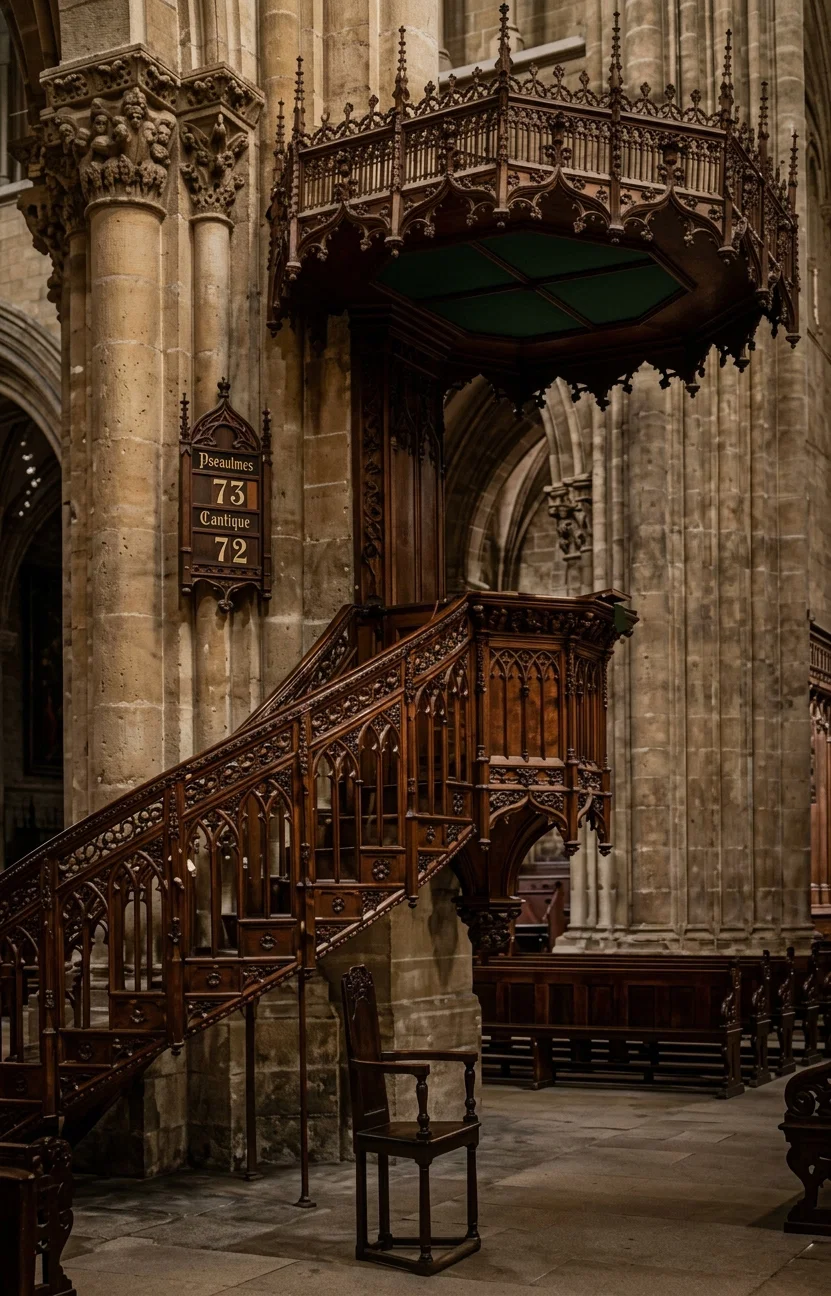
PULPIT OF JOHN CALVIN, WITH HIS PULPIT CHAIR ON THE FLOOR BENEATH