The Family as a School—Hand and Mind and Heart Were Trained Social Intercourse a Part of the Plan—Educative Value of the National Feasts
By the late MRS. E. G. WHITE
THE system of education established in Eden centered in the family. Adam was “the son of God” (Luke 3:38), and it was from their Father that the children of the Highest received instruction.
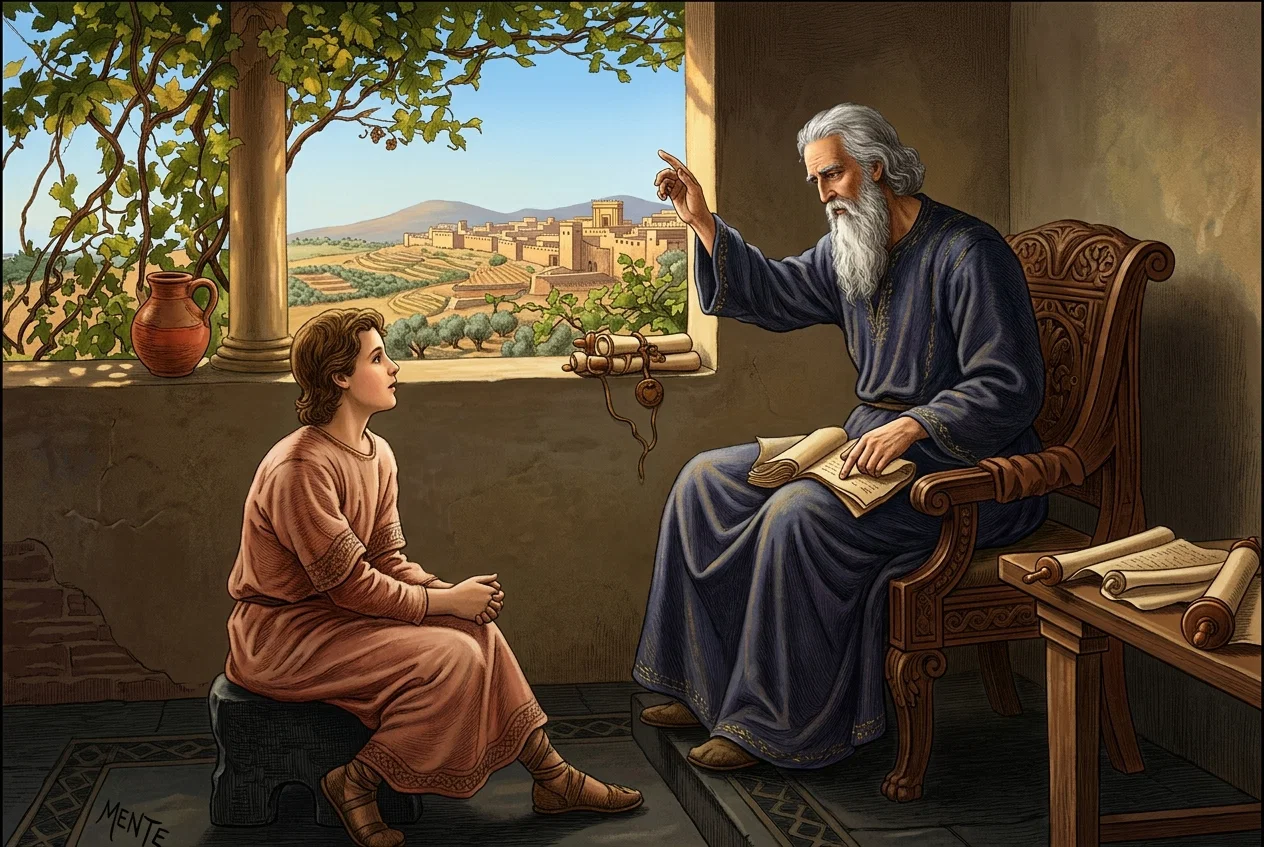
In the divine plan of education as adapted to man’s condition after the fall, Christ stands as the representative of the Father, the connecting link between God and man. He is the great teacher of mankind. And He ordained that men and women should be His representatives. The family was the school, and the parents were the teachers.
THE FAMILY AS A SCHOOL
The education centering in the family was that which prevailed in the days of the patriarchs. For the schools thus established, God provided the conditions most favorable for the development of character. The people who were under His direction still pursued the plan of life that He had appointed in the beginning. Those who departed from God built for themselves cities, and, congregating in them, gloried in the splendor, the luxury, and the vice that make the cities of to-day the world’s pride and its curse. But the men who held fast God’s principles of life dwelt among the fields and hills. They were tillers of the soil, and keepers of flocks and herds; and in this free, independent life, with its opportunities for labor and study and meditation, they learned of God, and taught their children of His works and ways.
ISRAEL’S CONDITION AND PECULIAR NEEDS
This was the method of education that God desired to establish in Israel. But when brought out of Egypt, there were among the Israelites few prepared to be workers together with Him in the training of their children. The parents themselves needed instruction and discipline. Victims of lifelong slavery, they were ignorant, untrained, degraded. They had little knowledge of God, and little faith in Him. They were confused by false teaching, and corrupted by their long contact with heathenism. God desired to lift them to a higher moral level; and to this end, He sought to give them a knowledge of Himself.
In His dealings with the wanderers in the desert, God was seeking to strengthen their faith by revealing to them the power that was continually working for their good. And having taught them to trust in His love and power, it was His purpose to set before them, in the precepts of His law, the standard of character to which, through His grace, He desired them to attain.
Precious were the lessons taught to Israel during their sojourn at Sinai. Here their surroundings were favorable for the accomplishing of God’s purpose. On every hand, vast, rugged heights, in their solemn grandeur, spoke of eternal endurance and majesty. Man was made to feel his ignorance and weakness in the presence of Him who hath “weighed the mountains in scales, and the hills in a balance.” Isa. 40:12. Here, by the manifestation of His glory, God sought to impress Israel with the holiness of His character and requirements, and the exceeding guilt of transgression.
IN PITY FOR THEIR WEAKNESS
But the people were slow to learn the lesson. Accustomed as they had been in Egypt to material representations of the Deity, and these of the most degrading nature, it was difficult for them to conceive of the existence or the character of the Unseen One. In pity for their weakness, God gave them a symbol of His presence. “Let them make Me a sanctuary,” He said; “that I may dwell among them.” Ex. 25:8.
In the building of the sanctuary as a dwelling place for God, Moses was directed to make all things according to the pattern of things in the heavens. God called him into the mount, and revealed to him the heavenly things; and in their similitude, the tabernacle, with all that pertained to it, was fashioned.
So to Israel, whom He desired to make His dwelling place, He revealed His glorious ideal of character. The pattern was shown them in the mount when the law was given from Sinai, and when God passed by before Moses and proclaimed, “The Lord, The Lord God, merciful and gracious, long-suffering, and abundant in goodness and truth.” Ex. 34:6.
THE LESSON IN THE SANCTUARY
But this ideal they were, in themselves, powerless to attain. The revelation at Sinai could only impress them with their need and helplessness. Another lesson the tabernacle, through its service of sacrifice, was to teach,—the lesson of pardon of sin, and power through the Saviour for obedience unto life.
“True education is not the forcing of instruction on an unready and unreceptive mind. The mental powers must be awakened, the interest aroused. For this, God’s method of teaching is provided.”
Through Christ was to be fulfilled the purpose of which the tabernacle was a symbol,—that glorious building, its walls of glistening gold reflecting in rainbow hues the curtains inwrought with cherubim, the fragrance of ever burning incense pervading all, the priests robed in spotless white, and in the deep mystery of the inner place, above the mercy seat, between the figures of the bowed, worshiping angels, the glory of the Holiest. In all, God desired His people to read His purpose for the human soul. It was the same purpose long afterward set forth by the apostle Paul, speaking by the Holy Spirit: “Know ye not that ye are the temple of God, and that the Spirit of God dwelleth in you? If any man defile the temple of God, him shall God destroy; for the temple of God is holy, which temple ye are.” 1 Cor. 3:16, 17.
A GREAT INDUSTRIAL SCHOOL
Great was the privilege and honor granted Israel in the preparation of the sanctuary; and great was also the responsibility. A structure of surpassing splendor, demanding for its construction the most costly material and the highest artistic skill, was to be erected in the wilderness, by a people just escaped from slavery. It seemed a stupendous task. But He who had given the plan of the building stood pledged to cooperate with the builders.
What an industrial school was that in the wilderness, having for its instructors Christ and His angels!
In the preparation of the sanctuary and in its furnishing, all the people were to cooperate. There was labor for brain and hand. A great variety of material was required, and all were invited to contribute as their own hearts prompted. Thus in labor and in giving they were taught to cooperate with God and with one another. And they were to cooperate also in the preparation of the spiritual building—God’s temple in the soul.
AN ALL-EMBRACING EDUCATION
The education of the Israelites included all their habits of life. Everything that concerned their well-being was the subject of divine solicitude, and came within the province of divine law. Even in providing their food, God sought their highest good. The678manna with which He fed them in the wilderness was of a nature to promote physical, mental, and moral strength. Notwithstanding the hardships of their wilderness life, there was not a feeble one in all their tribes.
THE EDUCATION OF SONG
As the people journeyed through the wilderness, many precious lessons were fixed in their minds by means of song. At their deliverance from Pharaoh’s army, the whole host of Israel had joined in the song of triumph. The commandments as given from Sinai, with promises of God’s favor and records of His wonderful works for their deliverance, were by divine direction expressed in song, and were chanted to the sound of instrumental music, the people keeping step as their voices united in praise.
Thus their thoughts were uplifted from the trials and difficulties of the way, the restless, turbulent spirit was soothed and calmed, the principles of truth were implanted in the memory, and faith was strengthened. Concert of action taught order and unity, and the people were brought into closer touch with God and with one another.
SPECIFIC INSTRUCTION IN EDUCATION
In the laws committed to Israel, explicit instruction was given concerning education. To Moses at Sinai God had revealed Himself as “merciful and gracious, long-suffering, and abundant in goodness and truth.” These principles, embodied in His law, the fathers and mothers in Israel were to teach their children. Moses by divine direction declared to them: “These words, which I command thee this day, shall be in thine heart; and thou shalt teach them diligently unto thy children, and shalt talk of them when thou sittest in thine house, and when thou walkest by the way, and when thou liest down, and when thou risest up.” Deut. 6:6, 7.
Not as a dry theory were these things to be taught. Those who would impart truth must themselves practice its principles. Only by reflecting the character of God in the uprightness, nobility, and unselfishness of their own lives can they impress others.
TRUE EDUCATION NOT BY FORCE
True education is not the forcing of instruction on an unready and unreceptive mind. The mental powers must be awakened, the interest aroused. For this, God’s method of teaching provided. He who created the mind and ordained its laws, provided for its development in accordance with them. In the home and the sanctuary, through the things of nature and of art, in labor and in festivity, in sacred building and memorial stone, by methods and rites and symbols unnumbered, God gave to Israel lessons illustrating His principles, and preserving the memory of His wonderful works. Then, as inquiry was made, the instruction given impressed mind and heart.
In the arrangements for the education of the chosen people, it is made manifest that a life centered in God is a life of completeness. Every want He has implanted, He provides to satisfy; every faculty imparted, He seeks to develop.
PROVISION FOR SOCIAL NEEDS
The Author of all beauty, Himself a lover of the beautiful, God provided to gratify in His children the love of beauty. He made provision also for their social needs, for the kindly and helpful associations that do so much to cultivate sympathy and to brighten and sweeten life.
As a means of education, an important place was filled by the feasts of Israel. In ordinary life, the family was both a school and a church, the parents being the instructors in secular and in religious lines. But three times a year, seasons were appointed for social intercourse and worship. First at Shiloh, and afterward at Jerusalem, these gatherings were held. Only the fathers and sons were required to be present; but none desired to forego the opportunities of the feasts, and, so far as possible, all the household were in attendance; and with them, as sharers of their hospitality, were the stranger, the Levite, and the poor.
THOSE IMPRESSIVE JOURNEYS
The journey to Jerusalem, in the simple, patriarchal style, amidst the beauty of the springtime, the richness of midsummer, or the ripened glory of autumn, was a delight. With offerings of gratitude they came, from the man of white hairs to the little child, to meet with God in His holy habitation. As they journeyed, the experiences of the past, the stories that both old and young still love so well, were recounted to the Hebrew children. The songs that had cheered the wilderness wandering were sung. God’s commandments were chanted, and, bound up with the blessed influences of nature and of kindly human association, they were forever fixed in the memory of many a child and youth.
The ceremonies witnessed at Jerusalem in connection with the paschal service,—the night assembly, the men with their girded loins, shoes on feet, and staff in hand, the hasty meal, the lamb, the unleavened bread, and the bitter herbs, and in the solemn silence, the rehearsal of the story of the sprinkled blood, the death-dealing angel, and the grand march from the land of bondage,—all were of a nature to stir the imagination and impress the heart.
THE GREAT THANKSGIVING SERVICE
The feast of tabernacles, or harvest festival, with its offerings from orchard and field, its week’s encampment in the leafy booths, its social reunions, the sacred memorial service, and the generous hospitality to God’s workers, the Levites of the sanctuary, and to His children, the strangers and the poor, uplifted all minds in gratitude to Him who had “crowned the year with His goodness,” and whose “paths dropped fatness.”
By the devout in Israel, fully a month of every year was occupied in this way. It was a period free from care and labor, and almost wholly devoted, in the truest sense, to purposes of education.
A knowledge of God, fellowship with Him in study and in labor, likeness to Him in character, were to be the source, the means, and the aim of Israel’s education,—the education imparted by God to the parents, and by them to be given to their children.