Superstitions Taught for the Benefit of the Priests—Barbarous Torments Threatened in the Next Life, for Those Who Refuse to Obey
The Tree Is Known by Its Fruits
By WALTER E. GILLIS
THE Western world has ever looked upon the continent of Asia as the stronghold of heathenism, the unevangelized East, the lands of idealism and idols. From their superior outlook as Christian nations, these Western peoples have deemed it to be their duty to send men and means, at hazard of life and fortune, that the great yellow races might partake of the benefits of the gospel.
HOW CAN GOD PERMIT IT?
As one passes through the native haunts of these teeming millions, one is often led to wonder how it is that a beneficent God can ever permit such degradation, such ignorance, such villainy, such injustice, to continue. The student of the Holy Scripture can see but one explanation.
When Satan was cast out of heaven instead of being immolated upon the altar of his own iniquity, it was that he might demonstrate his theories, and thus forever seal up the possibility of another rebellion arising in a realm where individual liberty and absolute right are the key to its symmetry and existence.
The great nations of Asia have been the most fruitful centers of his activities. Here his schemes for a kingdom have been permitted to take root and bear their fruit for centuries.
SPIRIT OF REBELLION AND SELF-EXALTATION
On the plains of Shinar, he would inspire his followers to rear a tower whose pinnacle would cleave the clouds. Thwarted in that, he attempted a counterfeit of Paradise, and built the world-renowned Babylon; and the record says that the rulers of that splendid city and kingdom looked to the magicians, astrologers, and sorcerers for guidance and occult wisdom. See the first chapters of Daniel.
As these various Heaven-daring schemes ripened, the Lord dispersed the nations; but they carried with them, in their dispersion, the same spirit of rebellion for the exaltation of self, and have continued to develop the plans of their spirit chieftain, as revealed through the magicians and the sorcerers, who everywhere maintain an ascendancy over the people, and thrive upon their credulity and moral ignorance.
In India, China, and Japan, the story repeats itself. Wherever you go, the ancient legends of the people determine their common origin; for they tell of the forbidden fruit, and of the loss of virtue and good fortune that followed the eating of it. And these are the countries where man believes in his ability to save himself. These are the countries where the dead are worshiped, and spiritualism revels in the superstitions of the inhabitants. Wherever you may go, you will see the towers dedicated to the spirits of the dead, processions and ceremonies for their propitiation, and fantastic arrangements for the outwitting of the spirits of devils, whose malign influence the wily hierarchy judiciously advertises as a means of maintaining a constant flow of coin into their ever hungry treasury. Spiritualism in all its subtler forms is maintained as a prerogative of the priestly caste.
CRUELTIES IN THE WORLD TO COME
For the educated, the soul-tempting philosophies of the esoteric weave a spell that must inevitably lead him into the toils of sheer devil worship. For the ignorant, a cruder school suffices.
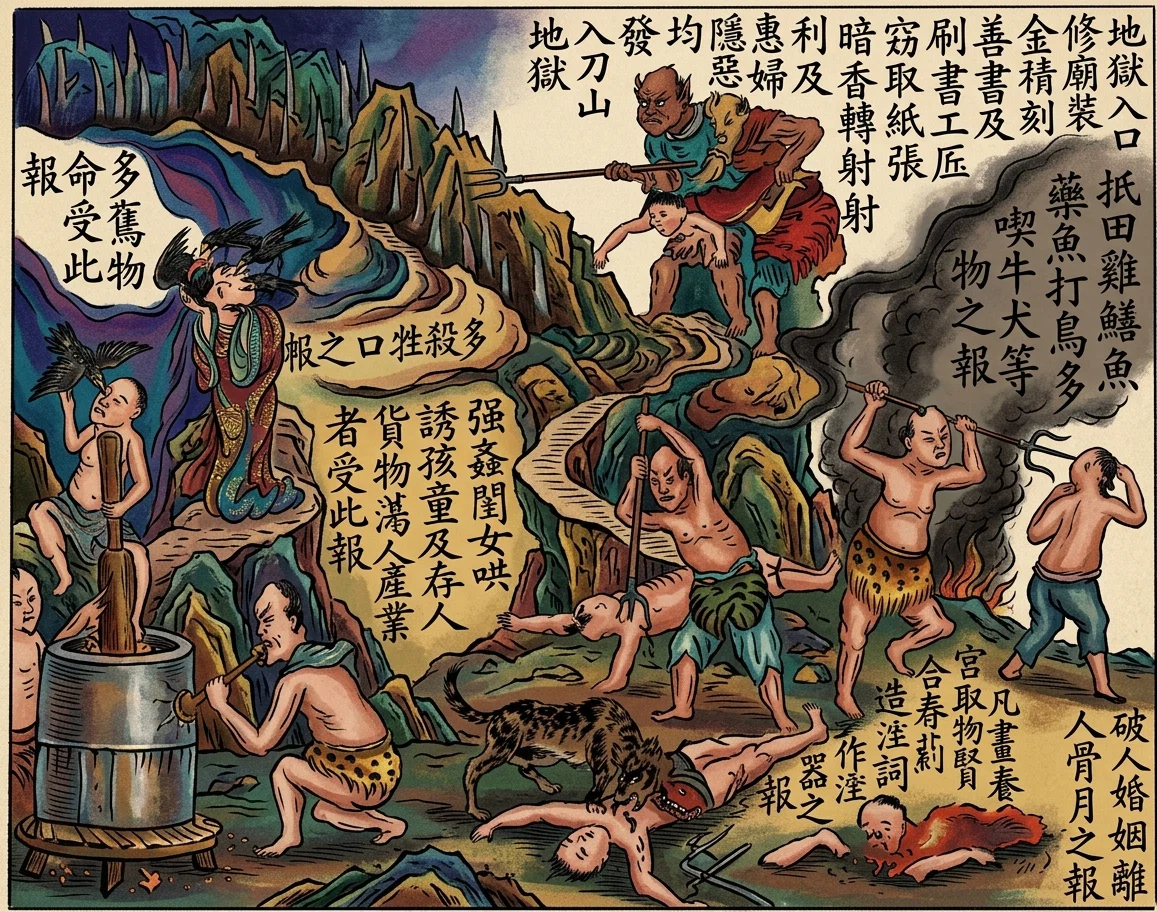
Images, and sculptured allegory of the supposed scenes of the nether world, adorn their temples. Frowning deities sit in judgment upon the cowering representations of disembodied souls. And then in horrid panorama appear the meted punishments. Because a soul dared to allow itself to be born into the world without the authorization of the gods, he is condemned to the misery of transmigration through the insect world. Here an unfilial son, who has failed to worship faithfully the departed shades of his ancestors, is sawed into sundry chunks and slices by two fear-inspiring imps of hades. There an unfaithful wife is taken by a sturdy son of hell and brutally jabbed against the broken-off limb of a tree, and left to wriggle in anguish for ages. Or it may be, for failing to reverence and obey her mother-in-law, she is dismembered, and each portion, sensitive as the whole, is nailed to a post, to endure such agony as can be imagined from the circumstances. For thieves and deceivers is provided a hell of broken ice, over the surface of which the shivering culprits painfully make their way. In a boiling pot of oil one sees those who have been remiss in worship of idols and service at the temple.
It is an endless tale, and the evidence of its infamy is found in the lives of its devotees.
It is an axiomatic statement that “a people approximate to the ideals of their religion.”
The illustration expresses some ideas of the Chinese about the tortures endured by the spirits of the dead.
The more intimate one’s acquaintance with heathenism, the more one is confirmed in the belief that the great heathen East is primarily and essentially spiritualistic, and that spiritualism is naturally the handmaid of idolatry, whether it be worship of self or of idols. Idolatry is the antithesis of Christianity. Therefore spiritualism is antichristian. As the Scriptures say of the backsliding Hebrews, “They left all the commandments of the Lord their God, . . . and used same as that of Paul, when in self-sufficiency he persecuted the church of God: ‘The good that I would I do not; but the evil which I would not, that I do.’ Why is it?—Because of that fallen spirit who in the beginning said, ‘Ye shall not surely die,’ and who has ever since induced men to trust in their own efforts for salvation; whereas the Scriptures say: ‘O Lord, I know that the way of man is not in himself: it is not in man that walketh to direct his steps.’ Jer. 10: 23.
Ostensibly in quest of truth as a balm for their troubled souls, they make their “ego” the judge of what is truth. Thus each, as it were, defines himself by making himself his own savior, to the end that he may at last be lost in the personality of an impersonal god. Truly these, as the Saviour said, worship they know not what. While they believe in incarnation, it is the reincarnation of the selfsame “ego”; whereas the Scriptures provide for the incarnation of the Son of God at the new birth, when in triumph the former victim of despair exclaims: “I am crucified with Christ: nevertheless I live; yet not I, but Christ liveth in me: and the life which I now live in the flesh I live by the faith of the Son of God, who loved me, and gave Himself for me.” Gal. 2: 20.
Much has been said about the beautiful663philosophies and rules of conduct of the great modern teachers; but they are infinitely feeble when compared with the Bible. The heathen literature of Greece and Rome brings to us the intelligence that man’s ultimate end is absolute satiety, apathy. The great heathen cults of the East to-day teach that man’s ultimate end is absorption into Nirvana—which is another way of stating the philosophy of the Stoics.
How manifestly superior is the teaching of the Bible, that in this life man’s ideal state is found in glorifying his Maker and being a blessing to his fellows; that in the life to come, he will through the eternal ages increase in knowledge and wisdom, his capacity for the enjoyment of eternal life ever increasing!