Interesting Lands Under the Equator — Nights and Days of the Same Length; Shipping and Commercial Center — Our Malaysian Field Work
By ARTHUR G. DANIELLS
Most readers will agree with the tourist who said, “The political distinctions obtaining to-day in the Malay peninsula are rather confusing to strangers, and the assonance of straits and states does not make them clearer.” It should be remembered that the whole of the Malay peninsula south of Siam is divided into “states” and “settlements.” In this letter, we shall consider the settlements only.
The number and location of these settlements were given in my last report. They are all British territory, and form a government known as the “Straits Settlements.” The city of Singapore is the capital of this government. This city is located on the south coast of the island of Singapore. It is the most southern city of the Malay peninsula, being only one and a half degrees north of the equator. Here the sun holds rigidly to a program of “rising and setting that ranges only from six minutes before to six minutes after six o’clock morning and evening the year round,” making all the days of the year practically twelve hours of daylight and twelve hours of darkness.
CROSSROADS OF THE EAST
Much has been written about Singapore by visitors to the peninsula. One recent writer says it “is a geographical and commercial center and crossroads of the eastern hemisphere like to be no other port in the world. Singapore is an ethnological center, too; and that small island swinging off the tip of the Malay peninsula holds a whole congress of nations, an exhibit of all the races and peoples and types of men in the world. . . . Japanese, Chinese, Siamese, Malays, Javanese, Burmese, Singhalese, Tamils, Sikhs, Parsis, Lascars, Malabars, Malagasy, and sailor folk of all coasts, Hindus and heathens of every caste and persuasion, are grouped in a brilliant confusion of red, white, brown, and patterned drapery, of black, brown, and yellow skins; and behind them, in ghostly clothes, stand the pallid Europeans, who have brought the law, order, and system, the customs, habits, comforts, and luxuries of civilization to the tropics and the jungle.”
SIXTY-NINE LANGUAGES
The statistician of Singapore reports that sixty-nine languages are spoken by this congress of races. The population of the city is 320,000. Fully two thirds of these citizens are Chinese. The Malays and the Indians number about 30,000 each. The Europeans and the Eurasians come next, with 12,000 each. Then there is a mixed class numbering about 15,000.
The island of Singapore is separated from the mainland of the peninsula by the Tebrau Strait, which is about three quarters of a mile wide. The length of the island east and west is twenty-seven miles, and the width is fourteen, giving a total area of 226 square miles. The distance around the island is sixty-six miles. This island became British territory in 1819, and the city of Singapore was made the seat of government for the Straits Settlements in 1837.
The harbor is large and deep, giving ample accommodation for the great volume of shipping that passes through it to both the east and the west. It forms a naval base of the highest importance to British interests at this great international highway.
Singapore is the headquarters of our Straits Settlements division of the Malaysian mission field. Here we have a church of nearly one hundred believers. Pastor C. M. Lee has charge of the Chinese section of this church. A neat, creditable building has been erected for church services. The believers receive thorough Bible instruction regarding the Christian life. They are also organized, and taught how to do personal missionary work for their neighbors and for the642unsaved about them. This church enjoys the advantages that cluster about the general headquarters of the entire Malaysian Division.
SCHOOL IN SINGAPORE
The school for the training of workers for the entire Malaysian Mission is located in Singapore. The presence and services of the faculty and students in the Singapore church are a source of great encouragement to the church. The work done by the students in the circulation of gospel literature aids in building up the church membership.
WORK IN OTHER SETTLEMENTS
Up to the present time, but little work has been done in the other settlements — Penang and Province Wellesley, the Dindings, and Malakka. Penang and Province Wellesley are located up the Straits of Malakka a distance of 370 miles from Singapore. Penang is an island separated from the mainland of the peninsula by a narrow channel of water. The island is nine by fifteen miles. Here, in 1786, was established the earliest British settlement in the Straits of Malakka. It is the first port of call for all steamers traveling east from India and Burma to the East Indies, the Philippines, China, Japan, and North America.
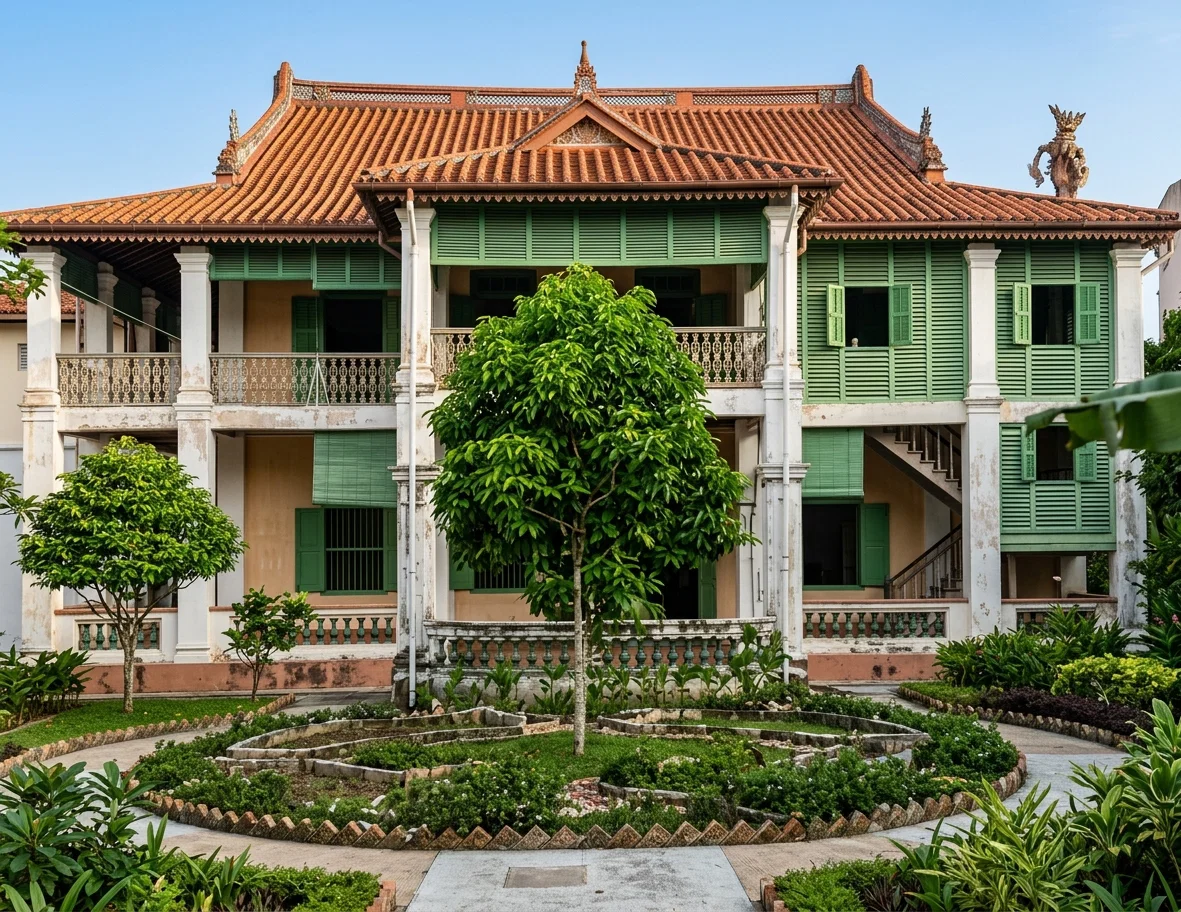
OUR MISSION BUILDING IN SINGAPORE
Just across the channel is a strip of land called Province Wellesley, which was purchased by Great Britain in 1800. It is forty-five miles long and seven miles wide. These two—the island and the province—are united in the one settlement, and have a population of 270,000. The climate at this place is hotter and drier than it is at Singapore. Coconuts, betel nuts, spices, and fruits are the principal products of this settlement. It is the plan of the committee in charge of the division to establish a mission at this place in the near future.
TIMBER AND TIN IN THE DINDINGS
Eighty miles south of Penang is a settlement called the Dindings. There are only seven or eight thousand people in this settlement. It has no railway connection, and is not a port of call for the large steamers. This place furnishes a large quantity of good timber and some tin.
As we sailed down the straits from Penang, we could see the lights of Malakka not far away. This is the oldest European settlement in the Far East. In 1511 the Portuguese formed a European settlement at Malakka. In 1641 the Dutch dispossessed the Portuguese of the settlement, and established themselves behind the strong fortifications. They made this the headquarters of their enterprise in this part of the world.
KEEN BUSINESS MEN
However, in 1795 Malakka was taken from the Dutch by the British. It was returned to the Dutch in 1818, but fell into the hands of the British in 1824, and has remained there ever since. The prevailing races in all these settlements are the Chinese and the Malays. The former, being industrious, and keen in business affairs, have come into possession of the sources of income which originally belonged to the Malays.
LABORS FOR THIS CHRISTLESS PEOPLE
It is in behalf of these Christless, hopeless people that we are carrying on gospel missionary work in that part of the world. The results thus far are not as encouraging as in some non-Christian lands, yet enough fruit has already been gathered to encourage the workers to press forward.
The superintendent of this division, Pastor R. L. Mershon, is extending the circle from Singapore as fast as he can obtain help from the Board of Foreign Missions.
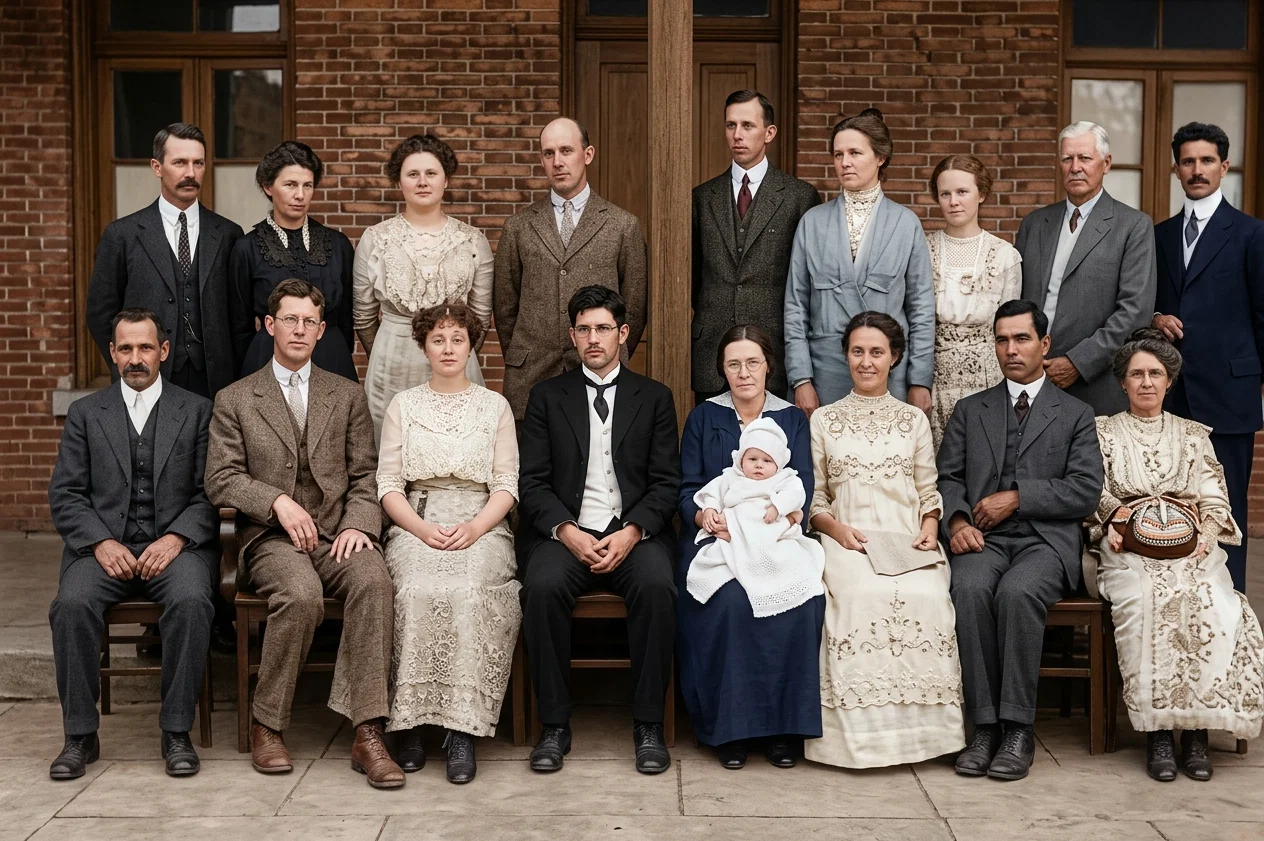
Group of workers who attended our last Shanghai general meeting, all of whom received their training, at least in part, at our Walla Walla College, Walla Walla, Washington