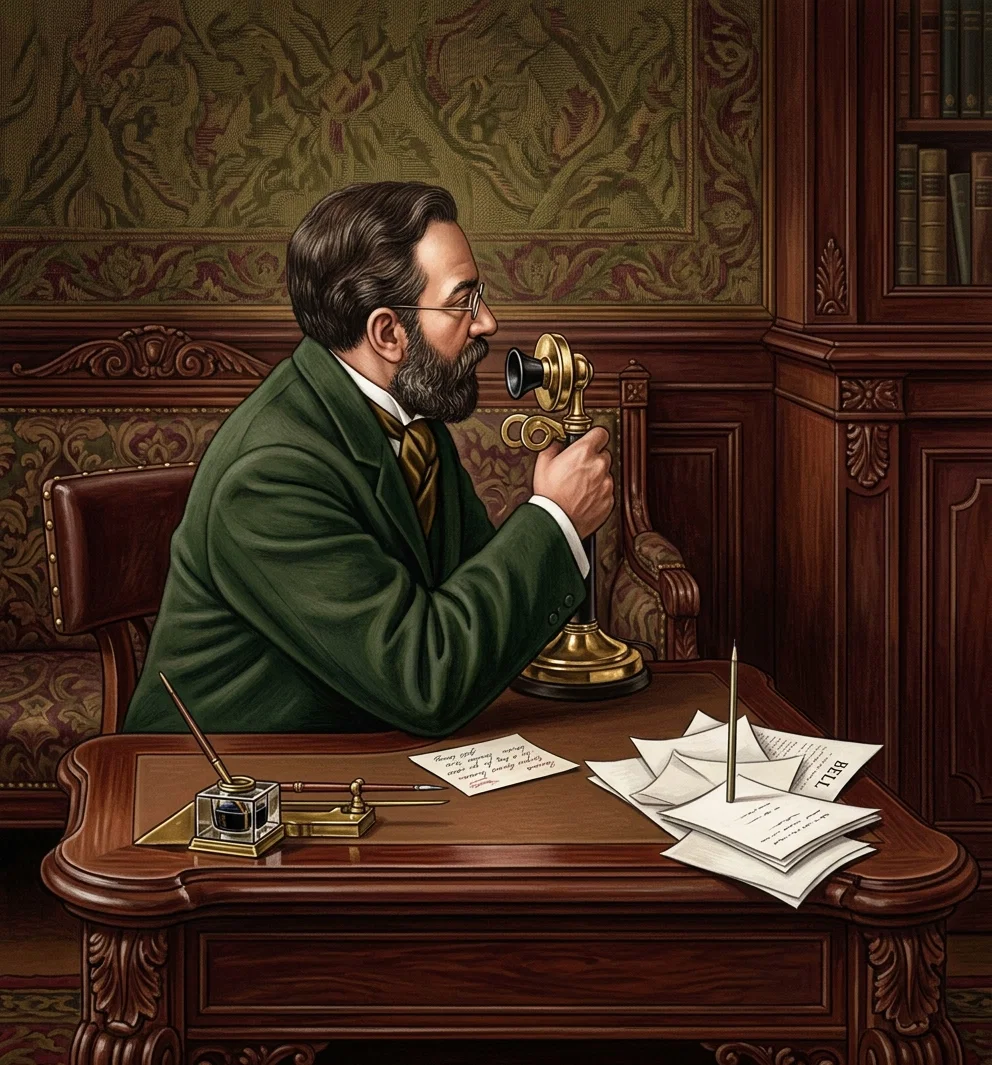
RECENTLY, at the great Panama Exposition, I sat down in the comfortable little auditorium of the American Telegraph and Telephone Company, and listened to the talk and viewed the moving pictures on the progress of electric communication from its feeble starting on the Atlantic coast till the wonderful mechanism of the telegraph and the telephone had, with pole and wire, topped the mountains, spanned the desert, and, with pencils of light, illuminated the whole country.
In life-size and wonderfully lifelike moving pictures, Mr. Thomas Watson stood before the audience, and told, in clear enunciation, illustrating by various objects, of the early struggles of Alexander Graham Bell, and his association with Mr. Bell in the development of the telephone. He told of repeated failures, and of Mr. Bell's faith that yet it would succeed.
The first long talking was over a distance of two miles. Then the instrument was perfected so that six miles became the limit; then forty-five, if I remember correctly; then from Boston to New York; a little later, from New York to Chicago; and when they could talk from New York to Denver, it was thought that the climax was reached. Not so, however. The sensitiveness and perfection of the telephone was still further developed, and now men are talking with one another from New York to San Francisco, over three thousand four hundred miles of wire.
I, with a hundred others, more or less, heard a man in New York talking. He told us the state of the weather. He gave us the latest news from the seat of war, also local news of the East. We saw and heard the waves breaking on the Atlantic beach, and the surf of the eastern sea surging over the sands.
Two men, one before us on the platform, and the other in New York, carried on a conversation, social, commercial, and otherwise, and we heard them both. We heard a New York band play, and then a man in New York sang that sweet old Southern song, “My Old Kentucky Home.” It did not sound as though he were singing 3,400 miles away, but over in Oakland, as it were.
It is a modern miracle. It would seem almost like wizardry unless we knew of its development. It surpasses the imagination of the “Arabian Nights”; and if it had been sprung upon the world a hundred years ago—a world that did not know the various steps in the development—its marvel would be increased a hundredfold.
Yet man invented this. Man executed it—man so feeble, so insufficient in many ways, and still the offspring of God. Men believe in these wonders. They are tangible enough for human minds to grasp—at least sufficiently to believe the rest. Strange that these men cannot believe that God can speak! You could see that there were doubters in the audience at the exposition. Every now and then, some one would remove the telephone from his ears while the surf was surging on the beach, to see if he could hear it without—whether it were not some sound, after all, close by. But the surge of the surf ceased to be heard as soon as the telephones were removed from the ears. The doubt was dissipated.
There are many who doubt God, and the sad fact is that they doubt God more than they doubt man. The majority of those who listened to the wonderful workings of the telephone, did not understand them. Even the men who have dealt with electricity the longest, say that it is still a mystery; yet it can do things, or men can do things with it. Why doubt God, who is infinite where man is finite? God can speak to His children, and He does. God knows, and knew long before men knew anything about it, the art of telegraphy and telephony and—to coin a new word—telepathy. That is, He can write afar off, and He can speak afar off, and He can make men who are in harmony with the laws of His operations, see afar off.
Men worked a long time to get electricity to speak so it could be understood. It took years to devise instruments that would transmit and receive the sound. God had all this in His mind when He made men to hear and to see. The ear and the eye are of His creation; but there must be harmony with God in order that we may hear and in order that we may see, and there must be willingness to hear. The soul must stand as did Samuel of old, saying, “Speak, Lord; for Thy servant heareth.” He must be willing to do as Ezekiel did when God called him up into the mount to see “visions of God”; for God has messages to His people, and has spoken them through His chosen servants at various times in the past. Read in His book of where “the word of the Lord came to Isaiah,” and “the word of the Lord came to Jeremiah,” and “the word of the Lord came to Ezekiel,” and “the word of the Lord came to” others, and they heard God’s word, and took the word that God gave them.
Visions?—Yes, He gave them visions; gave Daniel visions of all the centuries following him until the history of this earth in its present sinful condition should be completed; gave Ezekiel visions; gave Isaiah visions; gave John, the beloved disciple, visions, which he recorded for us, in the last book651of the Bible. Yet God wants us now to listen to His voice, and to see this world—its history of the past and its future—in the light of the visions that He gives. He wants to speak to our heart. One of His messages is: “Comfort ye, comfort ye My people, saith your God. Speak ye comfortably.” The literal Hebrew is indicated in the margin, “Speak ye to the heart.” God comforts by speaking to the heart.
God has foretold us all these various things that are occurring in the world at the present time, which have a molding power upon men and nations; told them through His chosen servants. He spoke to them by divine telephony. He made them see visions of God, seeings of God, seeing the things as God saw them. He writes upon men’s hearts and in men’s minds the great law of His government—the mighty principles that will mold character. This is divine telegraphy. Why not believe it?
We believe in human telephony. Why not believe in divine telephony? We believe in human telegraphy. Why not believe in divine telegraphy? God wants us in this uncertain age to come into that relationship with Him where He can speak to us, talk to us, lead us. And He is no respecter of persons. All that He asks is that we shall know the harmony of the divine. He will do the rest. And through all these various channels, as we communicate with Him, there will come life and power. M. C. W.