The year 1914 witnessed the opening of one of the large provinces of northwestern India, the Punjab. “Punjab” means,—punj, five; ab, water,—the five waters, often called “Land of the Five Rivers.” Previous to this time, our missionaries had done no work in this section. The Punjab includes forty-five native states. It is one tenth larger than the British Isles, or one tenth of the area of the Indian Empire. The population is about 26,000,000.
The house of the ordinary peasant, though not attractive, is fairly comfortable. It is built of mud, rarely decorated, and is cooler in summer and warmer in winter than a brick or stone house. The people dress simply in the plains, their clothing being made entirely of cotton cloth. Most of the people are zamindars, or cultivators. The plow used is of the simplest kind, made of wood, with an iron-pointed share, drawn by a single span of oxen.
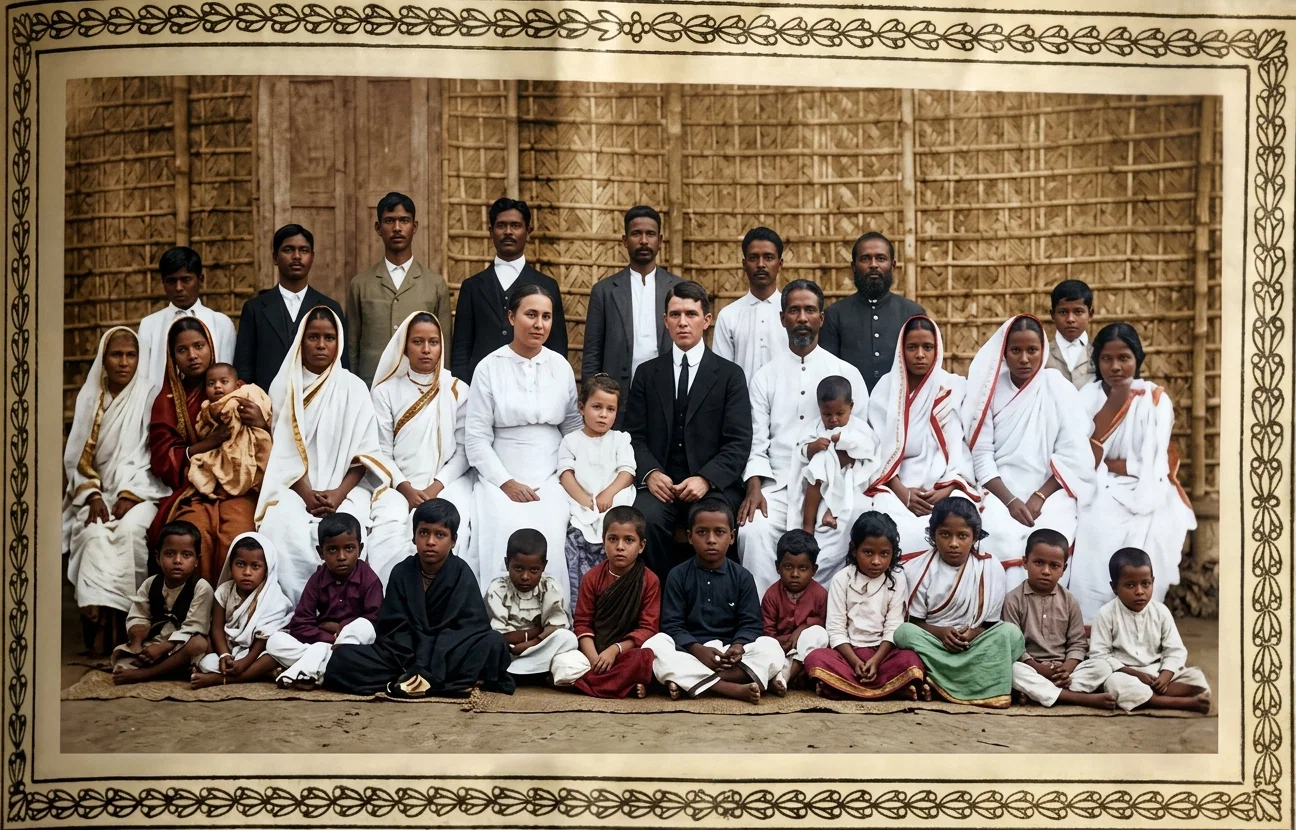
A Church Group, Bengal
Our mission villages among these simple and sturdy people are about621thirty miles from the city of Lahore, the great and historic capital of the Punjab.
Our method of labor among these people is to make tours of a week or ten days, going from village to village. We take our itinerating dispensary, tent, optical lantern outfit, beds, and many other things necessary for a trip of this kind, which we carry on our cart, drawn by two oxen.
It is not difficult to get an audience, as the people are very inquisitive, and crowd around to see what the sahib’s curious kul—machine—is. The doctor has no trouble in securing patients, and usually treats a hundred or more each day. Many come a great distance to obtain help.
At night, we hang up our sheet on the mud wall of the village. After singing and prayer, we give them a lecture on the life of Christ, or some simple Bible story, illustrated by lantern pictures. These lectures are very popular with the people, and we never fail to have an attentive audience of 250 or 300.
We are greatly handicapped because we have no mission building of any kind. We are hopeful that in the near future we may have necessary buildings for the advance of the gospel work in this great “Land of the Five Rivers.”