The End of the Prophetic Wonders—Resurrected to See the Climax—The Sealed Book Opened and Knowledge Increased
By JEAN VUILLEUMIER
This is the concluding study by Elder Vuilleumier on the book of Daniel. Our issue of October 19 will contain his opening study on that other interesting prophetic book, the book of Revelation. Many people regard the book of Revelation as being sealed, so that it cannot be understood; but the book itself claims to be a revelation, and therefore it is open to our understanding. Our readers, we are sure, will enjoy the studies that Elder Vuilleumier will furnish. Editor.
“AND at that time shall Michael stand up, the great Prince who standeth for the children of thy people.” Dan. 12:1, A. R. V.
The vision recorded in the eleventh chapter of Daniel brings us down the course of time, through two thousand five hundred years, to the close of human kingdoms. “At that time,” says the angel Gabriel to Daniel, shall Michael, the Son of God, “stand up.” Dan. 11:3, 7, 20. This means that He takes His “great power” and reigns, because then shall “the God of heaven set up a kingdom which shall never be destroyed.” Rev. 11:17; Dan. 2:44. Then “the saints of the Most High shall receive the kingdom, and possess the kingdom forever, even forever and ever.” Dan. 7:18. Then, as says Isaiah, “the government shall be upon His shoulder” whose name is “Prince of peace.” Isa. 9:6.
“And there shall be a time of trouble, such as never was since there was a nation even to that same time.” Dan. 12:1.
DISTRESSED BY SIN
This “time of trouble” coincides with “the great and terrible day of the Lord,” described years before Daniel, by the prophet Zephaniah, as “a day of wrath, a day of trouble and distress, a day of wasteness and desolation, a day of darkness and gloominess, . . . a day of the trumpet and alarm, against the fortified cities, and against the high battlements. And I will bring distress upon men, . . . because they have sinned against Jehovah; and their blood shall be poured out as dust, and their flesh as dung. Neither their silver nor their gold shall be able to deliver them in the day of Jehovah’s wrath.” Zeph. 1:15–18.
“And at that time thy people shall be delivered, every one that shall be found written in the book.” Dan. 12:1.
When the time of trouble begins, the Investigative Judgment has just closed on all the righteous by the blotting out of their sins. The names of all such are therefore retained in the book of life; and the happy throng of the faithful among the living will be “delivered” from the terrible calamities and plagues then poured upon a wicked and impenitent world.
SPECIALLY RESURRECTED
“And many of them that sleep in the dust of the earth shall awake, some to everlasting life, and some to shame and everlasting contempt.” Verse 2.
This verse describes a partial resurrection of a few leading characters selected from both righteous and unrighteous, just before the coming of Christ upon the clouds. The most renowned among the wicked will thus witness the triumph of the cause of Christ, which they have derided, oppressed, and persecuted; while the risen saints with exultation wait for the glorious appearing of the King of kings.
“And they that are wise shall shine as the brightness of the firmament; and they that turn many to righteousness as the stars forever and ever.” Verse 3.
Every one knows the brightness of the sun, which is so many times larger than our earth. But what do we know of the brightness of the polestar, 86 times brighter than our sun? of Vega, Capella, and Arcturus, whose light is respectively 344, 430, and 516 times greater than that of our sun? of Alcyone in the Pleiades, with a brightness that exceeds that of our sun 12,000 times, and whose light reaches us only after traveling 700 years at the rate of 186,000 miles a second? The comparison drawn by the prophet serves to illustrate the overwhelming glory of the saved.
A CONSUMMATION WORTHY OF GOD
With this glorious promise ends the long prophecy embraced in the eleventh chapter of Daniel, covering all the great political changes on the face of this earth during twenty-five centuries, until we reach the eternal kingdom of God. The consummation of this long and bloody struggle is worthy of the God who rules in the affairs of men; the reward given to the saints of the Most High is worthy of the long, sad waiting. And now the angel gives the aged prophet a word of encouragement as to the future usefulness of the book in which these wonderful revelations are written:
INCREASED KNOWLEDGE AND APPROACHING GLORY
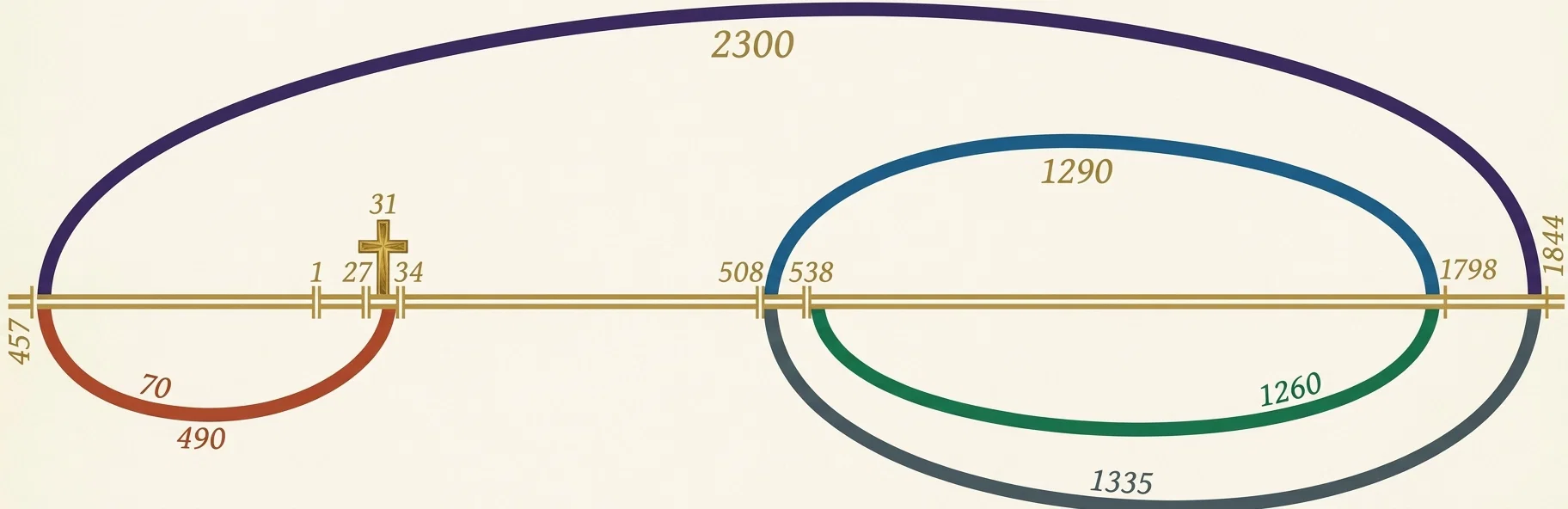
The above diagram includes, as will be seen, all the five prophetic periods of the book of Daniel. It shows at a glance the wonderful harmony and the sublime unity of prophetic chronology. The immutable firmness of the divine plan is seen in the fact that the least change in any period or date would upset the whole scheme, riveted on events, like the death of Christ in 31 A. D. All these periods are absolutely unassailable as matters of chronology.
“But thou, O Daniel, shut up the words, and seal the book, even to the time of the end: many shall run to and fro, and knowledge shall be increased.” Verse 4.
This closing caution and promise have both been fulfilled. For twenty centuries, the book of Daniel was nearly a blank. But since the beginning of the nineteenth century, a flood of light has been graciously poured from heaven upon the prophetic Word, of which the book of Daniel is the key. In all countries, devout men began to study these revelations; and the church of God has found new courage and hope in these unfolding mysteries, the sure harbingers of the approaching glory.
“Then I, Daniel, looked, and, behold, there stood other two, the one on the brink of the river on this side, and the other on the brink of the river on that side. And one said to the man clothed in linen, who was above the waters of the river, How long shall it be to the end of these wonders? And I heard the man clothed in linen, who was above the waters of the river, when he held up his right hand and his left hand unto heaven, and sware by Him that liveth forever that it shall be for a time, times, and a half; and when they have made an end of breaking in pieces the power of the holy people, all these things shall be finished.” Verses 5–7.
HOW LONG TO THE END?
And now to the “man greatly beloved” is given the rare privilege of beholding not only two more angels, but the divine Son of God, the future Messiah and Prince of peace. Compare Dan. 10:5, 6; Rev. 1:13–15. One of the angels graciously volunteers to be spokesman for the overawed prophet, voicing, at the same time, a question which would naturally come to every earnest student of these prophecies in future ages; namely, “How long shall it be to the end of these wonders?” To that honest inquiry, the great Michael Himself gives answer in the most solemn manner, swearing “by Him that liveth forever that it shall be for a time, times, and a half” (3½ x 360 = 1,260)—one thousand two hundred sixty years, reaching, as we have seen, from A. D. 538 to 1798.
But this important prophetic date, 1798, which marks the beginning of “the time of the end,” does not reach to the final end of the great controversy. “They”—the enemies of God—must yet make “an end of breaking in pieces the power of the holy people.” A latter-day persecution is yet to break out, of which the book of Revelation gives the full account.
“And I heard, but I understood not: then said I, O my Lord, what shall be the issue [margin, ‘latter end’] of these things? And He said, Go thy way, Daniel; for the words are shut up and sealed till the time of the end. Many shall purify themselves, and make themselves white, and be refined; but the wicked shall do wickedly; and none of the wicked shall understand; but they that are wise shall understand.” Dan. 12:8–10.
To Daniel, this period of three and a half times is shrouded in total darkness. So he ventures to repeat the question of the angel. The answer comes back that the understanding of these things must be left to those who shall live in “the time of the end.” At that time, these very prophecies will serve to “purify” and “refine” God’s people, who shall then “understand”; but a woeful pall of ignorance shall rest on “the wicked.”
“And from the time that the continual (burnt offering) shall be taken away, and the abomination that maketh desolate set up [margin, ‘taken away to set up the abomination’], there shall be a thousand two hundred and ninety days.” Verse 11.
SOME LONG PROPHETIC PERIODS
A new prophetic period is here given,—one thousand two hundred ninety days,—which is by thirty prophetic days, or 30 years, longer than the one mentioned in verse 7. The first period began in 538 A. D., when the “abomination that maketh desolate” was581not set up. The second period, starting “from the time that the continual shall be taken away” to make room for the abomination, precedes it by a period of thirty years, and therefore begins in A. D. 508. As we have shown at length on chapter 8, this “continual” to be “taken away” in 508 is organized paganism.
“The Complete Extinction of Paganism in the West” is the title of book 12 of Beugnot’s “History of the Destruction of Paganism in the West.” Paris, 1835. That “complete extinction” was brought about by an edict of Theodoric the Great, who was king of the Ostrogoths in Italy from 490 to 526. This edict, which must have been issued somewhere about 508 A. D., is found in the Edictum Theodorici Regis (Frankfurt, 1613), and pronounces the pain of death on all found guilty of “sacrificing according to pagan rite.” “What no emperor had dared to do,” says Beugnot, “a Gothic prince carried out without flinching.”
We find, therefore, that both periods, the one thousand two hundred sixty and the one thousand two hundred ninety days, bring us to the fateful date of 1798, where the papacy received that terrible blow from which it has not yet recovered.
“Blessed is he that waiteth, and cometh to the thousand three hundred and five and thirty days.” Verse 12.
IT ALSO POINTS TO 1844
A third prophetic period is brought to view by the Son of God, one thousand three hundred thirty-five years, symbolized by as many days. No new starting point being given, it must of necessity begin at the same date as the one immediately preceding it, 508 A. D. But it brings us to the year 1844, the very year that marks the end of the famous period of two thousand three hundred years of chapter 8. Well may we say, “Blessed is he that waiteth, and cometh” to the end of these two prophetic periods; for such reach the time when God’s work in the earth is soon to close, the time when the Judgment sits in the heavenly courts on the cases of the righteous,—a short period, at the end of which the living are to witness the first resurrection and the coming of the Lord. This short period is the antitypical day of atonement. Blessed is he who comes to such a time. He may expect to see with his own eyes “the latter end of these wonders.” “But go thou thy way till the end be; for thou shalt rest, and shalt stand in thy lot, at the end of the days.” Verse 13.
The venerable prophet, “greatly beloved,” must rest satisfied, after having written these things for remote generations, to go to his rest, with the happy assurance that he will be raised at the resurrection of the just, and stand in his appointed lot at the end of the days.