PIONEERING IN CHINA

3%

Pacific Press Publishing Association · Mountain View, California · Aug 17, 1915

FromSigns of the Times, Vol. 42, No. 32.

Read the full edition

PIONEERING IN CHINA

Vigorous Advertising Was Done—Our Bamboo Tent Was an Attraction—Crowds Came to the Meetings—The Success That Resulted
By FRANCIS E. STAFFORD
Kading is the name of an old walled city in the southern part of the Kiangsu province, about thirty miles northwest of Shanghai. The city still bears the marks of the Taiping Rebellion, more than fifty years ago, some buildings razed at that time having never been rebuilt. As late as the summer of 1913, at the time of the last rebellion in the Yangtse Valley, Kading became the headquarters of the rebel army after they were driven out of Shanghai.
It is a quiet, peaceful little city of about 15,000 people, who appear to have more time than money. It not being on the main artery of travel, business is not as brisk here as in other places. Yet, geographically it is an important center, being a district city, where a mandarin is stationed who controls some fifteen or twenty towns and villages in the surrounding country. It is a city of homes; and moreover, a large per cent of the people are of the educated class. One man we know, who made his fortune in America, has now returned to China, and has settled down here in Kading to pass his remaining days on earth in peace and happiness.

THE QUIET CITY BECAME STIRRED

One day, the daily routine life of this stolid old city, which had been going around in certain prescribed circles since the days of Confucius, received such a shaking up as it had not experienced for many a day. A man suddenly appeared at the south gate, entered the city, and pasted up large green and yellow posters on the walls of all the prominent streets.
Immediately great crowds collected to see what it meant. These were no patent medicine “ads,” neither did they advertise cigarettes, or Standard Oil products, such as the people were used to seeing placarded on their walls. No; this was something new. And what could it mean? The posters said plainly, in big letters, that “the countries of this world will eventually become one country.”
Then there was a picture of the great European war, and a statement of the numbers of soldiers of each country involved, with other statistics; but the provoking part of it was that it ended without saying what country was going to win and become the one world-wide kingdom. It simply said that any one who wanted to know about this could come to a certain place on a certain date, when they would be told the particulars. As the place mentioned was near the center of town, just around the corner from the mandarin’s yamen, nearly every one who read the poster determined to go.

EXCITED ABOUT THE BAMBOO TENT

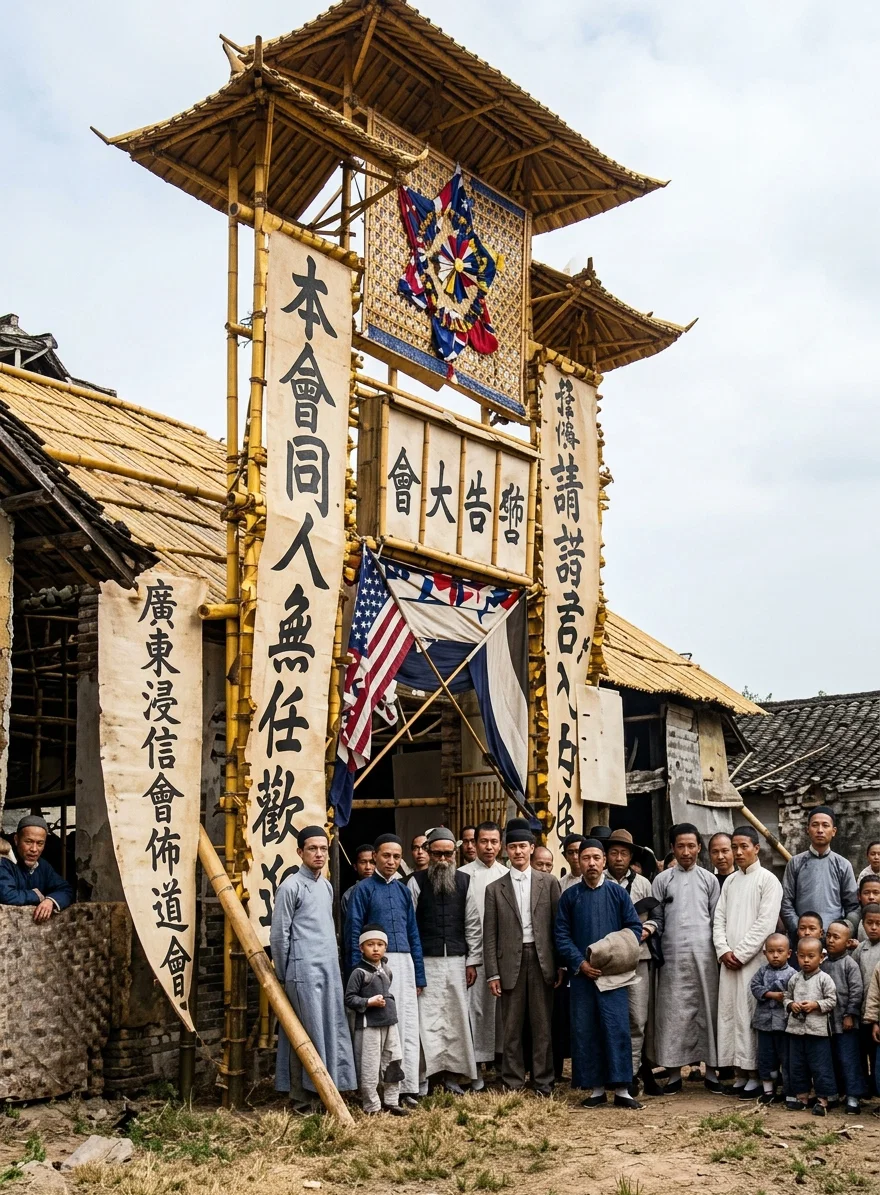
During the next two weeks, carpenters and bamboo workers could be seen daily engaged in erecting a mammoth bamboo tent, building seats, and setting up various paraphernalia. The men of the town left their work to come to see what was going on. The women, with babies in their arms, and youngsters of all ages following at their heels, camped on the premises for hours at a time, busy with their knitting, or making cloth shoes, while the children capered around on the grass, just as happy as any American boy is when a circus comes to town.
The day set for opening, dawned bright and clear; and during the forenoon, while some of the workers were putting the finishing touches on the tent, arranging the book display, and finishing up the decorations, the other half of the force, armed with red and gold invitations, went out upon the main streets and gave personal invitations to the people.

UNEXPECTED REINFORCEMENTS

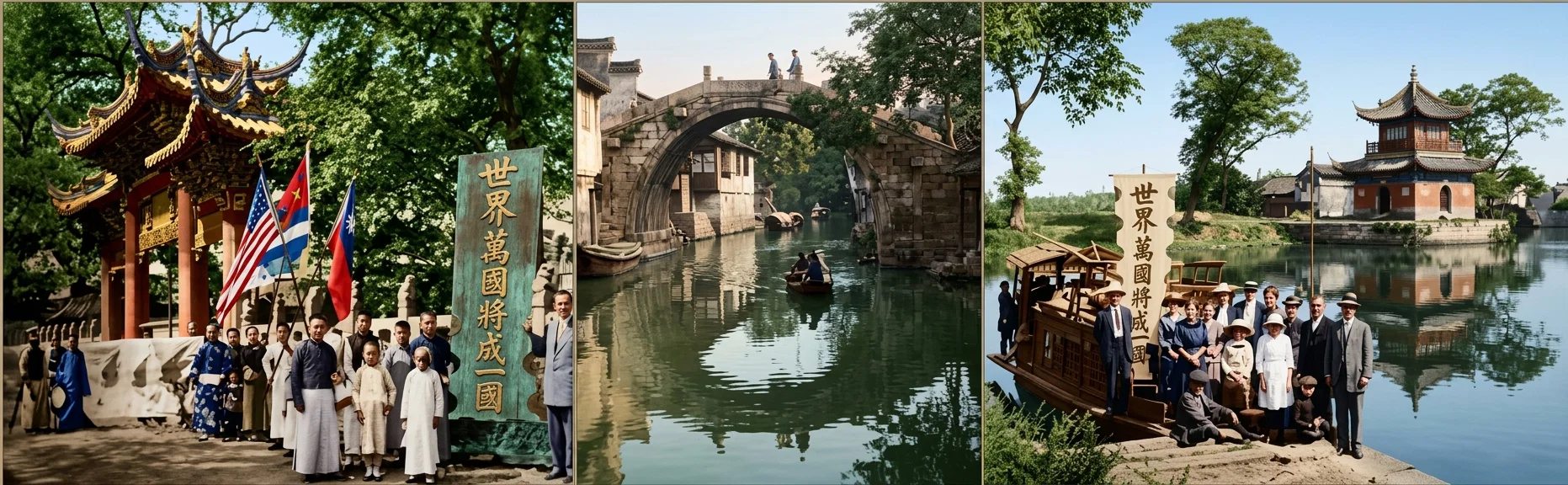
Then came the surprise of the day, a feature which we had had no hand in planning, and which was appreciated all the more for that reason. About ten o’clock in the morning a boat came up the canal from Nanziang; and upon investigation, it proved to be our Nanziang “Young People’s Missionary Volunteers,” who came up at their own expense, bringing offerings of flowers, scrolls, and banners. They went through the city, singing hymns, distributing handbills, and inviting the people to the meetings. This is the more wonderful when we consider that the Nanziang work was only opened four months before, and these young people at that time were almost all in the darkness of heathenism.

REMARKABLE SUCCESS OF THE EFFORT

As accommodations were made for the seating of only four hundred people, the capacity of the tent was stretched to the very limit from the start. Many were turned away the first few days. After that, the place was comfortably full.
For three full weeks, three meetings a day were held; and it was plainly manifest, from the start, that the Holy Spirit was moving on the hearts of the people. “Prepare to meet thy God,” by keeping “the commandments and the faith of Jesus,” was the keynote of every meeting, and it struck home to many hearts.

BREAKING AWAY FROM HEATHENISM

Front door of Elder Stafford's bamboo tent at Kading. The picture was taken just before the meetings were opened.
On the second night, the subject was “The One True God.” After showing that idol worship was worship of the devil, we asked all to arise who were willing to take their stand to serve the true God. The first few moments, it seemed as though no one were going to respond; but after an earnest silent prayer, and a few words of exhortation, two men stood up. Instantly the presence of the Holy Spirit flooded the tent, and men and women arose throughout the congregation, until more than fifty were standing. Ushers took the names and addresses of those who thus responded; and the next day, early in the morning, a visiting committee went out to find these people in their homes. This work was carried on daily, as we realize that it is what counts in the end. The preaching of the gospel sows the seed, and works upon the hearts of the people, to make them willing to receive; but the actual receiving of the Word, and becoming Christians, is largely the result of personal work with individuals.

SUCCESS OF THE STEREOPTICON

The meetings were brought to a close at the end of the third week, with a stereopticon lecture on “The Signs of the End.” We found a good place in a school not far from our chapel. Just inside the front gate was a large open space inclosed in a high wall, with a high gateway at the back. We hung our screen on this gateway, and put the machine back of the screen, out of sight; and by watching the screen, we were able to project the pictures through from the back. That left the front inclosure free for the people.
Tickets were distributed to all the inquirers, and to the prominent people of the city; and as soon as the place was filled, we shut the gates, and commenced the lecture. A great interest was manifested, and there is no doubt that this method of bringing the truth to the eye as well as the ear has a lasting effect upon the hearers.

HE WANTED THE TRUE SABBATH

The meetings are now continued in the building we have rented for a chapel, and an excellent interest has developed. The night meetings are crowded, and the Sabbath meetings are well attended. When the Sabbath question was presented, one man arose in the congregation, and said: “Now tell me, which day is it we ought to keep, Saturday or Sunday? I want to keep the true Sabbath, and worship God.” The Chinese originally had no names for the days of the week; but since the missionaries came to China, the people all call Sunday Worship Day. Monday is Worship Day One, and so on. This brings Saturday as the sixth day of the week, and many of the Chinese think it really is such; so we have no end of trouble in explaining which day is actually the seventh.

OVERCOMING OBSTACLES

An incident should be mentioned in connection with the Kading meetings, which shows how the Lord is able to open ways before His workers. When we decided to begin work there, we went to look up locations, and were very fortunate in finding a suitable building for a chapel in a central location, at a reasonable rental. But desirable sites for pitching a tent were very scarce. In fact there was only one place that was really suitable; and the landlord informed us that under no circumstances would he rent the ground to us, as he was using it as a drying ground for dyed cloth.
We told him we would give him rent enough so he could afford to shut up his business for a month; but he said that the grass on the place was “very precious,” and after we had tramped it all down, he would have nothing left but muddy ground to dry his cloth on. We retired for counsel and prayer, and it seemed that we must have that place, so we went back. This time, a shopkeeper across the street came out and offered hisservices as a middleman; and in a short time, we were writing up the contract for a month, at the nominal rent of $5.00.

THE POLICEMAN TRIED TO STOP US

The devil has more ways than one, however, of trying to stop God’s work; and he does not leave any stones unturned, in his efforts to get in our way. So while we were writing the contract, a policeman came running up, and holding up his hand, shouted at us: “Do not write that. Do not write that. You have to get permission first.” Fortunately our evangelist who was writing, coolly wrote on till the contract was finished and signed. Otherwise we never would have been able to get it signed at all.
a. Young people's society from Nanziang who went to Kading to help on the opening day of the meetings. The gateway and arch in the background are the front of a Confucian temple. b. Stone bridge outside the west gate at Kading. c. Brethren and sisters from Asiatic Division headquarters at Shanghai, who assisted at the opening of the meetings. The little house boat was the home and headquarters for Elder Stafford and company while the meeting was in progress.
We were then escorted to the chief of police, like criminals who had committed some terrible offense; and that official gave us a sound scolding for doing business in his city without first seeking permission of the mandarin.
Our evangelist again answered very wisely, and said he knew that his honor was a man of great affairs and very busy, and that therefore we had hesitated to trouble him in the slightest degree until we were sure that we were going to locate in the city. We had only that moment been able to rent a place; and knowing the customs of Chinese cities, we were in fact just preparing to call upon his honor when the policeman arrived, who had very kindly acted as our guide to his presence, etc., etc. So with a promise to call upon the mandarin at our earliest convenience, we were allowed to depart in peace.
As it was time for the launch to leave, we could not make the visit that day; and what was our surprise, upon returning to Shanghai, to receive a letter from the landlord, saying that he was not allowed to rent the place to us, and would be glad to return our money to us upon demand. As this letter came on Friday, we presented the matter at church Sabbath morning, and special prayer was offered that the Lord would move upon the heart of the mandarin to allow us to carry out our plans.

THE MANDARIN CAME TO OUR AID

When interviewed, the mandarin received us cordially, and issued a proclamation protecting us and our work; and we learned afterward that the chief of police who made the trouble had been removed from his office.
Praise the Lord, there is a God in heaven who still rules in the kingdoms of men. Yet this experience teaches us that as the end draws nearer, the way will become more difficult. Satan is growing angrier; and he will work with fiendish ingenuity to thwart the plans of God’s messengers to carry present truth to the souls in darkness whom Satan claims as his own.
Let us work while it is day; for “the night cometh, when no man can work.”
This is the day of China’s opportunity. The door is open to the gospel. The harvest is ripe, and waiting for reapers. This one province of Kiangsu has 30,000,000 waiting for the message — by comparison, a fourth of the population of the United States. Our present force of workers cannot reach more than 50,000 persons every year, probably not that many; but figuring at that rate, it would take six hundred years to give the message to this province. Surely we must have help. The Lord will cut the work short in righteousness, we know; but one way He will do this, is by moving upon the hearts of His people to give themselves to His service, to bring the gospel to these places. Man is God’s ordained messenger of the gospel, and angels will never take his place in this work. Who will answer now without hesitation, “Here I am, Lord; send me”?