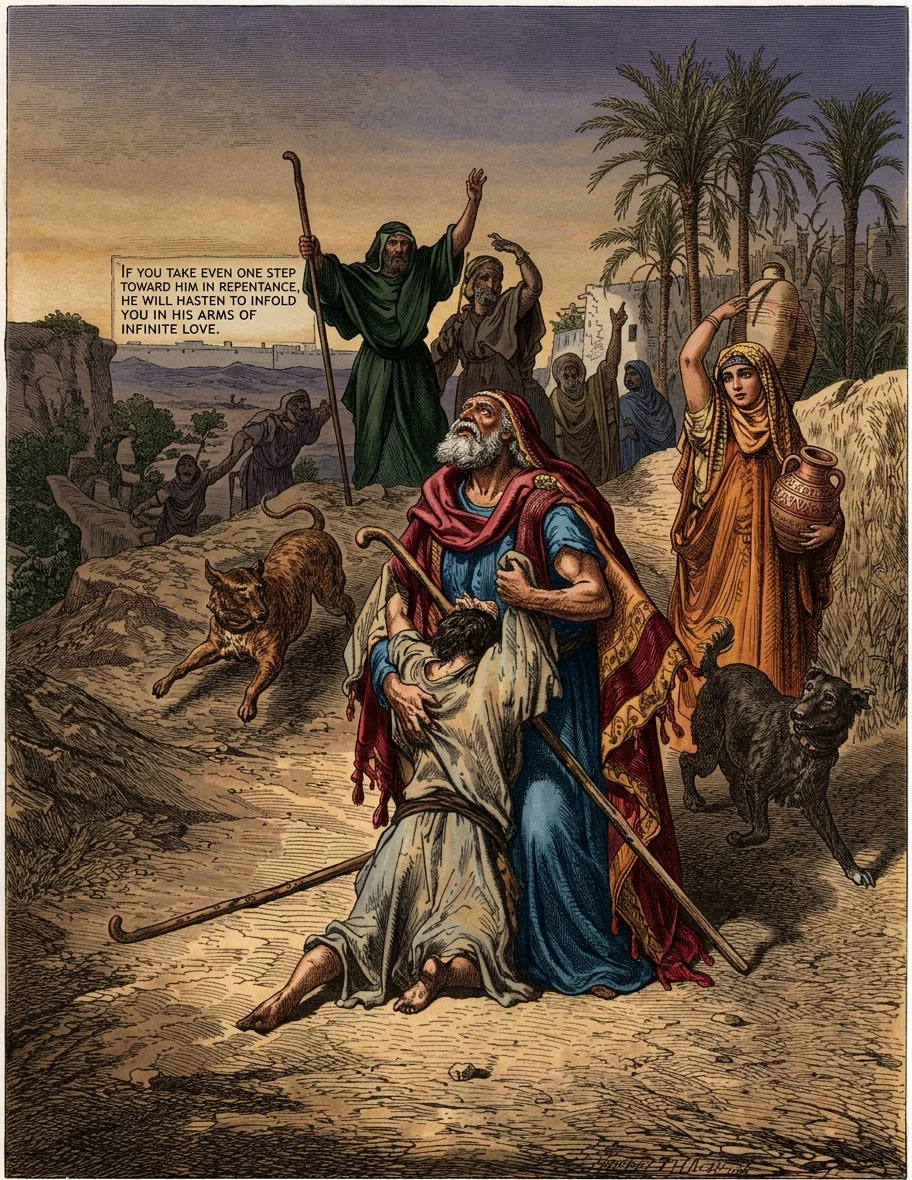
He Finds a Warm Welcome—The Father Forgives and Forgets His Past—Is Reinstated in His Once Happy Home
By Mrs. E. G. White
THE parables of the lost sheep, the lost coin, and the prodigal son, bring out in distinct lines God’s pitying love for those who are straying from Him. Although they have turned away from God, He does not leave them in their misery. He is full of kindness and tender pity toward all who are exposed to the temptations of the artful foe.
In the parable of the prodigal son is presented the Lord’s dealing with those who have once known the Father’s love, but who have allowed the tempter to lead them captive at his will.
“A certain man had two sons: and the younger of them said to his father, Father, give me the portion of goods that falleth to me. And he divided unto them his living. And not many days after the younger son gathered all together, and took his journey into a far country.”
This younger son had become weary of the restraint of his father’s house. He thought that his liberty was restricted. His father’s love and care for him were misinterpreted, and he determined to follow the dictates of his own inclination.
Having obtained his patrimony, he goes into “a far country,” away from his father’s home. With money in plenty, and liberty to do as he likes, he flatters himself that the desire of his heart is reached. There is no one to say, Do not do this, for it will be an injury to yourself; or, Do this, because it is right. Evil companions help him to plunge ever deeper into sin, and he wastes “his substance with riotous living.” The precious years of life, the strength of intellect, the bright visions of youth, the spiritual aspirations—all are consumed in the fires of lust.
Becomes a Swine Herder
A great famine arises, he begins to be in want, and he joins himself to a citizen of the country, who sends him into the field to feed swine. To a Jew this was the most menial and degrading of employments. The youth who has boasted of his liberty, now finds himself a slave. He is in the worst of bondage,—“holden with the cords of his sins.” Prov. 5:22. The glitter and tinsel that enticed him have disappeared, and he feels the burden of his chain.
Sitting upon the ground, in that desolate and famine-stricken land, with no companions but the swine, he is fain to fill himself with the husks on which the beasts are fed. Of the gay companions who flocked about him in his prosperous days, and ate and drank at his expense, there is not one left to befriend him. Where now is his riotous joy? Stilling his conscience, benumbing his sensibilities, he thought himself happy; but now, with money spent, with hunger unsatisfied, with pride humbled, with his moral nature dwarfed, with his will weak and untrustworthy, with his finer feelings seemingly dead, he is the most wretched of mortals.
What a picture here of the sinner’s state! Although surrounded
with the blessings of His love, there is nothing that the sinner, bent on self-indulgence and sinful pleasure, desires so much as separation from God. Like the ungrateful son, he claims the good things of God as his by right. He takes them as a matter of course, and makes no return of gratitude, renders no service of love. As Cain went out from the presence of the Lord to seek his home, as the prodigal wandered into the “far country,” so do sinners seek happiness in forgetfulness of God.
Whatever the appearance may be, every life centered in self is squandered. Whoever attempts to live apart from God, is wasting his substance. He is squandering the precious years, squandering the powers of mind and heart and soul, and working to make himself bankrupt for eternity.
Still Yearns over the Wanderer
The love of God still yearns over the one who has chosen to separate from Him, and He sets in operation influences to bring him back to the Father’s house. The prodigal son in his wretchedness “came to himself.” The deceptive power that Satan had exercised over him was broken. He saw that his suffering was the result of his own folly, and he said: “How many hired servants of my father’s have bread enough and to spare, and I perish with hunger! I will arise and go to my father.”
Decides to Confess All
Miserable as he was, the prodigal found hope in the conviction of his father’s love. It was that love which was drawing him toward home. So it is the assurance of God’s love that constrains the sinner to return to God. “The goodness of God leadeth thee to repentance.” Rom. 2:4. A golden chain, the mercy and compassion of divine love, is passed around every imperiled soul. The Lord declares, “I have loved thee with an everlasting love: therefore with loving-kindness have I drawn thee.” Jer. 31:3.
The son determines to confess his guilt. He will go to his father, saying, “I have sinned against heaven, and before thee, and am no more worthy to be called thy son.” But he adds, showing how stinted is his conception of his father’s love, “Make me as one of thy hired servants.”
The young man turns from the swine herds and the husks, and sets his face toward home. Trembling with weakness, and faint from hunger, he presses eagerly on his way. He has no covering to conceal his rags; but his misery has conquered pride, and he hurries on to beg a servant’s place where he was once a child.
A Great Lesson in the Contrast
Little did the gay, thoughtless youth, as he went out from his father’s gate, dream of the ache and longing left in that father’s heart. When he danced and feasted with his wild companions, little did he think of the shadow that had fallen on his home. And now as with weary and painful steps he pursues the244homeward way, he knows not that one is watching for his return. But while he is yet “a great way off,” the father discerns his form. Love is of quick sight. Not even the degradation of the years of sin can conceal the son from the father’s eyes. He “had compassion, and ran, and fell on his neck” in a long, clinging, tender embrace.
No Contemptuous Mockery Permitted
The father will permit no contemptuous eye to mock at his son’s misery and tatters. He takes from his own shoulders the broad, rich mantle, and wraps it around the son’s wasted form, and the youth sobs out his repentance, saying, “Father, I have sinned against heaven, and in thy sight, and am no more worthy to be called thy son.” The father holds him close to his side, and brings him home. No opportunity is given him to ask a servant’s place. He is a son, who shall be honored with the best the house affords, and whom the waiting men and women shall respect and serve.
Bring Forth the Best Robe
The father said to his servants, “Bring forth the best robe, and put it on him; and put a ring on his hand, and shoes on his feet: and bring hither the fatted calf, and kill it; and let us eat, and be merry: for this my son was dead, and is alive again; he was lost, and is found. And they began to be merry.”
In his restless youth the prodigal looked upon his father as stern and severe. How different his conception of him now! So those who are deceived by Satan look upon God as hard and exacting. But he whose eyes have been opened by the love of Christ will behold God as full of compassion. He does not appear as a tyrannical, relentless being, but as a father longing to embrace his repenting son. The sinner will exclaim with the psalmist, “Like as a father pitieth his children, so the Lord pitieth them that fear Him.” Ps. 103:13.
In the parable, there is no taunting, no casting up to the prodigal of his evil course. The son feels that the past is forgiven and forgotten, blotted out forever. And so God says to the sinner, “I have blotted out, as a thick cloud, thy transgressions, and, as a cloud, thy sins.” Isa. 44:22. “I will forgive their iniquity, and I will remember their sin no more.” Jer. 31:34.
Assured of Forgiveness
What assurance here, of God’s willingness to receive the repenting sinner! Have you, reader, chosen your own way? Have you wandered far from God? Have you sought to feast upon the fruits of transgression, only to find them turn to ashes upon your lips? And now, your substance spent, your life plans thwarted, and your hopes dead, do you sit alone and desolate? Now that voice which has long been speaking to your heart, but to which you would not listen, comes to you distinct and clear, “Arise ye, and depart; for this is not your rest: because it is polluted, it shall destroy you, even with a sore destruction.” Micah 2:10. Return to your Father’s house. He invites you, saying, “Return unto Me; for I have redeemed thee.” Isa. 44:22.
Do Not Wait to Be Better
Do not listen to the enemy’s suggestion to stay away from Christ until you have made yourself better—until you are good enough to come to God. If you wait until then, you will never come.
Arise and go to your Father. He will meet you a great way off. If you take even one step toward Him in repentance, He will hasten to infold you in His arms of infinite love. His ear is open to the cry of the contrite soul. The very first reaching out of the heart after God is known to Him. Never a prayer is offered, however faltering, never a tear is shed, however secret, never a sincere desire after God is cherished, however feeble, but the Spirit of God goes forth to meet it. Even before the prayer is uttered, or the yearning of the heart made known, grace from Christ goes forth to meet the grace that is working upon the human soul.
He will bring you into His banqueting house, and His banner over you shall be love.